Monthly Archives: March 2014

Rice paper rolls

Once you have mastered the art of cutting the veggies thin and short, and then soaking the rice paper wrappers for just enough time, the rest is easy! And they’re delicious served with Kylie Kwong’s home made Sweet Chilli Sauce!

ourkitchengarden.net

Fresh from the garden: cucumber, carrots, capsicum, avocado, sprouts, coriander, mint
Recipe source: adapted from a recipe on kidspot.com.au
Makes: 32

Equipment:

  • Peelers
  • Chopping board and knife
  • Bowls – large, medium, small
  • Large metal spoon
  • Scissors
  • Salad spinner
  • Measures – cup
  • Tea towel
  • Servingplates
Ingredients:

  • 1 large cucumber
  • 2 large carrots
  • 1 large red capsicum
  • 1 ripe avocado
  • A large handful bean & pea sprouts
  • A small bunch of coriander
  • A small bunch of mint
  • 32 x 22cm round rice paper wrappers

What to do:

  • Wash and peel the cucumber and carrots. Cut into short, thin strips and place in a bowl.
  • Wash the capsicum, shake dry and cut into short thin strips, discarding the seeds and membrane, and place in another bowl.
  • Cut the avocado in half length-ways and remove the stone. Using a large metal spoon, scoop out a half at a time, place on a chopping board and cut into thin slices.
  • Wash and drain the sprouts and trim the ends if needed.
  • Wash and spin-dry the coriander and mint, picking off the leaves and reserving. Finely chop the coriander stalks. You should have about 2 cups’ worth.
  • Half-fill a large bowl with hand-hot water.
  • Dip one wrapper at a time in the water for 5 seconds, until it is just soft.
  • Drain off excess water and place on a clean surface.
  • Place a few pieces of each of the ingredients on the wrapper, about 3cm from the base. Do not overfill!
  • Fold the bottom of the wrapper up over the ingredients.
  • Fold in the sides and roll up to enclose filling, keeping the wrapper tight.
  • Place on a tray and cover with damp tea towel.
  • Repeat with the remaining wrappers and ingredients, and divide among serving plates – slicing in half if needed.

Notes: Where do rice paper rolls come from? What other foods could you wrap up in a rice paper roll?


ourkitchengarden.net

Categories: Kitchen Garden, Recipe | Tags: , , , , , , , , , | Leave a comment

Pizzetta bianca

Russell writes, “This simple pizzetta is a variation on the classic Roman pizza bianca (not really a pizza at all, more like flatbread with olive oil, rosemary and salt). In this instance, it is better to use dense, cheap mozzarella rather than expensive, moist buffalo varieties. The cheaper stuff is very easy to grate and has less water content and therefore melts better.”

ourkitchengarden.net

Fresh from the garden: red onion, thyme
Recipe source: adapted from a recipe by Russell Norman in the book of his restaurant Polpo
Makes: 12 pizzette

Equipment:

  • Pizza stones or baking trays
  • Rolling pins
  • Scales
  • Graters
  • Medium bowls
  • Chopping board and knife
  • Paper towel
  • Pizza cutter
  • Serving plates
Ingredients:

  • 1 quantity pizzetta dough
  • 100g block mozzarella
  • 100g parmesan
  • A red onion
  • Small handful of thyme
  • Black pepper
  • Extra virgin olive oil

 What to do:

  • Preheat your oven to its highest setting: 250C. At the same time put a pizza stone or baking sheets in the oven to heat up.
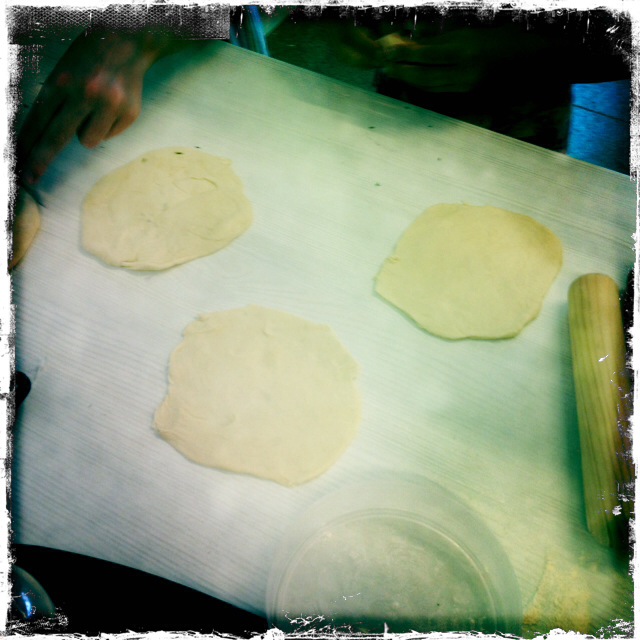
  • Divide the dough into 8 balls and then roll them into thin 20cm discs.Weigh and grate the cheeses and peel and thinly slice the red onion. Wash and pat the thyme dry then strip the leaves, discarding the stalks.
  • Evenly distribute a handful of the cheeses, some onion and almost all of the thyme over each of the pizza bases. Be sparing – a little goes a long way. If you use too much topping, the base won’t be crisp enough.
  • Remember that your pizza will benefit from being placed directly on to a hot baking sheet or pizza stone within a preheated oven. At 250C, yours will take about 6-8 minutes.
  • Use this time to make the dough for the next class if needed.
  • Just before serving, slice the pizzette into smaller pieces, grind on some pepper, sprinkle over a little olive oil and scatter over the remaining thyme leaves.
  • Finally, please don’t worry about getting totally round and even bases for your pizzetta. In fact, it’s much better if they are not; you’ll get some lovely bubbling and occasional charring.

 Notes: What does pizzetta bianca mean? What animal is mozzarella cheese from? Why do we place the pizza stone or baking tray in the oven to preheat?

Categories: Kitchen Garden, Recipe | Tags: , , , , , | Leave a comment

Pizzette dough

Russell writes, “In the restaurant we make pizzette, which are slightly smaller than pizza, about 20cm in diameter rather than 30cm. As well as being prettier, this size is also more convenient – you might get two or three pizzette on to your pizza stone rather than a single large one. We use fresh yeast, which you can find in health food shops, bakeries and even by asking at the bakery departments of some supermarkets. Otherwise use fast-action dried (instant) yeast.”

ourkitchengarden.net

Recipe source: adapted from a recipe by Russell Norman in the book of his restaurant Polpo
Makes: 12 pizzette

Equipment:

  • Large bowl
  • Scales
  • Measures – jug, tablespoon, teaspoon
  • Clingfilm or plastic wrap


Ingredients:

  • 500g strong white flour, Italian 00
  • 2 teaspoons fine salt
  • 2 teaspoons instant yeast
  • 2 tablespoons extra-virgin olive oil
  • 300ml tepid water

What to do:

  • In a large bowl, mix the flour, salt and dried yeast with the olive oil and the water and form the mixture into a ball.
  • Now knead the dough on a floured work surface. To do this, push the dough backwards and forwards simultaneously with your two hands so that you are stretching it and then pushing it back down into a ball. Repeat this, giving the dough a good working over. You shouldn’t break into a sweat but it should feel like a little workout for your hands and forearms, and you should be feeling the dough getting more and more springy.
  • After 10 minutes of kneading, push the dough back into a ball, flour the top, place in an oiled bowl and cover with clingfilm. Leave to rise in a warm place.
  • After at least 30 minutes, but ideally when doubled in size, your dough is ready.
  • If you want to use the dough later, place the balls of dough on a tray, cover with a damp cloth and leave in the fridge for up to 12 hours. Just remember to take them out 30 minutes before you’re ready to use them.

Notes: Why do we have to wait for the dough to rise? What is this process called? Do we have to make allowances for different sorts of weather?

Categories: Kitchen Garden, Recipe | Tags: , , , , , , , | Leave a comment

Handmade orecchiette

Orecchiette resemble little ears, which is where they get their name, and is the traditional pasta of Puglia. A perfect orecchietta is just under 2cm across and has a slightly domed shaped which enables it to hold pasta sauce well.

ourkitchengarden.net

Recipe source: adapted from a recipe by Lara Scala Quinn on marthstewart.com
Serves: 4 starter serves or enough tastes for 20

Equipment:

  • Large stockpot with lid
  • Measures: cup, ½ cup, ¼ cup, tablespoon
  • Chopping board and knife
  • Baking sheet
  • Tea towel
  • Large bowl
  • Serving bowls
Ingredients:

  • 1 cup semolina flour, plus more for baking sheet
  • 1/2 cup plain flour
  • 1/2 teaspoon coarse salt
  • 1/2 cup water, plus more if needed

What to do:

  • Fill the large pot with water and set to boil with the lid on.
  • Measure semolina, plain flour and salt into a large bowl.
  • Using your fingers, swirl ingredients together until combined then create a well in centre. Pour 1/4 cup water into well and gradually incorporate flour mixture into water using your fingers.
  • Once all the water is absorbed, continue adding water, 1 tablespoon at a time, until mixture begins to form a dough.
  • Turn out onto a large, clean work surface and start to gather and knead dough, working it until no dry flour remains on work surface.
  • Continue to knead until smooth and elastic, about 5 minutes.
  • Divide dough into 8 equal portions, and cover them with a clean, damp kitchen towel.
  • Roll 1 portion of dough into a 45-cm-long rope.
  • Use a knife to cut and drag a 1cm piece of dough from end of rope facing you — a grainy wooden cutting board helps grip the dough.
  • Holding knife at a 45-degree angle to work surface, press and roll dough toward you.
  • Unfurl each piece of dough over your thumb in the opposite direction to form a concave shape, and transfer to a baking sheet lightly sprinkled with semolina flour. Repeat with remaining dough.
  • When the pot of water is boiling add the orecchiette and a tablespoon of salt, stir and replace the lid. Cook for 2 or 3 minutes until the pasta bob to the top.
  • Using a slotted spoon, scoop out into a big bowl with a little of the cooking water and then toss in a tablespoon of olive oil before adding your sauce.
  • Orecchiette can be stored at room temperature in a single layer overnight: cover with a clean kitchen towel or plastic wrap. Any extra orecchiette can be frozen up to six weeks: First, freeze them in a single layer on a baking sheet, then transfer them to a resealable plastic bag and return them to the freezer. Boil directly from the freezer.

Notes: What does orecchiette mean? Name some other pasta shapes. What do they mean?

ourkitchengarden.net

Categories: Kitchen Garden, Recipe | Tags: , , , , , , , | Leave a comment

Blog at WordPress.com.