Posts Tagged With: vegan

Sean’s chilli oil

This chilli oil can be fired up with finely chopped bird’s-eye chillies if you like more fire than the nutty sweetness of the standard recipe. It is also worth grabbing some disposable gloves for this recipe as prolonged contact with chillies will burn the tips of your fingers!

From the garden: chillies, garlic
Recipe source: adapted from the recipe by Sean Moran at Sean’s Panaroma in ‘Let It Simmer’
Makes: about 700ml

 ourkitchengarden.net

Equipment:

  • Plastic gloves
  • Heavy-based stockpot
  • Slotted spoon
  • Colander
  • Paper towel
  • Food processor
  • Glass jars
Ingredients:

  • 250g long red chillies
  • 500ml olive oil
  • ¼ head garlic

What to do:

  • Pre-heat the oven to 160C.
  • Wash and drain the jars and place right side up on the baking tray. Slide into the oven for 10-15 minutes.
  • Wash and drain the lids and place in the small saucepan. Cover with water and set to boil for 2 or 3 minutes. Drain into a colander and then wipe out with a fresh piece of paper towel, taking care not to touch the inside of the lids.
  • Meanwhile put on some plastic gloves before slicing chillies lengthways and scraping out seeds, discarding the seeds.
  • Lightly crush and peel and the garlic cloves.
  • Place chillies in a heavy-based stockpot with the olive oil and garlic.
  • Bring to a gentle boil over a moderate flame, and fry until the chillies and garlic are deep golden and all their moisture has evaporated.
  • Lift out chillies and garlic with a slotted spoon and leave to cool.
  • Bring the jars out of the oven and leave to cool for a few minutes.
  • Process cooled chillies and garlic pulp to a coarse paste with just enough oil to lubricate the motion.
  • Stir the puree into the oil and then carefully pour into the sterilised jars.
  • Shake well before using.

Notes: What does to sterilise mean? Why can’t we touch the inside of the lids? Why do we need gloves to prepare the chillies?


Categories: Kitchen Garden, Recipe | Tags: , , , , , , , , | Leave a comment

Rice paper rolls

Once you have mastered the art of cutting the veggies thin and short, and then soaking the rice paper wrappers for just enough time, the rest is easy! And they’re delicious served with Kylie Kwong’s home made Sweet Chilli Sauce!

ourkitchengarden.net

Fresh from the garden: cucumber, carrots, capsicum, avocado, sprouts, coriander, mint
Recipe source: adapted from a recipe on kidspot.com.au
Makes: 32

Equipment:

  • Peelers
  • Chopping board and knife
  • Bowls – large, medium, small
  • Large metal spoon
  • Scissors
  • Salad spinner
  • Measures – cup
  • Tea towel
  • Servingplates
Ingredients:

  • 1 large cucumber
  • 2 large carrots
  • 1 large red capsicum
  • 1 ripe avocado
  • A large handful bean & pea sprouts
  • A small bunch of coriander
  • A small bunch of mint
  • 32 x 22cm round rice paper wrappers

What to do:

  • Wash and peel the cucumber and carrots. Cut into short, thin strips and place in a bowl.
  • Wash the capsicum, shake dry and cut into short thin strips, discarding the seeds and membrane, and place in another bowl.
  • Cut the avocado in half length-ways and remove the stone. Using a large metal spoon, scoop out a half at a time, place on a chopping board and cut into thin slices.
  • Wash and drain the sprouts and trim the ends if needed.
  • Wash and spin-dry the coriander and mint, picking off the leaves and reserving. Finely chop the coriander stalks. You should have about 2 cups’ worth.
  • Half-fill a large bowl with hand-hot water.
  • Dip one wrapper at a time in the water for 5 seconds, until it is just soft.
  • Drain off excess water and place on a clean surface.
  • Place a few pieces of each of the ingredients on the wrapper, about 3cm from the base. Do not overfill!
  • Fold the bottom of the wrapper up over the ingredients.
  • Fold in the sides and roll up to enclose filling, keeping the wrapper tight.
  • Place on a tray and cover with damp tea towel.
  • Repeat with the remaining wrappers and ingredients, and divide among serving plates – slicing in half if needed.

Notes: Where do rice paper rolls come from? What other foods could you wrap up in a rice paper roll?

ourkitchengarden.net

Categories: Kitchen Garden, Recipe | Tags: , , , , , , , , , | Leave a comment

Pizzette dough

Russell writes, “In the restaurant we make pizzette, which are slightly smaller than pizza, about 20cm in diameter rather than 30cm. As well as being prettier, this size is also more convenient – you might get two or three pizzette on to your pizza stone rather than a single large one. We use fresh yeast, which you can find in health food shops, bakeries and even by asking at the bakery departments of some supermarkets. Otherwise use fast-action dried (instant) yeast.”

ourkitchengarden.net

Recipe source: adapted from a recipe by Russell Norman in the book of his restaurant Polpo
Makes: 12 pizzette

Equipment:

  • Large bowl
  • Scales
  • Measures – jug, tablespoon, teaspoon
  • Clingfilm or plastic wrap


Ingredients:

  • 500g strong white flour, Italian 00
  • 2 teaspoons fine salt
  • 2 teaspoons instant yeast
  • 2 tablespoons extra-virgin olive oil
  • 300ml tepid water

What to do:

  • In a large bowl, mix the flour, salt and dried yeast with the olive oil and the water and form the mixture into a ball.
  • Now knead the dough on a floured work surface. To do this, push the dough backwards and forwards simultaneously with your two hands so that you are stretching it and then pushing it back down into a ball. Repeat this, giving the dough a good working over. You shouldn’t break into a sweat but it should feel like a little workout for your hands and forearms, and you should be feeling the dough getting more and more springy.
  • After 10 minutes of kneading, push the dough back into a ball, flour the top, place in an oiled bowl and cover with clingfilm. Leave to rise in a warm place.
  • After at least 30 minutes, but ideally when doubled in size, your dough is ready.
  • If you want to use the dough later, place the balls of dough on a tray, cover with a damp cloth and leave in the fridge for up to 12 hours. Just remember to take them out 30 minutes before you’re ready to use them.

Notes: Why do we have to wait for the dough to rise? What is this process called? Do we have to make allowances for different sorts of weather?

Categories: Kitchen Garden, Recipe | Tags: , , , , , , , | Leave a comment

Lavash crackers

We always need something to mop up our soups, sauces, dressings or dips – or simply a scrumptious blob of egg yolk!

ourkitchengarden.net

Recipe source: adapted from a recipe in the book Home Made by Yvette Van Boven
Serves: 8 or 24 tastes

Equipment:

  • An eggcup
  • Scales
  • Stand mixer and dough hook
  • Measures: a jug, tablespoon, teaspoon
  • Pastry brush
  • Baking paper
  • 2 baking trays
  • Oven mitts
  • Serving plates
Ingredients:

  • 2g yeast
  • 400g plain flour
  • A pinch of salt
  • 2 tablespoons vegetable oil plus extra to grease
  • Approx. 250ml lukewarm water

Garnish:

  • A small amount of poppy seeds or sesame seeds, caraway seeds, ground paprika, cumin seeds or flaked salt

What to do:

  • Measure the lukewarm water and then out of the that, pour out an eggcup full of water. Dissolve the yeast in the eggcupful of water and then combine all the ingredients – except for the rest of the water – in the bowl of the stand mixer and mix together with the dough hook.
  • Start to pour the rest of the water in, a little at a time, until a pliable dough ball is formed. Pay attention, sometimes you need a little less water.
  • Knead the dough for about 5 minutes and then finish off on a worktop lightly dusted with flour until smooth and silky.
  • Leave to rise for an hour.

 At the beginning of the lesson:

  • Preheat the oven to 175C. Using a teaspoon of vegetable oil and a pastry brush, grease the baking trays.
  • Roll the dough into a thin sheet (you may need to divide it into several pieces), place on a big sheet of baking paper and then onto the greased baking trays.
  • Lightly cover with water, flicking with your fingers, and sprinkle with your choice of garnish – doing this in nice strips for example.
  • Bake the dough in the preheated oven for 12-15 minutes until the crackers turn an even golden brown. Use this time to make the dough for the next class, if needed, and then clean up.
  • When the crackers are ready, remove from the oven, leave to cool for a few minutes and then break into equal parts. Divide among plates and serve with something dippy or saucy 😉

Notes: Why do we leave to dough for an hour? What other spices or herbs could you use? How many verbs can you name in this recipe?

Categories: Kitchen Garden, Recipe | Tags: , , , , , , | 2 Comments

Harissa

Bondi kids are brave when it comes to chilli but we still sunstituted the sightly less-spicy green chillies here  – and this paste is a perfect accompaniment to so many dishes: braises, soups, stews, roasts, sandwiches… and so much better made than bought!

ourkitchengarden.net

Fresh from the garden: capsicum, red onion, garlic, chillies, lemon
Recipe source: Yotam Ottolenghi in Plenty
Makes: 1 small jar

Equipment:

  • Chopping boards & knife
  • Citrus juicer
  • Measures: tablespoon, teaspoon, ½ teaspoon
  • Skewer, tongs
  • Frying pan
  • Mortar & pestle
  • Food blender
  • Jar & lid
  • Bowls to serve
Ingredients:

  • 1 red capsicum
  • ½ teaspoon each coriander seeds, cumin seeds and caraway seeds
  • 1 tablespoon olive oil
  • 1 red onion
  • 3 garlic cloves
  • 2 red chillies
  • 1 lemon
  • ½ tablespoon tomato purée
  • ½ teaspoon coarse sea salt

What to do:

  • Peel and dice the onion. Peel and chop the garlic cloves. Slice the chillies in half lengthways and scrape out the seeds and white membranes. Chop the chillies, taking care to wash your hands properly afterwards!
  • Cut the lemon in half and juice to yield 2 tablespoons.
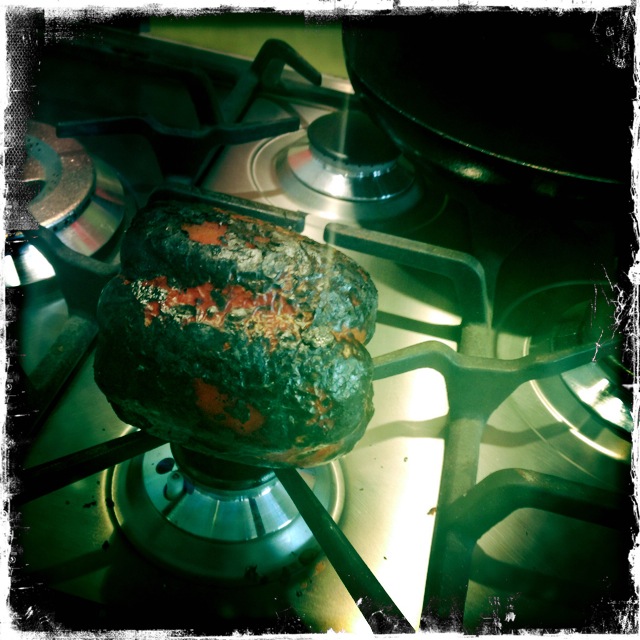
  • To blacken the capsicum, skewer the whole capsicum and roast it directly on the gas flame of the stove, turning every minute or two until the entire surface is blackened. The metal skewer will get hot – be careful! Once charred, set aside to cool.
  • Place a dry frying pan on a low heat and carefully toast the coriander, cumin and caraway seeds for two minutes. Transfer to a mortar with the salt and grind to a powder. Set aside.
  • Peel the charred skin from the capsicum under cool running water. Core and remove seeds, drain and dice.
  • Heat the oil in the frying pan and fry the onion, garlic and chillies over medium heat until dark and smoky for about six minutes.
  • In a food processor or blender, combine the capsicum, ground spices, onion, garlic and chillies with the lemon juice and tomato puree and process until smooth.
  • Set aside until needed or spoon into a sterilised jar and keep for 2 weeks in the fridge.

Notes: Where does harissa originate? What could you serve it with? Can you name any other accompaniments?

Categories: Kitchen Garden, Recipe | Tags: , , , , , , , , , | Leave a comment

Eurasian slaw!

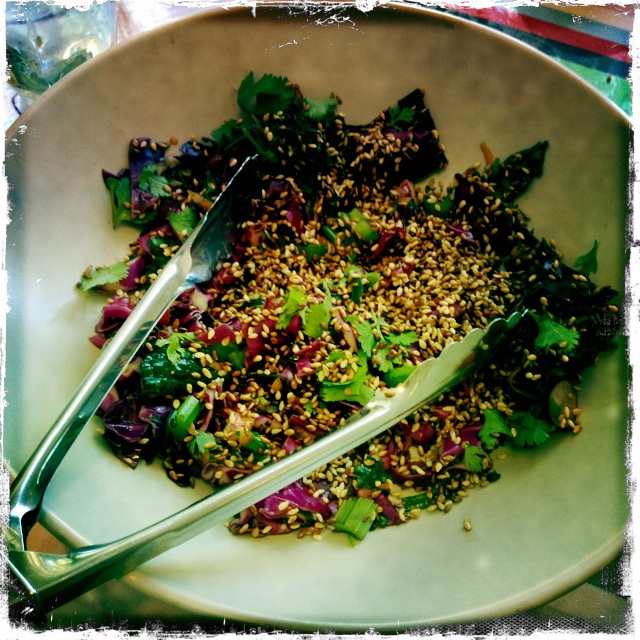
As ‘Dude’ food reaches its zenith in Sydney restaurants, we feel we must join the wagon trail rather than beat it… and this is a rather great way to climb on board! The beauty of this dish lies in the freshness of the ingredients – but also in the precision of the slicing – as the finer, the better…

ourkitchengarden.net

Fresh from the garden: red cabbage, cavolo nero, carrots, radishes, celery, coriander
Recipe source: Melissa
Serves: 6 or 24 tastes

Equipment:

  • Frying pan
  • Jar with lid
  • Measures: jug, ¼ cup, tablespoon, teaspoon, ½ teaspoon
  • Chopping board & knife
  • Colander
  • Graters
  • Salad spinner
  • Bowls – large, med, small
  • Serving bowls


Ingredients:

  • 1 small or half a large red cabbage
  • 3 leaves cavolo nero (Tuscan kale)
  • 2 carrots
  • 3 radishes
  • 2 stalks of celery
  • 2 tablespoons sesame seeds
  • A small handful coriander

Spicy Soy Sesame Dressing:

  • 30ml light soy sauce
  • 1/4 cup brown sugar
  • 30ml sesame oil
  • 1 tablespoon apple cider vinegar
  • 2 teaspoons rice vinegar
  • 1 teaspoon toasted sesame seeds
  • 1/2 teaspoon chilli flakes
  • Salt and sugar to taste

What to do:

  • Heat the frying pan and gently dry-toast the sesame seeds for a minute or so, making sure they don’t burn. Put a teaspoons-worth into the jar for the dressing and reserve the rest for the garnish.
  • Make the Spicy Soy Sesame Dressing by adding all the dressing ingredients together in a jar. Adjust seasoning as per taste. Shake well with lid on and set aside.
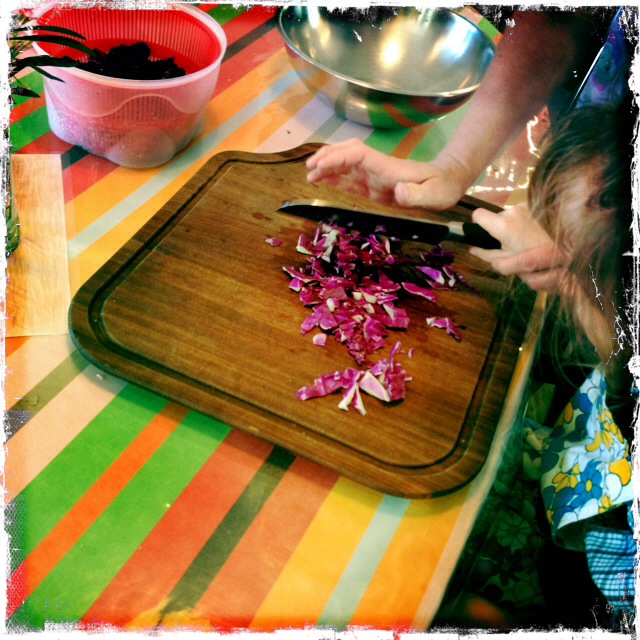
  • Meanwhile separate out all the cabbage leaves and wash well under running water. Shake dry then trimming the stalk into the chook bucket, super-finely slice the leaves into thin shreds.
  • Wash the kale leaves and shake dry. Cut the leaves from the stalks, discarding the stalks into the compost, and slice the leaves into super-fine ribbons.
  • Wash and peel the carrots and grate. Wash and scrub the radishes, cut in half and slice super-thinly. Wash the celery and shake dry. Finely slice into little crescents.
  • Wash and spin the coriander dry. Finely slice the stalks and add to a big bowl. Chop the leaves and reserve for the garnish.
  • Add the rest of the vegetables to the large bowl and mix well. Lightly spoon a generous amount of the dressing over it, stir well, and chill in the fridge until ready to serve.
  • Just before serving add the rest of the dressing to the slaw, and divide into serving bowls, sprinkling on the reserved toasted sesame seeds and the coriander leaves. Eat!

Notes: What does Eurasian mean? What is rice vinegar? What is slaw short for?

ourkitchengarden.net

Categories: Kitchen Garden, Recipe | Tags: , , , , , , , , , , | Leave a comment

Green lentil and spinach soup

Hugh says, “This makes a substantial soup – add some good bread and it makes a great lunch.” We say, “This is such a tasty soup but for goodness sake please don’t tell the kids how healthy it is!”

ourkitchengarden.net

Fresh from the garden: shallots, carrots, thyme, garlic, tomatoes, parsley, spinach
Recipe source: adapted from a recipe by Hugh Fearnley-Whittingstall in Veg Every Day
Serves: 6 at home or 24 tastes

Equipment:

  • Kettle
  • Measures: jug, tablespoon, teaspoon
  • Scales
  • Chopping board & knife
  • Peeler
  • Bowls – large, med, small
  • A salad spinner
  • Garlic press
  • Mezzaluna
  • Stockpot
  • Serving bowls
Ingredients:

  • 1.5 litres vegetable stock (or 1½ tablespoons bouillon and 1½ litres boiling water)
  • Extra-virgin olive oil
  • 3 shallots (or 1 onion)
  • 1 carrot
  • A few sprigs fresh thyme
  • 3 garlic cloves
  • 3 tomatoes
  • 150g Puy or green lentils
  • 1 small bunch parsley
  • 150g spinach
  • Salt and freshly ground black pepper

What to do:

  • Fill the kettle and turn on. When boiled carefully pour into the jug and stir in the bouillon.
  • Peel the shallots or onion and finely dice.
  • Wash and peel the carrot, then finely dice.
  • Wash the thyme and spin it dry. Pick the leaves and reserve in a small bowl.
  • Peel the 3 garlic cloves and squeeze through the press.
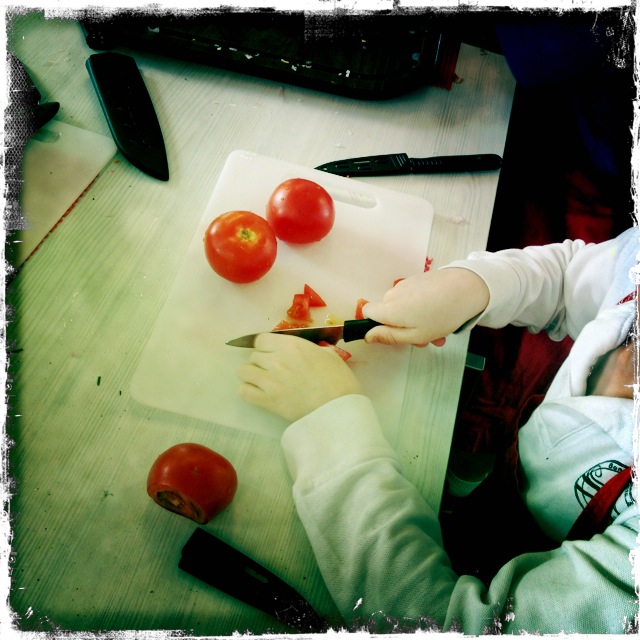
  • Wash the tomatoes and dice.
  • Weigh the lentils then pour into the sieve and then rinse under running water.
  • Wash the parsley, spin dry and remove the tough stalks. Finely chop with the mezzaluna.
  • Wash the spinach in several changes of water, shake it dry over the sink, then slice the leaves into ribbons and the stalks into small pieces.
  • In the stockpot, warm 2 tablespoons of the oil over a medium-low heat. Add the shallots, carrot and thyme, and sauté gently for five minutes.
  • Add the garlic and tomatoes, and sauté for a minute more.
  • Tip in the lentils, stir, then add the stock and a little salt and pepper. Bring to a boil, reduce the heat and simmer for 25 minutes until the lentils are tender.
  • Add the parsley and spinach, simmer for another five minutes, season to taste and ladle into bowls. Trickle over a drop of oil and serve!

Notes: How many types of lentil are there? Do you need to soak lentils overnight? What’s a mezzaluna?

ourkitchengarden.net

Categories: Kitchen Garden, Recipe | Tags: , , , , , , , , , , | 1 Comment

Cauliflower and nutmeg soup

Silky and spiced, creamy and smooth – we love cauliflower soup! And with a little crunchy addition of speedy croutons, we’re in heaven!

ourkitchengarden.net

Fresh from the garden: cauliflower, leeks, onion, potato, garlic
Recipe source: Melissa
Serves: 6 or 24 tastes

Equipment:

  • Kettle
  • Garlic press, peeler
  • Chopping board & knife
  • Stockpot
  • Measures – tablespoon, jug
  • Wooden spoon
  • Large & med bowls
  • Stick blender
  • Mouli
  • Microplane grater
  • Ladle
  • Serving bowls
Ingredients:

  • 1 leek
  • 1 brown onion
  • 4 cloves of garlic
  • 1 large potato
  • A large head of cauliflower
  • Extra-virgin olive oil
  • 1.5 lt water & 1.5 tablespoons bouillon (or 1.5 litres stock)
  • White pepper & flaked salt
  • A whole nutmeg

 What to do:

  • Fill the kettle and set to boil.
  • Wash the leek, scoring and peeling the outer layers off to look for hidden dirt, and then finely chop the leek.
  • Peel and finely chop the onion. Peel the potato under running water and chop into 1cm cubes.
  • Peel and squeeze the garlic cloves through the press.
  • Wash, shake dry and cut or tear the cauliflower into small florets.
  • Heat the 2 tablespoons of olive oil in the stockpot. Add the leek and onion and fry gently for 5 minutes.
  • Carefully measure the boiling water into the jug and add the bouillon. Stir.
  • Add the cauliflower, the potato and the garlic and sweat for a minute, then add the hot stock.
  • Simmer for 20 minutes until the cauliflower is tender. Season with salt and ground white pepper and puree with the stick blender until very smooth.
  • You may need to pass the soup through the mouli into another bowl to achieve an even smoother texture.
  • Just before serving, grate in about half a nutmeg using the microplane grater, the ladle out into your bowls.

 Notes: What other vegetables can be used for soup? Why do we sweat the veggies out?

Categories: Kitchen Garden, Recipe | Tags: , , , , , , , , , , | Leave a comment

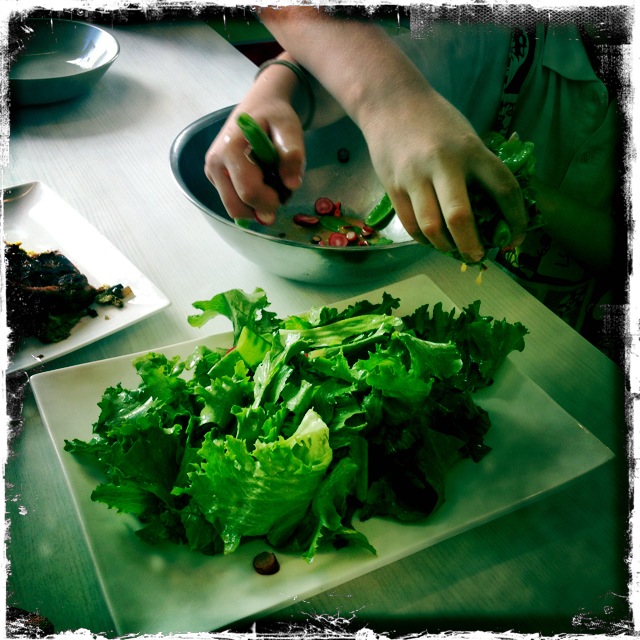
A simple side salad

This is a lovely salad to pair with heavily flavoured dishes and is easy and quick to assemble. You get the option too of inventing your own salad dressing!

ourkitchengarden.net

Fresh from the garden: lettuce, rocket, radishes, snap peas, edible flowers, garlic, herbs
Recipe source: Melissa
Serves: 6 tastes

Equipment:

  • Bowl – large
  • Asalad spinner
  • Tea towel, kitchen paper
  • Chopping board& knife
  • Citrus juicer
  • Jar with lid
  • Serving bowl


Ingredients:

  • A small head of lettuce
  • A few garnishing flowers
  • A couple of radishes
  • A small handful of snap peas

Salad dressing ingredients:

  • Balsamic or red wine vinegar or lemon juice
  • Extra-virgin olive oil
  • Mustard
  • Garlic
  • Honey
  • Herbs
  • Flaked salt

What to do:

  • Fill up the big bowl with cold water & wash the salad leaves & flowers separately in several changes of water, making sure that no dirt remains. Spin the leaves dry and then wipe the bowls dry.
  • Scrub the radishes clean under running water and then slice into thin discs.
  • Wash the snap peas and then top and tail each one, de-stringing as you go. Chop any large snap peas in half or even thirds.
  • Tip the leaves into a bowl, tearing large leaves into smaller mouth-sized pieces. Tear the petals from the flowers and put in bowl too with the radish slices and snap peas.
  • Make your salad dressing – you can use any combination of the ingredients listed above, and use honey, garlic or mustard if you like. The correct ratio is 3 times as much oil to vinegar – so for example 1 teaspoon of balsamic to 3 teaspoons of olive oil. If you use herbs, make sure you wash, spin dry and prepare them first.Put your ingredients in the jar and shake well to emulsify, and taste as you go!
  • Drizzle the dressing over the leaves and gently toss the leaves, then pile the salad up into the serving bowls.
  • Serve immediately.

 Notes: How do you de-string a snap pea? Why do we completely dry the leaves before adding the dressing? What does to emulsify mean? What does to top and tail mean?

ourkitchengarden.net

Categories: Kitchen Garden, Recipe | Tags: , , , , , , , | Leave a comment

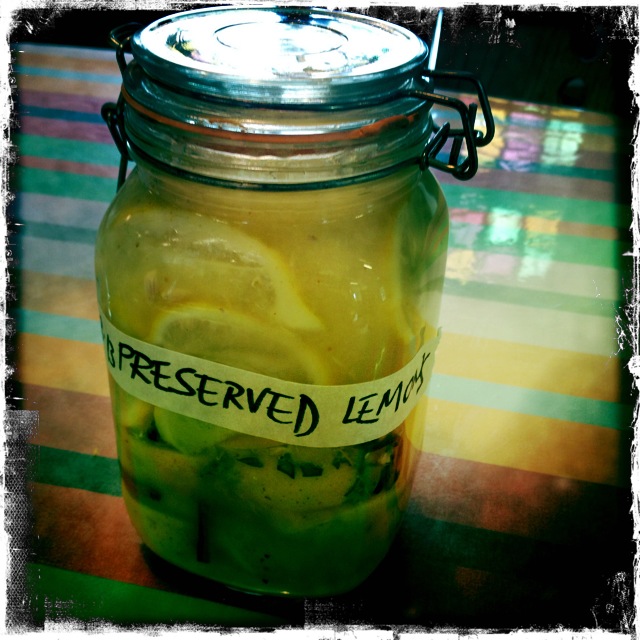
Stephanie’s preserved lemons

We have been quite successful in our preserving efforts at Bondi – olives from our trees, bouillon from our veggies, chilli oil to dress fresh pasta, and the odd jam here and there… I’m looking forward to seeing how the lemons turn out with Stephanie Alexander‘s recipe – and what we can make with them!

ourkitchengarden.net

Fresh from the garden: lemons, bay leaves
Recipe source: Stephanie Alexander
Makes: 1 large jar

Equipment:

  • Large jars with lids
  • Paper towel
  • Chopping boards and knives
  • Measures: tablespoon
  • Large bowl


Ingredients:

  • 250g coarse kitchen salt
  • 10 or more thick-skinned lemons (depends on the size of the jar)
  • 2 bay leaves
  • 8 cloves
  • 2 sticks of cinnamon
  • 10 peppercorns
  • Extra lemons for juice

What to do:

  • First, sterilise your jars. You can do this by washing the jars in soap and hot water, and then or placing in a 150C oven for 10 minutes until dried thoroughly. Fill the jars while warm.
  • Wash and then dry the lids with a clean piece of paper towel.
  • Scrub the lemons clean, wipe dry with paper towel, then chop into quarters, removing any pips. Discard any lemons with imperfections.
  • Scatter a large tablespoon of salt into your sterilised jar.
  • Place the lemons into a large bowl and cover with remaining salt.
  • Tear the bay leaves into pieces and break the cinnamon sticks into shards.
  • Pack the lemons tightly into the jar, skin side out, inserting pieces of bay leaf, pepper, cloves and cinnamon at intervals.
  • Press down hard on the fruit so that as much juice is released as possible.
  • Make sure that the lemons are completely covered in juice, otherwise mould will develop. If required, squeeze extra juice into the jar to cover the lemons.
  • With a fresh clean piece of paper towel, wipe the cap of the jar free of salt. Tightly close the lid.
  • Leave in a cool, dark cupboard for at least a month before using. Refrigerate the lemons once you have opened the jar.

 Notes: What is a preserve? Why do the lemons have to be completely covered? What could we use the preserved lemons for afterwards?

Categories: Kitchen Garden, Recipe | Tags: , , , , , , | 1 Comment

Blog at WordPress.com.