Posts Tagged With: kids

Cold spicy sesame noodles

The secret to this dish is the balance of flavours in the sauce: spicy, salty, sweet, savoury.

ourkitchengarden.net

Fresh from the garden: spring onions, ginger, garlic
Recipe source: adapted from a recipe by Diana Lampe on goodfood.com.au
Serves: 6 at home or 24 tastes

Equipment:

  • Peeler
  • Microplane grater
  • Chopping boards and knives
  • Garlic press
  • Heavy frying pan
  • Wooden spoon
  • Sieve
  • Bowls – large, small
  • Scales
  • Measures – tablespoon, teaspoon, ½ teaspoon
  • Large saucepan and lid
  • Slotted spoon
  • Colander
  • Teaspoons
  • Serving bowls


Ingredients:For the salad

  • 2 generous handfuls (about 200g) fresh bean sprouts
  • A 450g packet of fresh noodles
  • 2 teaspoons peanut or Rice Bran oil
  • 2 or 3 large spring onions
  • 1 tablespoon sesame seeds

Sesame sauce:

  • 1 small knob ginger
  • 3 cloves of garlic
  • ½ teaspoon Sichuan pepper
  • 3 tablespoons Chinese sesame paste
  • 4 tablespoons water
  • 3 tablespoons tamari or light soy sauce
  • 1 tablespoon Chinkiang black rice vinegar
  • 1 tablespoon sugar
  • 2 tablespoons chilli oil
  • 1 teaspoons sesame oil

What to do:

  • For the sesame sauce: Peel and finely grate the ginger to yield 1 tablespoon. Peel and squeeze the garlic cloves through the press. Pick through the Sichuan pepper, removing any gritty black seeds and small twigs. Toast in a heavy pan over low heat until fragrant and beginning to smoke, being careful not to scorch it. Grind the seeds while hot with a mortar and pestle. Sieve through a fine strainer and discard the pale bits left behind.
  • Mix together these and the remaining ingredients for the sesame sauce. Taste and make any adjustments you like. It will be quite spicy but will be less so when mixed with the noodles. Chill in the fridge until ready to use.
  • For the noodles: Boil a large saucepan of water and add salt. Have a bowl ready of cold water with some ice cubes. Throw the bean sprouts into the boiling water for a few seconds, then lift them out and plunge into the iced water. Drain and chill.
  • Add the noodles to the boiling water & stir to separate. Cook for the time suggested on the packet until tender. Drain the noodles & tip into the cold water. Drain & toss with the oil to stop them sticking and spread out to dry on the tray, and chill in the fridge until needed.
  • Wash the spring onions, trimming and removing the first layers if needed and finely slice into thin rounds. Toast the sesame seeds gently in the frying pan until lightly coloured.
  • To serve: Divide the bean sprouts between your serving bowls, then place the noodles on top. Scatter the spring onions and sesame seeds, then pour the sesame sauce over the noodles and mix through.
Categories: Kitchen Garden, Recipe | Tags: , , , , , | Leave a comment

Chicken and shiitake dumplings with chilli and black vinegar sauce

Jill says, “Black-rice vinegar and chilli oil are sold at Asian food stores (Lee Kum Kee’s Chiu Chow chilli oil is very good). Round wonton wrappers are often called gow gee wrappers.”

ourkitchengarden.net

Fresh from the garden: spring onions, ginger, garlic, chilli, egg
Recipe source: adapted from a recipe by Jill Dupleix on goodfood.com.au 
Makes: 30 dumplings

Equipment:

  • Stockpot and lid
  • Bowls – large, small
  • Chopping boards and knives
  • Microplane grater, peeler
  • Measures – jug, tablespoon, teaspoon
  • Scales
  • Fork or whisk
  • Tea towels
  • Slotted spoon
  • Serving plates
Ingredients:

  • 6 dried shiitake mushrooms
  • 250g minced chicken
  • 2 spring onions
  • 1 mild chilli
  • A thumb-sized knob of ginger
  • 1 egg
  • 150ml soy sauce
  • 1 teaspoon sesame oil
  • Sea salt and pepper
  • 30 round wonton wrappers
  • 1 tablespoon chilli oil
  • 2 garlic cloves
  • 2 tablespoons black-rice vinegar

What to do:

  • Soak the mushrooms in hot water for at least 30 minutes.
  • Set a large pot of water to boil & then turn it down to simmer.
  • Drain the mushrooms, discard stalks and finely dice.
  • To make the dumplings: Peel and microplane the ginger to yield 2 tablespoons. Wash and trim spring onions. Chop 2 finely and julienne the remaining spring onion.
  • Carefully slice the chilli in half, scrape out the seeds and membrane and julienne. Reserve the julienned chilli and spring onion for the garnish.
  • Combine chicken, mushrooms, chopped spring onion, ginger, one tablespoon soy sauce, sesame oil, salt and pepper in a bowl, then beat the egg and mix and mulch it in well into the chicken mixture with your hands until combined.
  • Clean down and dry your work space. Lay one wonton wrapper down per person, then place a teaspoon of filling in the centre of each wrapper (don’t overfill!) and brush edges with a clean finger dipped in a bowl of cold water.
  • Bring three sides of each wrapper up to meet the centre, then press together to seal the edges to form a tricorne. Press again at the ends of each point and in the centre. Continue until you finish the dumplings.
  • To make the dressing: peel and finely grate the garlic. Whisk the chilli oil, garlic, remaining soy sauce and black-rice vinegar in a medium bowl.
  • Cook dumplings a batch at a time for about two minutes in simmering water until they float to the surface.
  • Drain and divide among the serving plates. Spoon the dressing generously on top, scatter with the reserved chilli and spring onions and serve.
Categories: Kitchen Garden, Recipe | Tags: , , , , , , | Leave a comment

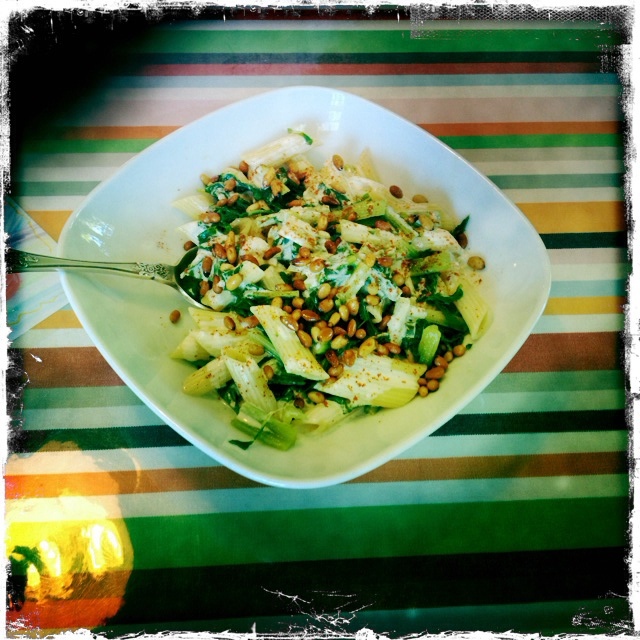
Penne with Swiss chard, tahini, yoghurt and buttered pine nuts

Yotam says, “Chard leaves are some of the most popular greens in Jerusalem. They have a fantastic sharp aroma and tend to hold their texture when cooked. Garlic is essential! Paired with tahini and yoghurt, they make a remarkable dish – sharp and full of flavour…” We have made it into a main course simply by adding some penne pasta – a dried staple found in every kitchen.

ourkitchengarden.net

Fresh from the garden: Swiss chard (silverbeet), garlic, lemon
Recipe source: adapted from a recipe in the book Jerusalem by Yotam Ottolenghi
Serves: 4 or 24 tastes

Equipment:

  • Citrus juicer
  • Bowls – big, med
  • Scales
  • Garlic press
  • Measures: jug, tablespoon
  • Whisk
  • Chopping boards and knives
  • 2 large stockpots
  • Colander
  • Large frying pan
  • Slotted spoon, wooden spoon
  • Serving bowls


What to do:

Ingredients:

  • 250g dried penne
  • 1.3kg Swiss chard
  • 40g unsalted butter
  • 2 tablespoons olive oil, plus extra
  • 40g pine nuts
  • 2 cloves garlic
  • 60ml dry white wine, stock or water
  • Sweet paprika, to garnish

The sauce:

  • 50g light tahini paste
  • 50g Greek yogurt
  • 1 lemon
  • 1 garlic clove
  • 2 tablespoons water
  • Flaked salt
  • Start with the sauce: Squeeze the lemon to yield 2 tablespoons juice. Place all sauce ingredients in a medium bowl and add a pinch of salt. Peel the garlic clove and squeeze through the press and add too; whisk well until you get a smooth, semi-stiff paste. Set aside.
  • Bring the 2 large pots of salted water to a boil. Use a sharp knife to separate the chard stalks from the leaves and cut both into 2cm wide slices, keeping them separate. Peel the garlic cloves and slice thinly.
  • Add the pasta to one pot of boiling water with a tablespoon of salt and cook for 10 minutes. Add the chard stalks to the other pot of boiling water, simmer for 2 minutes, add leaves and simmer for another minute. Drain and rinse well under cold water. Allow the water to drain and then use your hands to squeeze the chard well until it is completely dry.
  • Put half the butter and the 2 tablespoons of olive oil in the frying pan and place on a medium heart. Once hot, add the pine nuts and toss them in the pan until golden, about 2 minutes. Use a slotted spoon to remove them from the pan then throw in the garlic. Cook for about a minute until it starts to become golden.
  • Carefully pour in the wine, stock or water and leave for about a minute until it reduces to about a third. Add the chard and the rest of the butter and cook for 2-3 minutes, stirring occasionally.
  • Drain the pasta and turn back into the hot pot, reserving some cooking water. Add the chard and mix to combine. Divide the into serving bowls, spoon some tahini sauce on top and scatter with the pine nuts. Finally, drizzle with a tiny splash of olive oil and dust with some paprika.
Categories: Kitchen Garden, Recipe | Tags: , , , , , , , , | Leave a comment

Carrot and potato latkes

Potato pancakes, also called latkes, are a traditional Chanukkah treat. For sweetness, colour and general good stuff, carrots have been added.

ourkitchengarden.net

Fresh from the garden: potatoes, carrots, lemon, apples, egg, chives
Recipe source: adapted from a recipe on marthastewart.com
Makes: about 12

Equipment:

  • Oven tray with rack
  • Chopping boards and knives
  • Saucepans – medium
  • Food mill or mouli with medium disk
  • Graters, citrus juicer
  • Colander
  • Bowls – large
  • Measures: ½ cup, tablespoon
  • Non-stick heavy frying pan
  • Spatula or egg slice
  • Sauce bowls
  • Scissors
  • Serving plates
Ingredients:

  • 400g red apples
  • A lemon
  • 500g potatoes
  • 2 tablespoons plain flour
  • 1 teaspoon freshly ground black pepper
  • 3 medium carrots
  • 1 large egg
  • 1 cup Rice Bran oil
  • Salt and pepper, to taste
  • 100g sour cream
  • Small handful chives

What to do:

  • Preheat the oven to 160C with the baking tray & rack inside.
  • To make the apple sauce: Juice the lemon & quarter & core the apples & slice into 1cm thick chunks. In the medium saucepan, combine apples & half the lemon juice. Cook over low heat with the lid on, stirring occasionally, until apples are soft & beginning to burst, for about 15 minutes. Pass through the food mill & divide among half the sauce bowls.
  • To make the latkes: Peel potatoes and coarsely grate into a bowl. Add the remaining lemon juice and mix to incorporate, combining each time you add another lot of potato.
  • Meanwhile peel and coarsely grate the carrots, and then in the medium bowl, lightly beat the egg and add in the carrots. Stir in the flour with a little salt and pepper and mix well.
  • Scrape out the potatoes into the colander set over a large bowl and squeeze to press out all the starchy juices. Combine with the carrot mixture and mix well.
  • In the large non-stick frying pan, heat the oil over medium heat. Scoop up 2 tablespoons of the potato mixture in to your hands and shape into tightly compacted disks.
  • Carefully lower into the hot oil one at a time – do not crowd the pan, you may have to do this in several batches! – and cook until browned on one side and turning crispy at the edges, about 3 minutes. Turn the latkes over with egg slice and brown the other side for about 3 minutes again.
  • Carefully transfer into the oven tray to keep warm and drain and repeat with remaining latke mixture until all are cooked. Season with salt and pepper.
  • Divide between serving plates & spoon the sour cream into the remaining sauce bowls with a snip of chives on top. Add them to the plates with the apple sauce & serve the latkes hot.
Categories: Kitchen Garden, Recipe | Tags: , , , , , , , , , | 1 Comment

The holiday salad (AKA the Salad with Massaged Kale)

This is where we clean out the garden in preparation for the big break… so expect the unexpected! Why do we massage kale? To soften it and infuse it with the wonderful flavours of olive oil and lemon. Also we recently discovered the delicious crunchiness of radish pods – if you purposefully let your radish harvest go to seed, you’ll be rewarded with unfeasibly long and spindly branches of delicate flowers complete with the most amazing – and not too hot – pods to eat straight off the plant, or include in your favourite salad. Here’s our version:

ourkitchengarden.net

Fresh from the garden: The last veggies of the year…
Recipe source: Melissa with inspiration from Allison!
Serves: 4 or 24 tastes

Equipment:

  • Mortar and pestle
  • Citrus juicer
  • Measures: 1/3 cup, teaspoon
  • Teaspoon
  • Scissors
  • Paper towel
  • Bowls – 2 big, med, 4 small
  • Salad spinner
  • Chopping boards and knives
  • 2 frying pans, one deep-sided
  • Slotted spoon


What to do:

Ingredients:

  • Cavolo nero
  • Lettuce, rocket, baby spinach
  • Beans, bok choy
  • Tomatoes
  • Radish pods
  • 1 egg per person
  • Ground coriander

Herby vinaigrette dressing

  • 1 clove garlic
  • Flaked salt & black pepper
  • 1 lemon
  • 1/3 cup extra virgin olive oil
  • A small handful mixed herbs: parsley, marjoram, thyme, chives
  • For the dressing: Peel the garlic clove and put it in the mortar with a large pinch of salt. Pound to a paste. Juice the lemon and add the juice to the mortar (without pips) then stir the lot with the teaspoon and scrape it into the large bowl. Stir in the oil and grind some pepper, then whisk the dressing lightly. Wash and spin dry the herbs, pick off the leaves and snip finely with the scissors. Add to the dressing.
  • For the massaged kale: Wash the kale and using scissors, strip the leaves from the stalks in small pieces. Dry really well with paper towel, then place in a bowl and squeeze a segment of lemon over with a pinch of flaked salt and a teaspoon of olive oil. Massage all the flavour into the kale for 5 minutes until the kale is soft and juicy.
  • Fill up the 2 big bowls with cold water & wash the salad leaves in several changes of water. Spin dry and wipe the bowls dry. Fill the small bowl with water and wash the small garnishing leaves, flowers and radish pods. Reserve them carefully on a piece of paper towel then keep separate in the bowl.
  • Wash the beans and snip the stalk-ends off. Wash the bok choy & tomato & chop. Heat a tablespoon of olive oil in a frying pan & add the beans, bok choy & tomato with a pinch of salt, a squeezed clove of garlic & a teaspoon of ground coriander. Cook on high for a few minutes.
  • Meanwhile, to poach eggs, fill the deep-sided frying pan 5cm deep with water and bring to a simmer. Fill the large bowl with cold water. Carefully crack each egg into a small bowl without breaking it and then carefully slide into the water. Let the pan sit for 4 minutes before removing each egg into the bowl of cold water with a slotted spoon and reserving until needed.
  • Add the salad leaves to the bowl with the herbs and the dressing. Gently turn the leaves in the dressing using a clean hand without squishing the leaves.
  • Pile up the dressed leaves into the serving bowls, carefully drain an egg and place in each bowl with the massaged kale, beans, bok choy, garnishing petals, leaves & pods, & serve immediately.
Categories: Kitchen Garden, Recipe | Tags: , , , , , , , , , , | Leave a comment

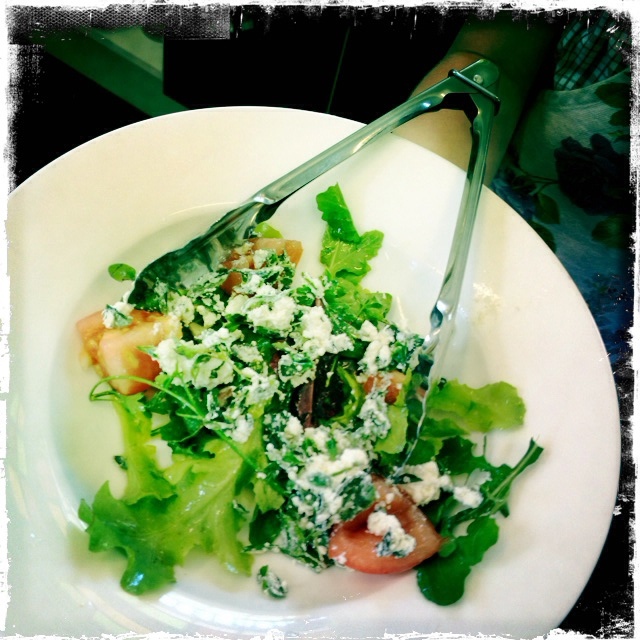
Rocket and herbed feta salad

Salad is a tiny word for a massive selection of broad-ranging ingredients, held together by any number of sauces, unguents and potions. Here’s another one to add to the list!

ourkitchengarden.net

Fresh from the garden: rocket, lettuces, early tomatoes, radishes, limehairy (perennial basil), marjoram, parsley, garlic, lemon
Recipe source: Melissa
Serves: 4 or 24 tastes

Equipment:

  • Bowls – big, medium
  • Salad spinner
  • Chopping boards & knife
  • Measures: tablespoon, teaspoon
  • Tongs
  • Small jar & lid
  • Scissors
  • Colander
  • Serving bowls or plates


Ingredients:

  • A small handful limehairy leaves
  • A small handful marjoram
  • A small handful parsley
  • A block of Danish feta (150–200g)
  • Extra-virgin olive oil
  • 2 handfuls rocket & lettuce leaves
  • Any early tomatoes and radishes
  • A few edible flowers

For the dressing:

  • One small piece of preserved lemon
  • ½ small garlic clove
  • 3 tablespoons extra-virgin olive oil
  • 1 tablespoon cider vinegar
  • 1 teaspoon Dijon mustard
  • A pinch of sugar
  • Flaked salt and black pepper

What to do:

  • To make the herbed feta: Wash the herbs, spin them dry and then pick off all the leaves. Chop them finely on a small chopping board and then unwrap the feta and then place it on the herb mixture. Slice the feta into small cubes, turning them over in the herbs, and then drizzle with a tablespoon of olive oil. Reserve until needed.
  • To make the dressing: Using tongs, take out a small piece of preserved lemon out of the jar and rinse under cold water. Using a small sharp knife, scrape off the fleshy inside part and discard. Chop up the remaining skin very finely and add to the jar, along with the rest of the dressing ingredients, season with salt and pepper, and shake until emulsified.
  • Fill up a big bowl with cold water and wash the rocket and lettuce leaves gently, emptying and refilling several times before draining and spinning dry. Chop or snip any large leaves into 2 or 3 pieces and reserve in a clean and dry big bowl.
  • Wash the tomatoes and carefully slice into small mouth-sized pieces and place in a medium bowl. Scrub the radishes and slice very thinly, adding them to the tomatoes. Drizzle a tablespoon of dressing into the bowl.
  • Drizzle the rest of the dressing onto the rocket and lettuce and gently toss to coat.
  • Divide the dressed leaves on to your serving bowls or plates and distribute the tomatoes, radish and feta cubes over the salad.
  • Garnish with the edible flowers and serve straight away.

Notes: What does emulsified mean? What is limehairy also known as?

Categories: Kitchen Garden, Recipe | Tags: , , , , , , , , | Leave a comment

Kitchen news – 21st November 2013

ourkitchengarden.net

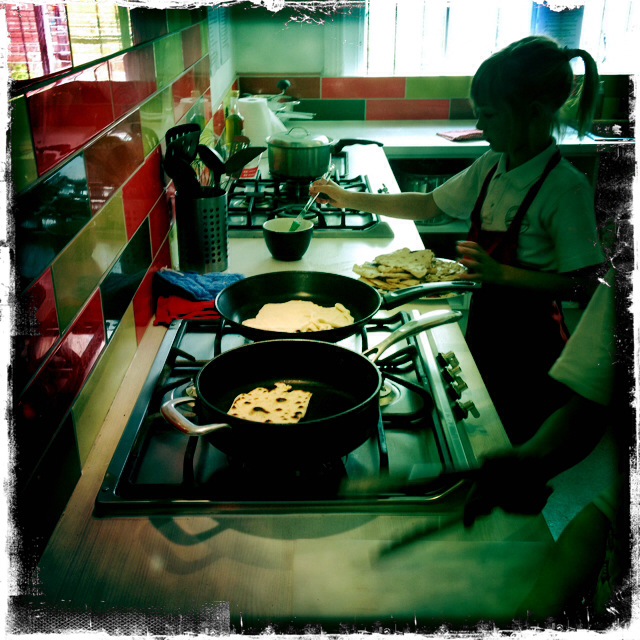
Flatbread production line

The theme this fortnight has been ‘Our Families’, recommended to me by Miss Murden for her Stage 1 unit theme. This has been particularly appropriate at my house as we’ve had our English family to stay (who of course brought the rain with them!) but also has led to discussion in the classes about our Bondi Kitchen Garden Family, where we cook, eat and work together – and also how I very much feel like an auntie to all the children (or as a cheeky little Year 3 kid said, a Great Grandma. Hmph!) The UK folks left yesterday, so the weather should be a lot better from now on…

So to our menu: Hugh’s fish-free salad Niçoise (gorgeously golden yolks from our fresh eggs); slurpy Cream of celery soup; River Cottage garlicky flatbreads to mop up Alice’s broad bean puree (that’s the end of them!); and the most popular dish ever, judging by the requests for the recipe and general comments from parents AND children: the creamy and vibrant Risotto primavera.

A fabulous bunch of dishes and the children working so well together – so helpful, mature and an absolute delight to cook with! And not a grain of rice left…

To finish, I made a call-out for some haberdashery help… I mentioned that I had over a dozen aprons that need some sewing-machine attention or other and said would love to hand them over for a fix, and that it could be a project for the holidays? But it looks like I have a Machinist Miracle Maker who is even picking up the aprons on Tuesday! Thanks Fiona 🙂

For loads of great photos from the week and recipes updated fortnightly, click back here!

Mx
ourkitchengarden.net

Team zest!

Categories: Kitchen Garden, News | Tags: , , , , , , , , , , , , , , , | 1 Comment

Risotto primavera

This lovely spring risotto is positively bursting with green goodies!

ourkitchengarden.net

Fresh from the garden: broad beans, green beans, marjoram, garlic, onion, pea shoot tendrils
Recipe source: Melissa
Serves: 6 at home or 24 tastes

Equipment:

  • Saucepans – small, medium and large stockpot
  • Salad spinner
  • Bowls – 1 large, small, med
  • Large knife& chopping board
  • Grater, microplane zester
  • Ladle
  • Wooden spoon with a flat end
  • Heavy based stockpot
  • Measures: scales, jug, cup, tablespoon
  • 4 bowls or soup plates to serve


Ingredients:

  • 2 litres water with 2 tablespoons bouillon (or 2 litres stock)
  • 3 garlic cloves
  • 1 brown onion
  • 20g butter
  • Extra-virgin olive oil
  • 400g Arborio rice
  • A handful broad beans
  • A bunch of asparagus
  • A handful of green beans
  • A cup of frozen peas
  • 1 lemon
  • 50g parmesan
  • A small handful marjoram
  • A handful pea shoot tendrils

What to do:

  • Measure 2 litres of water into the medium saucepan, add the bouillon and bring it to a simmer on medium heat.
  • Peel and finely chop the onion and garlic.
  • Heat the butter and 2 tablespoons of olive oil and butter over medium heat in the large stockpot. Add the chopped onion and cook until translucent & then stir in the garlic and then rice until the grains begin to crackle.
  • Begin adding the simmering stock, a ladle at a time, and stir in until fully absorbed. The stock should just cover the rice and bubble. Stir every minute or so, making sure you get into all the edges of the pan with the wooden spoon.
  • Meanwhile fill the smaller saucepan with water and set to boil. Pod the broad beans and boil for 3 minutes. Drain, refresh in a bowl of cold water and pod again. Reserve in a small bowl.
  • Wash and chop the asparagus into 1cm lengths. Measure out the peas from the freezer and reserve. Wash and snip the beans into 1cm lengths.
  • After about 15 minutes add all the peas, the broad beans, the green beans and the asparagus and stir in, cooking for another 5 minutes.
  • Meanwhile, zest the lemon and grate the parmesan to yield about ½ cup. Wash and gently spin the pea shoots dry. Wash, spin and strip the marjoram leaves.
  • When the rice is just tender all the way through but still slightly firm, usually in about 20 minutes, it is done.
  • When you are ready to serve, add in a last ladleful of stock. Stir in the pea shoots, lemon zest and parmesan, and remove from the heat. Taste now and check the seasoning. The mixture should be creamy.
  • Serve onto the bowls and eat right away!

ourkitchengarden.net

Categories: Kitchen Garden, Recipe | Tags: , , , , , , , , , , | Leave a comment

Cream of celery soup

The classics keep coming back, and for good reason! We love our 70’s soups…

ourkitchengarden.net

Fresh from the garden: celery, onion, potatoes, garlic, chives
Recipe source: Melissa
Serves: 6 at home or 24 tastes

Equipment:

  • Kettle
  • Chopping boards and knives
  • Peelers
  • Paper towel
  • Scissors
  • Stockpot, wooden spoon
  • Scales
  • Measures: jug, tablespoon
  • Microplane grater
  • Garlic press, ladle
  • Stick blender, mouli
  • Serving bowls
  • Teaspoons

Ingredients:

  • 1.5 litres boiling water and 1.5 tablespoons bouillon (or 1.5 litres vegetable stock)
  • 1 brown onion
  • 1kg white potatoes
  • 4 garlic cloves
  • A large bunch of celery
  • 2 tablespoons olive oil
  • 1 whole nutmeg
  • 100ml single cream
  • A small handful chives
  • Freshly ground black pepper
    What to do:
  • Fill the kettle and set it to boil. Measure the bouillon and boiling water into the jug and stir.
  • Peel the potatoes under running water and then coarsely chop into 2cm cubes.
  • Peel and coarsely chop the onion.
  • Wash and finely chop the celery, including leaves.
  • Heat the oil in the stockpot over medium heat. Add the onion and cook, stirring, for 5 minutes and then add the chopped celery and cook for another few minutes.
  • Meanwhile peel and crush the garlic, and then add the garlic and potato cubesand stir together.Sweat for a minute until aromatic.
  • Increase heat to high. Add the prepared stock and bring to the boil, then simmer gently, uncovered, for 10 minutes or until the potato is almost tender.
  • Remove from heat, add the cream and using the microplane, grate 1/2 a nutmeg into the soup.
  • Blitz the soup with the stick blender. You may want to pass the soup through the mouli to make it super-smooth.
  • Taste and season if needed.
  • Wash the chives and then roll them in a piece of paper towel. Snip into tiny pieces and reserve.
  • Ladle soup among serving bowls and sprinkle with the snipped chives.

Notes: What do celery leaves taste like? Where does nutmeg grow?

Categories: Kitchen Garden, Recipe | Tags: , , , , , , , , | Leave a comment

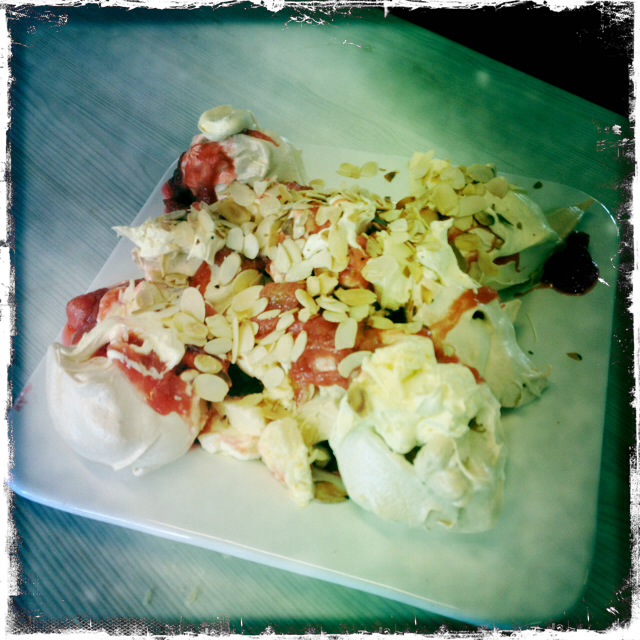
Rhubarb and rosewater Eton mess

A take on the classic English dessert with gorgeous contrasting textures & flavours: crunchy, soft, creamy, hard, sweet, acid… yum yum YUM!

ourkitchengarden.net

Fresh from the garden: strawberries, rhubarb, eggs
Recipe source: Adapted from a recipe by Sophie Dahl in The Delicious Miss Dahl
Serves: 12 at home

Equipment:

  • Kitchen Aid, whisk attachment
  • Scales
  • Large baking tray
  • Baking paper
  • Measures: teaspoon
  • Chopping board and knife
  • Saucepan
  • Wooden spoon
  • Frying pan
  • 2 serving plates


Ingredients:

For the meringues

  • 8 large eggs
  • 400g raw caster sugar
  • 1 pinch salt

For the rhubarb compote

  • 200ml boiling water
  • 120g raw caster sugar
  • 1kg rhubarb
  • 2 teaspoons rose water

For the cream

  • 500ml double cream
  • 1 vanilla pod
  • Almond slivers to serve

What to do:

  • First make the meringues. Preheat the oven to 120C. Separate the eggs.
  • In a clean bowl or mixer whisk the egg whites until they reach firm peaks.
  • Gradually mix in the sugar and salt and whisk well until the mixture is thick white and glossy. This should take about 7-8 minutes.
  • Line a large baking tray with non-stick baking paper – use a little dab of the meringue mixture to stick it down.
  • Spoon the mixture into blobs on your baking tray leaving a generous gap between them. Bake for 1 hour.
  • Whilst the meringues are baking, make the rhubarb compote. Wash the rhubarb and trim any leaves away. Chop into 3cm rounds.
  • In a pan, boil the water with the sugar and add the rhubarb when it starts bubbling. Stir and let it cook for about 5 minutes on a medium heat. When the rhubarb is tender, remove from the heat. Add the rose water and leave to the side.
  • Whip the cream until it forms soft peaks.
  • Split the vanilla pod down the middle and scrape out the seeds. Stir them into the whipped cream.
  • Place the cooled meringues on the serving plate, breaking a few of them up and leaving a few whole. Spoon the cream over the top, then drizzle the compote on top of the cream.
  • Lightly toast the almond slivers in a dry frying pan and sprinkle them over the top.
Categories: Kitchen Garden, Recipe | Tags: , , , , , , , , , | Leave a comment

Blog at WordPress.com.