Posts Tagged With: meat-free Mondays

Creamy polenta with poached eggs and sage

This is such a vibrant and comforting dish, with the frizzled sage leaves giving everything a crispy, colourful lift. Just be sure the eggs are very fresh – and then there’s no need to add vinegar or do any of that silly swirling stuff!

ourkitchengarden.net

From the garden: eggs, sage, garlic
Recipe source: Melissa
Serves: 4 or 24 tastes

Equipment:

  • Chopping board &small knife
  • 1 heavy-based saucepan & lid
  • Scales
  • Measuring jug
  • Grater
  • 1 small saucepan
  • Salad spinner
  • Paper towel
  • Wooden spoons
  • Bowls – 4 small
  • Deep-sided frying pan
  • Serving bowls
Ingredients:

  • 250ml milk plus extra 100ml on standby
  • 250ml water
  • 1 bay leaf
  • 1/2 cup fine polenta
  • 1/3 cup mascarpone
  • 50g pecorino
  • 25g butter
  • 4 very fresh large eggs
  • A branch of sage leaves
  • Flaked salt and black pepper

ourkitchengarden.net What to do:

  • Bring the milk, water and bay leaf to the boil in the larger saucepan then remove from heat and allow to infuse for 20 minutes. Strain and discard the bay leaf, bring to the boil again, pour in the polenta and stir continuously until it thickens, about 10-20 minutes, depending on the variety of polenta.
  • Meanwhile grate the pecorino and measure out the mascarpone.
  • When the polenta is cooked, add the mascarpone and grated pecorino and mix until well combined. Taste for seasoning and adjust if necessary. The polenta should be soft and creamy and only just hold its shape. You may need to add a little extra of the standby milk to loosen up the polenta if it becomes too stiff – this will also depend on what brand of polenta you use. You want a sloppy, porridge type consistency.
  • About 5 mins before the polenta is ready, poach the eggs. Fill the deep-sided frying pan 5cm deep with water and bring to a simmer. Carefully crack each egg separately into a small bowl without breaking it and then carefully slide into the water until they’re all in. Let the pan sit on a simmer for 4 minutes.
  • Pick the sage leaves, then wash and spin them dry. Heat the butter in the small saucepan over medium heat. Add the sage leaves and cook, stirring, until they are dark green, crispy and fragrant.
  • To serve, divide polenta among serving bowls. Lift the eggs out of the water, drain, and then place one on top of each bowl. Season generously and scatter with the frizzled sage leaves & browned butter.

Notes: What is polenta? What is cooking by ‘absorption’ method? Why shouldn’t we break the eggs when poaching them? What is to simmer?

ourkitchengarden.net

Categories: Kitchen Garden, Recipe | Tags: , , , , , , , , , , , , | Leave a comment

Cabbage, barley and coriander soup

Thick and chunky, perfect for a winter’s day outside in the fields threshing wheat, or even dealing with the Westfield car park… We used Demeter organic pearled barley – super texture, super delish!

ourkitchengarden.net

Fresh from the garden: cabbage, onion, garlic, carrots, bay, coriander
Recipe source: Melissa
Serves: 8 or 24 tastes

Equipment:

  • Kettle
  • Chopping board & knife
  • Bowls – large, med
  • Peelers
  • Colander
  • Salad spinner
  • A large stockpot
  • Measures – jug, ½ cup, tablespoon
  • Wooden spoon
  • Serving bowls
Ingredients:

  • 1 medium onion
  • 4 cloves garlic
  • 4 large carrots
  • 1/2 large head cabbage
  • 2 tablespoons olive oil
  • 1½ litres stock (or 1½ litres boiling water & 1½ tablespoons bouillon)
  • 1 tin diced tomatoes
  • 1/2 cup pearled barley
  • A teaspoon of ground coriander
  • 1 bay leaf
  • Black pepper
  • A small bunch of fresh coriander

What to do:

  • Fill the kettle and set it to boil.
  • Peel and finely chop the onion and garlic.
  • Peel, wash and chop the carrots into small bite-sized chunks.
  • In a large stockpot, heat olive oil over medium heat.
  • Add onion and garlic, and cook until fragrant and translucent, about 3-5 minutes. Stir in carrots and cook until slightly softened, about 5 minutes.
  • Measure out the boiling water & add to bouillon, stir and carefully pour in to the stockpot. Bring to the boil then measure out and add the barley, bay leaf, the ground coriander and a few grinds of pepper.
  • Cut the cabbage into quarters, wash them then chop out the core (good for the chooks!) and roughly chop. Then add the cabbage and tomatoes and return to the boil. Simmer for about 25 minutes all up, stirring occasionally, until the barley is cooked.
  • Meanwhile wash and spin the fresh coriander dry, then finely chop (but not into mush!!!)
  • When the soup is done, divide among bowls, sprinkle on the coriander and eat hot!

Notes: What does fragrant and translucent mean? What is barley? What does pearled barley mean? What else is coriander known as?

ourkitchengarden.net

Categories: Kitchen Garden, Recipe | Tags: , , , , , , , , , , | 2 Comments

Tempura veggies

These crunchy, crispy and delicious veggies are easy to make as long as you are super-careful with the hot oil… Please read the warning below before you start!

ourkitchengarden.net

Fresh from the garden: zucchini, zucchini flowers, capsicum, eggplant, carrot
Recipe source: adapted from a recipe by Damian Heads in Ready Steady Cook

Equipment:

  • Bowls – big, small
  • Chopping board & knife
  • Paper towel, plate
  • Zip-lock freezer bag
  • Rolling pin
  • Tea towel
  • Measures –  jug, cup
  • Whisk
  • Saucepan
  • Tongs, slotted spoon
  • Serving plates
Ingredients:

  • Vegetable or Rice Bran oil, for deep frying
  • 1 cup self-raising flour
  • 3 ice cubes
  • 200-300ml soda water
  • A selection of veggies: bokchoy, zucchini, zucchini flowers, capsicum, eggplant etc


What to do:

  • Pre-heat the oven to 150C and line a baking tray with paper towel.
  • Wash the vegetables thoroughly, separating any leaves and drying well. Slice any firm vegetables into thin strips or slices. If using zucchini flowers, check to make sure there aren’t any ants or bugs inside each flower & remove the stamen.
  • Take 3 ice cubes from the freezer and zip into a plastic freezer bag.  Place the bag onto the chopping board, cover with the tea towel and bash a few times with the rolling pin to form crystals.
  • Measure the flour and 200ml soda water into a big bowl, add the crushed ice and then whisk to make a batter – do not over mix, the flour should still be a little lumpy. If it’s too thick then add a little more soda water but you’ll need it to be thick enough to cling!
  • Pour the oil into a medium saucepan until one-third full. Heat over medium-high heat until hot. SEE WARNING!
  • Using tongs, dip each vegetable piece into the batter allowing excess to run off, then carefully lower one at a time into the pan to deep fry, until a few are cooking at the same time in batches. Fry for a minute or two, then scoop out with the slotted spoon on to the lined baking tray and place back in the oven with the door slightly ajar.
  • Finish all the veggies – then divide among serving plates & eat hot!

Warning:

  • Whenever working with hot oil, take extreme care and keep small children and pets well away.
  • Never leave hot oil unattended. Never fill the pan more than half way with oil.
  • Make sure any saucepan handle is turned in & not overhanging the stove.
  • Drop food to fry in carefully, using tongs – and make sure the food isn’t wet or the water will make the oil spit!

Notes: Why do we need to take care around hot oil and never leave the pan unattended? Why can we not fill the pan more than half full? Why should the handle be turned in?

ourkitchengarden.net

Bashing out the ice-cubes for tempura

Categories: Kitchen Garden, Recipe | Tags: , , , , , , | Leave a comment

Mini chive, gruyere and rocket frittate

Tasty little morsels – these are lovely just warm out of the oven with a dollop of basil aioli or even cold to pop in a lunch box!

ourkitchengarden.net

Fresh from the garden: chives, eggs, rocket, parsley
Recipe source: adapted from recipe by Cynthia Black Australian Good Taste
Makes: 48 mini frittate

Equipment

  • Pastry brush
  • 2 mini muffin pans
  • Paper towel
  • Scissors
  • Graters
  • Bowls – big, small
  • Chopping board & knife
  • Whisk
  • Salad spinner
  • Measures –  jug, cup, tablespoon, teaspoon
  • Serving plates
Ingredients:

  • 2 tablespoons olive oil
  • A small bunch of chives
  • 9 eggs
  • 200ml thickened cream
  • 50g gruyere
  • 30g parmesan
  • A small handful rocket plus extra to garnish
  • 2 or 3 sprigs of parsley
  • Basil aioli

What to do:

  • Preheat oven to 180°C. Brush the holes of the non-stick mini muffin pans with a little of the oil.
  • Wash the chives and pat dry with paper towel. Using the scissors, thinly snip. Divide the chives between the mini-muffin holes.
  • Measure and coarsely grate the gruyere. Finely grate the parmesan. Sprinkle the cheeses into each of the chive holes.
  • Wash, spin-dry and shred most of the rocket to yield about a cup, reserving a few leaves for the garnish. Wash and spin-dry the parsley, discard the stalks and chop the leaves to yield about a tablespoon. Add these too to the pans.
  • Crack the eggs into a large bowl and lightly whisk. Measure the cream & add into the same bowl, whisk again and then carefully pour into the prepared pans.
  • Bake for 20 minutes or until just set.
  • Meanwhile clean up your station & then make the aioli (see separate recipe).
  • When the frittate are ready, set aside in pans for 5 minutes to cool slightly before dividing onto your serving plates. Soak the pans in water straight away…!
  • Garnish your serving plates with the rocket, add the frittate, serve with a dollop of aioli & eat!

Notes: Why do we need to preheat the oven? What is gruyere? What does to shred mean?

Categories: Kitchen Garden, Recipe | Tags: , , , , , , , , , | Leave a comment

Green soup!

(Rocket, silverbeet and potato…)

These sunny-but-cool days & lengthening nights sing to me of soup, soup and more soup – and this is a great way to use up the bolting rocket!

ourkitchengarden.net

Green soup!

Fresh from the garden: rocket, silverbeet, potatoes, chives
Recipe source: Melissa
Serves: 8 or 24 tastes

Equipment:

  • Kettle
  • Scales
  • Chopping boards & knives, scissors
  • Peelers, garlic press
  • Bowls – big
  • Salad spinner
  • Large stockpot
  • Wooden spoon
  • Measures – litre jug, tablespoon
  • Handheld mixer
  • Ladle
  • Serving bowls
Ingredients:

  • 500g waxy potatoes
  • A small bunch of chives
  • 1 big bunch rocket
  • 2 or 3 silverbeet stems & leaves
  • 4 cloves garlic
  • 50g unsalted butter
  • 1 litre water
  • 1 tablespoon bouillon
  • Black pepper

What to do:

  • Fill the kettle and, making sure you have dry hands, set it to boil.
  • Peel the potatoes under running cold water & cut into 2cm cubes.
  • Wash the chives, shake dry and slice into 1cm bits.
  • Peel the garlic cloves and squeeze them through the garlic press.
  • Melt butter in the large stockpot over medium heat and sauté the chives and garlic for a minute, and then add the potato cubes and turn so that the potato sweats in the butter.
  • Meanwhile wash the rocket in several changes of water and spin dry. Roll up and slice into thin ribbons.
  • Wash the silverbeet in several changes of water and shake dry. Slice or cut the leaves up the middle to remove the stems, then chop them into cm pieces. Roll up the leaves and finely slice them into ribbons.
  • Measure the bouillon & boiling water into a litre jug, stir and then pour it into the potatoes. Bring them to a boil, then turn down to a simmer, cover and cook gently over low heat for 10 minutes, then add the silverbeet stalks.
  • Cook for 2 minutes – check that the potato is tender, then stir in rocket and silverbeet leaves. Increase heat to medium and simmer for another 2 minutes. If it’s really thick you may want to add another cup of hot water.
  • With dry hands, plug in the handheld mixer and carefully whizz the soup until it is silky smooth.
  • Taste for correct seasoning (the bouillon is salty so you may not need any extra salt) and ladle into bowls to serve.

Notes: What other vegetables can be used for soup? How many different procedures are there in this recipe? Why do we want the potato to ‘sweat’?

ourkitchengarden.net

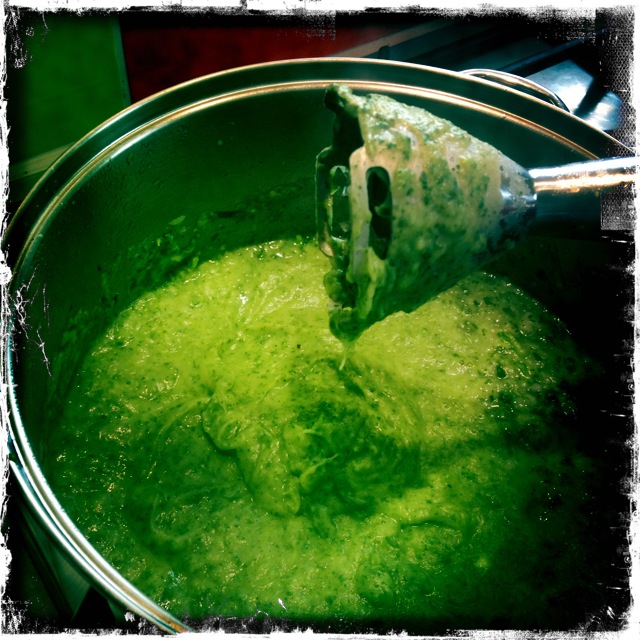
Thick green soup!

Categories: Kitchen Garden, Recipe | Tags: , , , , , , , , , , , , , | Leave a comment

Melanzane alla Parmigiana

Eggplant Parmigiana

The key here is to make sure the eggplant is well-cooked and therefore slippery and succulent… combined with melted cheese, tomato and basil, well – that’s a marriage made in heaven!

ourkitchengarden.net

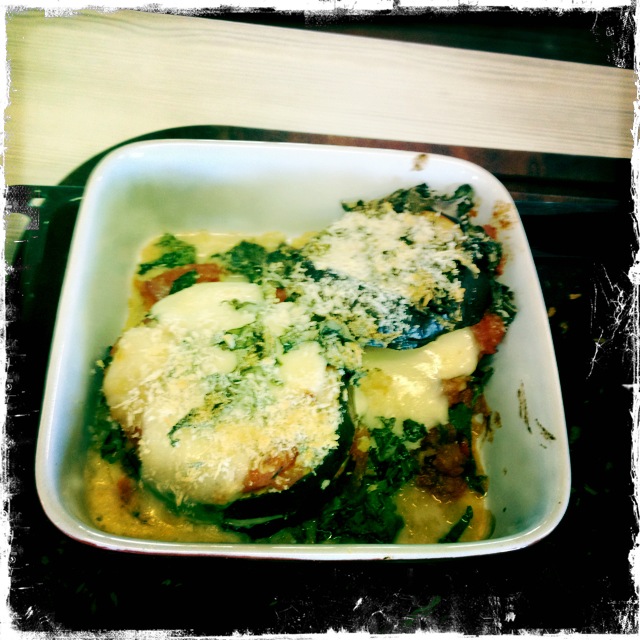
Eggplant parmie!

Fresh from the garden: eggplant, basil, onion, garlic, thyme, carrot
Recipe source: adapted from a recipe by Mario Batali in Molto Mario
Serves: 6 or 24 tastes

Equipment:

  • Pastry brush
  • Baking sheet
  • Paper towel
  • Chopping board & knife
  • Bowls – big, med, small
  • Scales
  • Grater
  • Peeler
  • Frying pan
  • Wooden spoon
  • Plate
  • Measures – cup, ¼ cup, tablespoon, teaspoon
  • Egg slice
  • 4 small baking dishes
  • Pot holders
  • Serving plates
Ingredients:

  • Extra-virgin olive oil
  • 2 large eggplant
  • Flaked salt and black pepper
  • 2 cups basic tomato sauce (recipe below)
  • 1 bunch fresh basil
  • A 200g pot of bocconcini
  • 50g Parmigiano-Reggiano
  • 1/4 cup bread crumbs

Basic tomato sauce

  • 2 tablespoons extra-virgin olive oil
  • 1 Spanish onion
  • 4 garlic cloves
  • A handful thyme sprigs
  • 1 small carrot
  • 1 can chopped tomatoes
  • Flaked salt


What to do:

  • Preheat the oven to 230C. Using a pastry brush, oil a baking sheet.
  • Wipe the eggplant and then carefully cut each into slices about ½ cm thick – you may need the mandoline for this, set to the thickest setting. Lightly season each disc with salt and pepper and place on the oiled sheet. Bake the eggplant for about 10 minutes until the slices begin turning deep brown on top.

Then make the tomato sauce:

  • Peel the onion and finely chop. Peel the garlic and finely slice. Wash and wipe the thyme dry, and then strip off the leaves to yield 3 tablespoons. Wash, peel and grate the carrot.
  • Then: Heat the olive oil in the frying pan over medium heat. Add the onion and garlic and cook until soft, about 5 minutes. Add the thyme and carrot and cook 5 minutes more, until the carrot is quite soft. Add the tomatoes and juice and bring to a boil, stirring often. Lower the heat and simmer until thick. Season with salt to taste.

Continued…

  • While the eggplant is baking and the sauce is simmering,  you can organise the rest of the dish: pick the basil leaves, wash them well and spin them totally dry. Rolling up a few leaves at a time into a roll, slice them into very fine ribbons (chiffonade).
  • Drain the bocconcini and carefully cut the balls into thin slices.
  • Measure the parmesan and grate it. Weigh the breadcrumbs and have ready.
ourkitchengarden.net

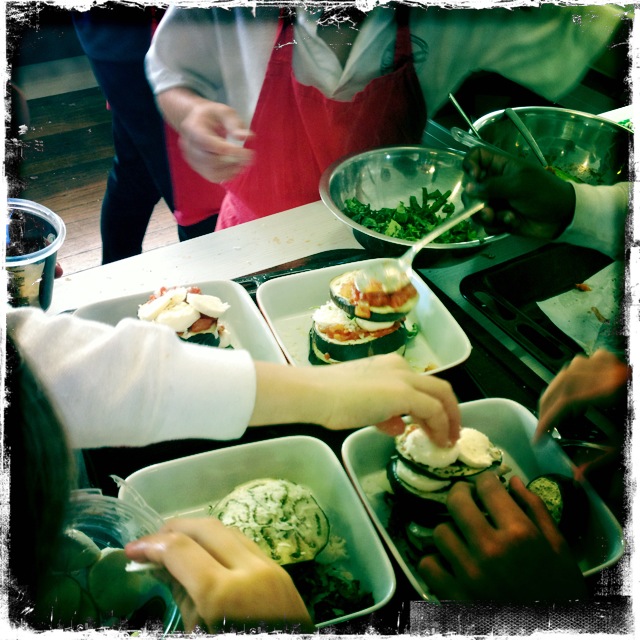
The stacking game

To complete the dish:

  • When the eggplant slices are done, slide them out of the oven and lower the oven temperature to 180C.
  • We are going to layer the different ingredients into each of the four small baking dishes – to start, sprinkle half a teaspoon or so of olive oil into each dish and then carefully place the largest eggplant slices on top of the oil.
  • Over each slice, spread a spoon or two of tomato sauce over the top and sprinkle with a teaspoon of basil. Place one layer of mozzarella over each and sprinkle with 1 teaspoon grated parmesan. Place the smaller slices of eggplant over each of the discs and repeat with tomato sauce, basil, and the 2 cheeses. Repeat the layering again until all the ingredients are used.
  • Sprinkle the breadcrumbs over the top of the eggplant dish, and bake uncovered until the cheese melts and the tops turn light brown, about 15/20 minutes.
  • Using pot holders, carefully place on serving plates and serve immediately.

Notes: This dish’s original name is melanzane alla Parmigiana – what does it mean and which language is it from? What other foreign language dishes can you name?

ourkitchengarden.net

Categories: Kitchen Garden, Recipe | Tags: , , , , , , , , , , , , , | Leave a comment

Pumpkin gnocchi with burnt butter and sage

Don’t be put off thinking that these gnocchi are too hard to make! The trick here is to lightly knead the dough so that the gnocchi too are light… super-yum! And once you’ve had a go you will NEVER buy packaged gnocchi ever again! The crispy sage is a big hit too – get the kids to have a smell of the savoury and almost meaty sage leaves, and then compare after the leaves have sizzled in the butter…

And if you’re interested in the gluten-free version, see below!*

ourkitchengarden.net

Pumpkin gnocchi, burnt butter and sage

Fresh from the garden: potatoes, pumpkin, sage
Recipe source: adapted from a recipe by Stephanie Alexander, Kitchen Garden Cooking W/ Kids
Serves: 6-8 or about 24 tastes

Equipment:

  • Ovenproof serving dishes
  • Chopping board & knife
  • Peelers, grater, scales
  • Medium saucepan
  • Wok & steamer basket
  • Bowls – med, small
  • Skewer, colander
  • Baking tray, Mouli food mill
  • Measures – tablespoon
  • Pastry scraper, slotted spoon
  • Frying pan with 5cm sides
  • Non-stick frying pan
Ingredients:

  • 500g potatoes (use Nicola or Desiree)
  • Cooking salt
  • 600g pumpkin (use a dry-fleshed variety, such as butternut)
  • 320g plain flour, plus extra for dusting
  • 80g Parmesan
  • 20 large sage leaves
  • 150g butter
  • Ground nutmeg
  • Flaked salt and freshly ground black pepper
ourkitchengarden.net

Gnocchi ready for the pan

What to do:

  • Preheat the oven to 120C and place serving dishes in the oven to keep warm. Peel the potatoes, cut into chunks, then place in a saucepan with a teaspoon ofcooking salt and enough cold water to cover generously. Bring to the boil and cook for 15 minutes.
  • Peel and seed the pumpkin. Weigh to make sure you have 500g and cut into bite-sized chunks. Place a wok over a high heat and pour in enough hot water to come a third of the way up the sides. Rest a bamboo steamer on top and spread the pumpkin cubes out in it; cover and steam for 10 minutes. Set the pumpkin aside. Meanwhile weigh the parmesan and grate.
  • Check the potatoes are tender with a skewer then drain, return to the saucepan, shake over the heat to dry out and tip into a bowl. In a separate, small bowl, place the flour. Set this aside until needed.
  • Lightly flour the workbench and the baking tray, and have the measured flour close by. Squash the pumpkin and potato through the coarsest disc of the food mill to form a loose mound on the bench. Sprinkle with a good pinch of flaked salt. Sieve most of the flour over the vegetable mound and, quickly but lightly, combine. Knead briefly until the dough is smooth, using a little more flour if necessary.
  • Cut the dough into four pieces and, with your fingers, roll each into a sausage 2-3cm wide. Cut each “sausage” into pieces 2cm long and place on the floured baking tray.
  • Fill a high-sided frying pan with water, add a teaspoon of salt and bring to the boil. Drop in as many gnocchi as will fit easily in a layer. Adjust the heat to a simmer. When the gnocchi rise to the surface (about three minutes), lift out with a slotted spoon, drain well and slip into the warmed serving dishes. Return to the oven after adding each batch of gnocchi. Scatter over the Parmesan and a sprinkle of nutmeg.
  • Spread the sage leaves in the non-stick frying pan and add the butter. Fry until the leaves are crisp and the butter has become a medium-brown colour. Spoon the sage leaves and butter over the gnocchi in the serving dish and add some ground pepper. Place heatproof mats on the tables and serve the gnocchi in the ovenproof dishes.

*Gluten-free note: We took off about 100g of the milled potato and pumpkin mixture and combined it with about 30g gluten-free plain flour, the results were fabulous – check these babies out:

ourkitchengarden.net

Gluten-free pumpkin gnocchi

Categories: Kitchen Garden, Recipe, School Holiday Program | Tags: , , , , , , , , , , , , , , , | Leave a comment

Mushroom and rocket frittate

We love eggs! They are so versatile… and we also love the magic combination of eggs with mushrooms… this recipe has heaps of different things to do so great for budding chefs! The original also calls for spinach but we had heaps of rocket to use instead – the pepperiness isn’t so obvious once the rocket has wilted…

Fresh from the garden: spring onions, mushrooms, rocket, thyme, eggs
Recipe source: adapted from a recipe by Martha Stewart
Serves: 12 frittate or about 30 small

Equipment:

  • Muffin tins (12-hole large or 2 x 24-hole mini)
  • Pastry brush
  • Chopping board & knife
  • Bowls – large, medium
  • Salad spinner
  • Large frying pan
  • Wooden spoon
  • Whisk, spoons
  • Scales
  • Serving plates
Ingredients:

  • 2 tablespoons olive oil plus extra for greasing
  • 2 spring onions
  • 300g mushrooms of your choice!
  • 300g fresh rocket
  • A sprig or two of thyme
  • A good grind of pepper
  • 1 pinch flaked salt
  • 8 eggs
  • 1/3 cup milk
  • 100g feta cheese


What to do:

  • Preheat the oven to 180C. Lightly grease the muffin tin holes with a pastry brush and a teaspoon or 2 of olive oil.
  • Wash the spring onions, stripping the first layer off and trimming any dried-up ugly parts.  Thinly slice the white & green parts but keep them in separate bowls.
  • Wipe the mushrooms with a piece of paper towel – do not wash them! Slice finely.
  • Wash and spin-dry the rocket. Roll it up & slice into thin ribbons.
  • Wash and wipe the thyme dry, then strip from the stalks.
  • In the frying pan, heat oil over medium-high heat; cook the white parts of spring onions, stirring for 1 minute. Add the mushrooms, thyme, pepper and salt and cook on a low heat, stirring occasionally until no liquid remains and mushrooms are light golden for about 5 minutes.
  • Stir in the rocket and cook, stirring, until wilted for about 1 minute. Remove from heat and then stir in the green parts of green onions. Divide among the muffin cups and set aside.
  • Break the eggs into a large bowl and whisk lightly, then add the milk and beat again. Spoon the egg mixture evenly among muffin cups. Weigh the feta cheese & then crumble it up and then sprinkle into each hole.
  • Bake in 180C oven until edges are set, about 10 minutes for the large (or 7-8 minutes for the small) then let cool in pan on rack for a few minutes.
  • Divide among serving plates. Yum!

Notes: Why do we separate the spring onion parts? Why shouldn’t we wash mushrooms?What does thyme smell like? Where does the word frittate come from?

Categories: Kitchen Garden, Recipe | Tags: , , , , , , , , , , , , , , | Leave a comment

Spelt pasta

Our Kitchen Garden students love making pasta! This recipe uses spelt flour, an ancient grain that is slightly nutty. Spelt has a lower gluten content than wheat flour, and whilst not suitable for a coeliac diet, can be eaten by those with a low threshold gluten intolerance.

ourkitchengarden.net

Spelt linguine with quick pesto

Fresh from the garden: eggs
Recipe source: adapted from a recipe by Sean Moran at Sean’s Panaroma
Makes: about 600g pasta, enough for 6, or 24 tastes

Equipment:

  • Scales
  • Stand mixer, bowl & paddle
  • Pasta machines
  • Measures – tablespoon
  • Plastic film
  • Large knife
  • Pastry brush
Ingredients:

  • 570g spelt flour plus extra
  • 4 free-range eggs
  • 15ml water

 What to do:

  • Weigh the flour into the bowl of the mixer, then with the motor running, add the eggs one at a time. Process for a few minutes until the dough clings together and feels quite springy.
  • Tip the dough onto a clean, dry workbench. Knead the dough for a few minutes, then wrap it in plastic film and let it rest for about an hour at room temperature.

_______________________________________________________________

  • Get an adult to help fix the pasta machine to a suitable bench. Screw the clamp very tightly.
  • Set up your pasta hanging poles, ideally between 2 chairs.
  • Clear a large space on the workbench alongside the pasta machine. All surfaces must be clean and dry. Press the dough into a rectangle about 8 cm wide.
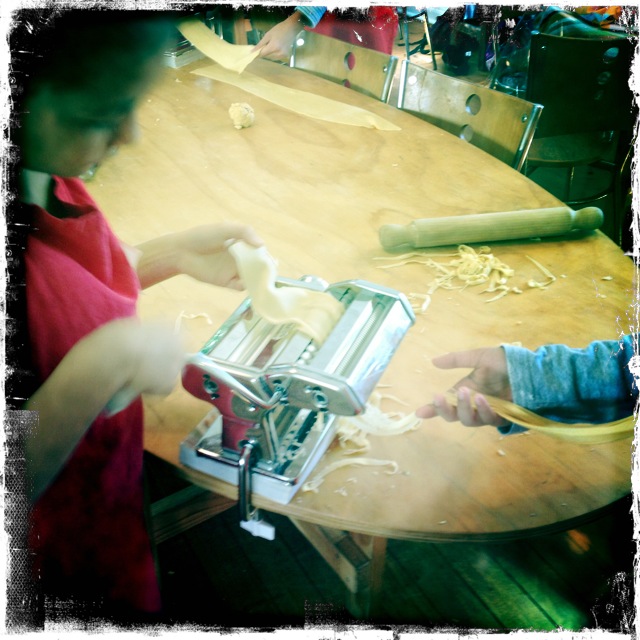
  • Set the rollers on the pasta machine to the widest setting and pass the dough through. The dough will probably look quite ragged at this stage. Fold it in 3, turn it 90 degrees and roll it through again. Go to the next-thickest setting and pass the dough through 3-4 times.
  • Continue in this manner (changing the settings and passing the dough through) until the dough has passed through the second thinnest setting. Don’t use the very thinnest setting, as the dough gets too fine and is hard to manage. If the dough gets too long to handle comfortably, cut it into 2-3 pieces using the large knife, and roll each piece separately.
  • Depending on which type of pasta you want, you can either lay the strips out on a lightly-floured table and cut them by hand, or you can fix the cutter attachment to the machine and carefully roll the pasta strips into strips for linguine or the thinner cutters for angel hair, gently catching them as they come through.
  • Drape the pasta over the hanging poles to dry while you make your sauce.
  • Clean the pasta machine parts by brushing them down with a dry pastry brush, pop the collected parts back into their boxes, and then clear and clean the table.

Notes: Never wash the pasta machine – it will rust! Just brush down with a strong pastry brush to remove the leftover dough.

ourkitchengarden.net

Busy hands!

Categories: Kitchen Garden, Recipe, School Holiday Program | Tags: , , , , , , , , , , | Leave a comment

Dee Nolan’s kabuli chickpeas, leek and green veggie soup

Late last year I bumped in to Dee Nolan at Sean’s and we soon got chatting about her amazing olive oils (Sean’s pours the Nolan’s Road Extra Virgin Delicate with the malt scrolls and cracked wheat log) and her organic, South Australian kabuli chickpeas – as well as the great deeds done in the SAKGP schools… Soon after I was the beneficiary at school of a wonderful gift from Nolan’s Road: a huge box of Dee’s chickpeas! Regular readers of this site will know how much I love to blend up these quick-cooking* chickpeas for Yotam’s hummus, but I’ve also been waiting for an excuse to simmer up some seasonal soup…

Rugged up against a cold, windy and rainy autumn day? Perfect!

ourkitchengarden.net

Nolan’s Road delivery!

Fresh from the garden: potato, leeks, garlic, bok choy, cabbage, kale, spinach, silverbeet
Recipe source: Melissa
Serves: about 6 or 30 tastes

Equipment:

  • Scales
  • 2 large saucepans with lid
  • Chopping board & knife
  • Peeler
  • Grater
  • Kettle
  • Colander
  • Bowls – big, med
  • Mandoline
  • Stick blender
  • Measures – lt jug, tablespoon
  • Wooden spoon, ladle
  • Serving bowls
Ingredients:

  • 250g dried chickpeas, soaked overnight
  • 1 large potato
  • 2 large leeks
  • A bunch of leafy green veg: bok choy, cabbage, kale, spinach, silverbeet
  • 1 tablespoon extra-virgin olive oil
  • 1 knob of butter
  • 2 cloves garlic
  • Flaked salt and freshly-ground black pepper
  • 1 litre boiling water with 1 rounded tablespoon bouillon or 1 litre stock
  • 50g parmesan

What to do:

  • Rinse soaked chickpeas, cover with water, bring to the boil and simmer for 10 minutes.
  • Meanwhile, slice off tough bits of leek skin.  Slit from top to bottom and rinse thoroughly under running water to get rid of any mud trapped between layers of the vegetable.  Slice finely.
  • Peel the potato under running water and then slice finely using the mandoline.
  • Peel and finely slice the garlic. Grate the parmesan.
  • Warm a thick-bottomed pan, and add the tablespoon of oil and the knob of butter. Add the leeks and garlic to the pan and sweat gently with a good pinch of salt until tender and sweet – 5 minutes at least. Add the sliced potato and turn in the buttery mixture.
  • Drain the chickpeas and then add to the leeks and sliced potato and cook for 1 minute. Add about two-thirds of the stock and simmer for 15 minutes.
  • Meanwhile wash the leafy veg thoroughly, shake dry and chop into bite-sized pieces.
  • With about 5 minutes to go, add any veggie stalks in to the soup, and then after a minute or two add in the leaves, stirring to combine & wilt.
  • Pour half the soup out into the 2nd pot and puree with the stick blender. Leave the other half whole, and then pour back in together – pureeing half gives a lovely smooth comforting feel but also keeps a bit of texture. Now add enough of the remaining stock to achieve the consistency you like.
  • Check for seasoning, ladle into bowls to serve and add a sprinkle of parmesan to finish.

 Notes: Why do we soak the chickpeas overnight? What’s the number one rule with the mandoline? What is sweating the leeks?

ourkitchengarden.net

Nolan’s Road kabuli chickpea, leek & green veggie soup

*If you’re researching recipes from European or US books or websites you may read that the chickpeas, once you’ve soaked them overnight, will need an hour or more of  boiling. I find that the Nolan’s Road chickpeas take less than half that time so start checking after about 20 minutes!

And PS. If you can be organised enough to soak your chickpeas in advance, DO IT!!! Whilst I also keep tins of chickpeas, borlotti beans, cannellini et al in my pantry, there is simply nothing better than long-soaked and freshly cooked ones, plus you avoid the nasty BPA-lined tins. Hooray!


Categories: Kitchen Garden, Recipe | Tags: , , , , , , , , , , | 2 Comments

Create a free website or blog at WordPress.com.