Posts Tagged With: vegetarian

Our spring salad with strawberries and flowers

This is a lovely salad to pair with heavily flavoured dishes and is fun to prepare – try not to gobble all the strawberries first!

ourkitchengarden.net
Fresh from the garden: Beetroot, lettuces, rocket, strawberries, edible flowers, lemon, parsley, marjoram, thyme, coriander, oregano
Recipe source: Melissa

Equipment:

  • Medium saucepan
  • Bowls – 2 large
  • 2 salad spinners
  • Tea towel
  • Kitchen paper
  • Chopping board & knife
  • Mortar & pestle
  • Measure – 1/3 cup
  • Citrus juicer
  • Mezzaluna, teaspoon
  • Serving bowls, little tongs
Ingredients:

  • A bunch of baby beetroot
  • A large handful salad leaves
  • A few garnishing flowers
  • A handful of strawberries

Herby vinaigrette dressing

  • 1 small garlic clove
  • Flaked salt & black pepper
  • 1 lemon
  • 1/3 cup extra virgin olive oil
  • A small handful mixed herbs:
    parsley, marjoram, thyme, coriander, oregano, chives

What to do:

  • Chop off the beetroot leaves, keeping any small leaves. Scrub the beets and place them whole into the medium saucepan and fill with cold water. Set to boil for about 20 minutes.
  • Fill up the 2 big bowls with cold water & wash the salad leaves, gently dunking them a handful at a time into the water, then pulling out to see if any dirt is left behind. Repeat in fresh water until no dirt remains. Spin the leaves dry and then wipe the bowls dry.
  • Wash the flowers separately and drain on a piece of paper towel. Keep the flowers reserved, picking off the petals to use.
  • Wash and spin dry the herbs, and pick off the leaves. Wash and hull the strawberries and slice.
  • Lay out the tea towel and line it with kitchen paper. Spread the salad leaves over the paper and roll the whole lot up like a log. Keep the rolled parcel of leaves in the fridge until needed.
  • When the beetroot are tender, drain them and place under running cold water until cool. Slip the skins off with your fingers and slice up.

To make the dressing:

  • Peel the garlic clove and put it in the mortar with a large pinch of salt. Pound to a paste.
  • Juice the lemon and add the juice to the mortar (without the pips) then stir the lot with the teaspoon and scrape it into a large bowl.
  • Stir in the olive oil and grind a little pepper, then whisk the dressing lightly. Add the herbs, chopping any large leaves in the mezzaluna if needed. Add to the dressing in the large bowl.

To assemble:

  • Unwrap the parcel of salad leaves & tip them into the bowl with the flower petals, herbs, strawberries, beetroot and the dressing. Gently turn the leaves in the dressing using your hands or tongs.
  • Transfer the salad to the serving bowls and serve immediately with little tongs.
Categories: Kitchen Garden, Recipe | Tags: , , , , , , , , , , | Leave a comment

Salad of blood orange, beetroot, radish and goats’ cheese

We love the arrival of blood oranges to signify the end of winter & beginning of spring! This salad is a firm favourite of ours, with its contrasting flavours and textures, and beautiful deep colours.

Our Kitchen Garden

Serves: 6 or 24 tastes
Fresh from the garden: blood oranges, radishes, beetroot, beetroot leaves, lettuce leaves, marjoram

Equipment:

  • Chopping board & knife
  • Small saucepan & lid
  • Colander
  • Paper towel
  • Measuring: tablespoon, teaspoon
  • Bowls – large, small
  • Garlic press
  • Salad spinner
  • Fork
  • Plates to serve
Ingredients:

  • 3 or 4 baby beetroot
  • A small bunch of radishes
  • Small sprig of marjoram
  • A handful of lettuce leaves
  • 3 blood oranges
  • 1 garlic clove
  • 2 teaspoons aged balsamic vinegar
  • 2 tablespoons extra-virgin olive oil
  • A small roll of goats’ cheese
  • Flaked salt and black pepper

What to do:

  • Cut the leaves from the beetroot, leaving about 2cms of stalk and reserving any small leaves. Gently scrub the beets to remove any dirt and place them in the saucepan with cold water to cover by about 5cm. Heat on high with lid on and boil for 20 minutes until soft when pierced.
  • Remove the stalks from the radishes & discard. Wash them well and then wipe dry with paper towel. Finely slice the radishes into thin discs and slide them into the big bowl.
  • Wash, dry and pick the marjoram leaves and reserve for the garnish.
  • Carefully wash and spin the lettuce and beetroot leaves dry. Break up into smaller pieces with your hands if needed, then roll up into a kitchen paper-lined tea towel & place in the fridge until needed.
  • Peel the oranges, removing any white pith and discarding it. Carefully cut the oranges into thin slices crossways and then place them into the big bowl. Scrape any juice into the bowl.
  • Squeeze the garlic through the garlic press into the small bowl.
  • Mix into the garlic the balsamic vinegar and olive oil, whisk with the fork and pour over the orange and radishes.
  • Season with salt and pepper and stir together gently. Leave to marinate for 10 minutes.
  • Meanwhile when the beetroot are soft, drain the saucepan and fill with cold water to cool the beets. When cool to handle, slide off the skins and root and thinly slice the beetroot. Add the slices to the radish and orange and combine in the dressing.
  • To finish, divide the salad leaves among your serving plates and scatter the beetroot mixture on top. Remove the wrapping from the goats’ cheese and dab chunks of cheese over each salad. Sprinkle with the marjoram and serve.

Notes: What other fruit and vegetable combinations can you think of for a salad? What other fruits can be dressed with balsamic vinegar? Why do we let the salad ‘rest’ for 10 minutes?

Categories: Kitchen Garden, Recipe | Tags: , , , , , , , , , , , | Leave a comment

Pita bread

If you’ve never made bread from scratch, pita is the perfect place to start. If you have made bread before, you’ll know how delicious these can be! They are great served with hummus for dipping, or our falafel with herby yoghurt… this recipe makes about 20 small pita breads.

Equipment:

  • Measuring jug
  • Bowl – 2 small
  • Bowl – large mixing
  • Teaspoon
  • Tablespoon
  • Glad wrap
  • Rolling pin
  • Fork
  • 6  tea towels
  • Medium frying pan
  • Large knife
  • 4 serving plates
Ingredients:

  • 7g dried yeast
  • 20g sugar
  • 375ml warm water
  • 2 teaspoon salt
  • 500g plain unbleached flour, plus extra
  • 100g fine semolina
  • 1 tablespoon olive oil, plus extra

What to do:

  • Dissolve the yeast and sugar in 125ml warm water, cover and set aside for 15 minutes until frothy. Dissolve salt in remaining 250ml warm water.
  • Place flour and semolina in a large mixing bowl and make a well in the centre. Add yeast mixture, 1 tablespoon olive oil and salt water. Knead with hands for 10 minutes in the bowl. Shape into a ball in the bowl, cover with glad wrap and place in a warm area to rise. Wait about one hour until dough has doubled in volume.
  • Punch down dough and knead on a floured surface for one minute. Divide dough into pieces slightly larger than an egg and roll quickly into little balls. Leave to rest under a damp tea towel for 5 minutes, then roll out on a floured surface to a thickness of about 6mm. Prick bread with a fork in several places.
  • Preheat a frying pan, add a dash of olive oil and cook bread over high heat for a couple of minutes each side until lightly browned. Repeat with remaining breads, carefully wiping out the frying pan if smoking and adding oil for every second one if necessary.
  • Stack breads on a clean tea towel, placing clean tea towels between each second one to absorb the moisture, and allow to cool.
  • Slice into quarters or strips and divide onto the plates.

Notes: Where does pita bread originate? Where are other flat breads used? What other sort of dishes do they go with? What does dissolve mean? What does absorb mean?

Categories: Kitchen Garden, Recipe | Tags: , , , , , , , , | Leave a comment

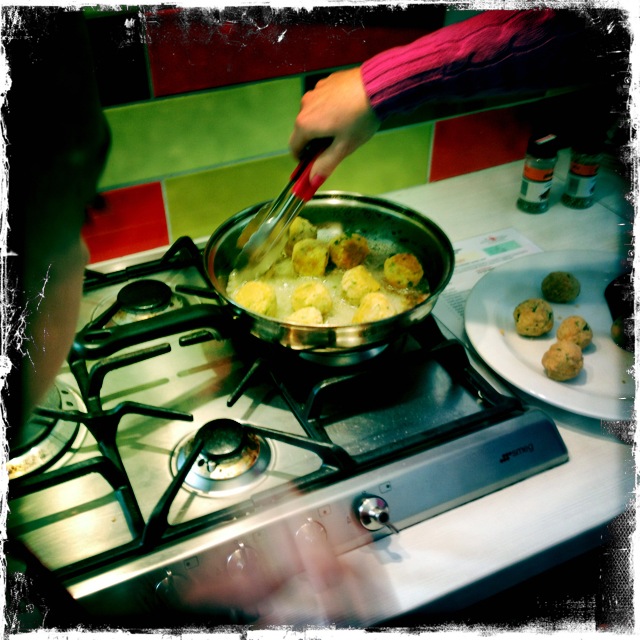
Simon Rimmer’s carrot and coriander falafel

Simon Rimmer is a British chef with a reputation for heading wonderful vegetarian restaurants in England whilst not actually being vegetarian himself. He has written four cookbooks.

Fresh from the garden: carrot, chilli, coriander, parsley, mint

Equipment:

  • Frying pan
  • Mortar & pestle
  • Peelers, sieve
  • Kitchen paper
  • Salad spinner
  • Chopping board & knife
  • Lemon juicer
  • Garlic press
  • Food processor
  • Spatula
  • Grater
  • Plate
  • Slotted spoon & metal spoon
  • Measures – tablespoon, teaspoon, ½ teaspoon
  • Serving plates
Ingredients:

For the falafels

  • 1 teaspoon cumin seeds
  • 1 teaspoon coriander seeds
  • 2 x 400g cans chickpeas
  • salt and freshly ground black pepper
  • 1½ teaspoons baking powder
  • 2 tablespoons plain flour
  • 100g carrot
  • 1 red chilli (optional)
  • 1 garlic clove
  • A small handful fresh coriander
  • A small handful fresh parsley
  • 1 lemon
  • vegetable oil, for frying
  • sesame seeds, to garnish

For the yoghurt dip

  • 100ml Greek yoghurt
  • A small handful fresh coriander
  • A small handful fresh mint
  • 1 lime
  • 1 tablespoon tahini

What to do:

  • For the falafels, toast the cumin and coriander seeds in the dry frying pan for 1-2 minutes, or until fragrant. Grind the seeds in the pestle and mortar.
  • Peel and finely grate the carrot & squeeze the moisture out a piece of kitchen paper. Wash, spin-dry the coriander, parsley and mint and finely chop to yield 2 tablespoons of each. Reserve some of the coriander and all of the mint for the yoghurt dip. Zest the lemon and peel and crush the garlic clove. Juice the lime. Drain the chickpeas into the sieve & rinse.
  • Blend the toasted spices together with the rest of the falafel ingredients in the food processor until well combined.
  • Shape spoonfuls of the falafel mixture into balls and set aside on a plate.
  • Meanwhile, heat 1cm vegetable oil in the frying pan and fry the falafels for 1-2 minutes on each side. Remove the falafel from the pan with a slotted spoon and set aside to drain on kitchen paper. Sprinkle with the sesame seeds.
  • For the yoghurt dip, combine the Greek yoghurt, coriander, mint, lime and tahini in the jug of the stick blender and whizz until smooth.
  • Serve the falafels with the yoghurt dressing and toasted pita breads if you have them!
Categories: Kitchen Garden, Recipe | Tags: , , , , , , , , , , , | Leave a comment

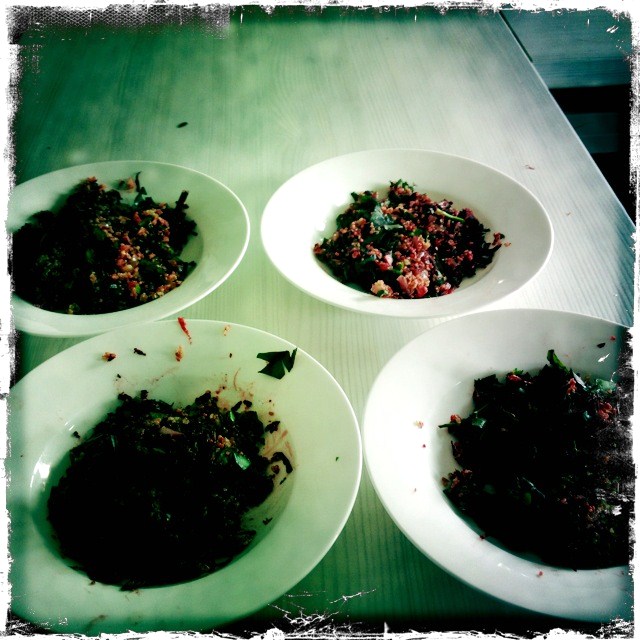
Rose Elliott’s warm beetroot and quinoa tabbouleh

Rose Elliott is a British vegetarian cookery writer. She first became a vegetarian at the age of three and has since written 55 books on vegetarian cookery.

 Fresh from the garden: lemon, beetroot, onions, parsley


Equipment:

  • Scales
  • Sieve
  • Saucepans & lids – med, large
  • Chopping board & knife
  • Peelers
  • Bowls – 2 large
  • Grater
  • Salad spinner
  • Citrus juicer
  • Measures – tablespoon
  • Serving bowls
Ingredients:

  • 125g quinoa
  • 2 tablespoons olive oil
  • 2 large red onions
  • 2 tablespoons balsamic vinegar
  • ½ a lemon
  • 2 small raw beetroot & any small leaves
  • A handful flat-leaf parsley
  • Salt and freshly ground black pepper

What to do:

  • Put the quinoa in a sieve and rinse thoroughly under the cold tap, then put into a saucepan with 300ml water and bring to the boil. Cover and leave to cook slowly for 18 minutes. Remove from the heat and leave to stand, still lidded, for 5 minutes.
  • Meanwhile peel, halve and finely slice the onions. Warm the olive oil in a roomy saucepan, put in the onions, stir to coat with the oil, then cover and leave to cook gently for 10 minutes, or until very tender.
  • Wash, peel and chop off the beetroot leaves. Carefully grate the beetroot to yield about 200g. Wash and spin-dry the small beetroot leaves & parsley and chop the leaves coarsely. Juice the half lemon.
  • Stir the balsamic vinegar into the onion, let it bubble, then remove from the heat and add the quinoa, 2 tablespoons of lemon juice, beetroot, parsley and plenty of salt and freshly ground black pepper to taste.

 Notes: What is quinoa? Are beetroot leaves edible? What is balsamic vinegar? Where does the name tabbouleh come from?


Categories: Kitchen Garden, Recipe | Tags: , , , , , , , , , | Leave a comment

Hugh Fearnley-Whittingstall’s chickpea, potato and kale curry

Hugh Fearnley-Whittingstall is a British chef, famous for the TV show ‘River Cottage’ and his support of real food, local and seasonal foods, and humanely produced livestock .

Fresh from the garden: potatoes, kale, onion, coriander

Equipment:

  • Bowls – glass, large
  • Saucepans – med, large
  • Sieve & colander
  • Chopping board & knife
  • Microplane zester
  • Salad spinner
  • Peeler
  • Measures – jug, tablespoon, teaspoon, ½ teaspoon
  • Scales
  • Frying pan
  • Mortar & pestle
  • Wooden spoon
  • Serving bowls
Ingredients:

  • 300g dried chickpeas (or 2 tins, drained and rinsed)
  • 1 teaspoon cumin seeds, plus a little extra to garnish
  • 1 teaspoon coriander seeds
  • ½ teaspoon mustard seeds
  • 1 hot, dried red chilli, crumbled
  • 1 teaspoon ground turmeric
  • 2.5cm piece fresh ginger
  • 1 tablespoon rice bran oil
  • 1 large onion
  • 2 cloves garlic
  • 700ml chicken or vegetable stock
  • 250g potatoes
  • 150g kale (or cabbage)
  • Greek yogurt, to serve
  • A small handful coriander leaves

What to do:

  • Soak the chickpeas overnight in plenty of cold water.
  • Next day, drain, rinse and simmer them for about 30 minutes in fresh ­water until tender, then drain. (If using tinned, just drain and rinse.)
  • Peel and grate the ginger with the microplane zester. Peel, halve and finely slice the onion. Peel and finely chop the garlic. Peel and chop the potato into 3cm dice.
  • Wash and shake the kale leaves dry. Strip the leaves from the stem (discarding the stem) and finely shred the leaves. Wash and spin-dry the coriander and finely chop.
  • Put the frying pan over a medium heat and, when hot, dry-toast the cumin, coriander seeds and mustard seeds and the chilli for a couple of minutes ­until they smell ­really fragrant and the mustard starts to pop. Grind to a powder with the pestle and mortar, and mix in the turmeric and ginger.
  • Heat the oil in a large saucepan over a medium heat, and fry the onion, stirring regularly, until soft and golden brown. Stir in the garlic and spices, leave to cook for a minute or two, and add the stock. Simmer for five minutes, then add the chickpeas and potatoes. Cook until the spuds are tender, then add the kale. Cook for a few minutes, until the greens are tender, then serve with a dollop of thick yogurt on top, along with a ­sprinkling of toasted cumin seeds and some coriander leaves.

Notes: Why do we dry-toast the spices? What does to shred the leaves mean?

Categories: Kitchen Garden, Recipe | Tags: , , , , , , , , , , , , | Leave a comment

Create a free website or blog at WordPress.com.