Recipe

Turnip tops, kale, herbs and ricotta tart

Yotam says, “It is possible to use a wide range of wild, cultivated or supermarket greens in this recipe. Consider nettles, beetroot tops, turnip tops, spinach or watercress, in combination.”

We say, ” This is DELICIOUS!”

ourkitchengarden.net

Fresh from the garden: onion, celery, turnip tops, kale, silverbeet, herbs, lemon
Recipe source: adapted from a recipe by Yotam Ottolenghi
Serves: 6 or 24 tastes

Equipment:
  • Chopping boards and knives
  • Large and smaller frying pans
  • Measures: tablespoon
  • Scales
  • Grater & microplane
  • Mixing bowls
  • Rolling pin
  • Baking paper
  • Large oven tray
  • Pastry brush
  • Fork
  • Serving plates

Ingredients:

  • ½ a small red onion
  • 3 celery stalks
  • 8 large turnip leaves & silverbeet
  • 2 garlic cloves
  • A small branch mint
  • A small bunch of parsley
  • A small branch of sage
  • 2 tablespoons olive oil, plus extra for drizzling
  • 50g pecorino
  • 75g feta
  • 15g pine nuts
  • 1 lemon
  • 350g all-butter puff pastry (we use Careme)
  • 100g ricotta
  • 1 egg
  • Salt and black pepper

What to do:

  • Peel and thinly slice the onion. Wash and thinly slice the celery stalks and leaves. Wash the turnip tops and shake dry then finely chop, discarding any tough stalks. Peel and finely slice the garlic. Wash and spin dry the herbs then pick off the leaves, tearing the mint leaves and finely chopping the parsley and sage.
  • Place a large frying pan on medium-high heat and sauté the onion, celery, chard, garlic, mint, parsley and sage in the olive oil. Cook, stirring continuously, for 10 minutes or until the greens are wilted and the celery has softened completely.
  • Meanwhile weigh the pecorino and grate it. Weigh the feta and crumble it. Weigh the pine nuts and lightly dry toast in the smaller frying pan. Wash and wipe the lemon and finely zest using the microplane grater.
  • Remove the greens from the heat and stir through the feta, pecorino, pine nuts, lemon zest, ¼ teaspoon of salt and a hearty grind of black pepper. Leave aside to cool for a moment.
  • Preheat the oven to 200C.
  • Roll the pastry so it is 5cm bigger than your baking tray on all sides, and then cut the extra off in strips. Place the large pastry sheet on an oven tray lined with baking paper and lay the border strips on top of the edges of the pastry sheet. Spread the filling out on the pastry inside the borders and dot the filling with large chunks of ricotta. Lightly beat the egg, then brush the pastry borders with egg.
  • Bake the tart in the oven for 30 minutes until the pastry is golden and cooked on the base.
  • Remove from the oven and brush with a little olive oil. Divide onto serving plates and serve warm or at room temperature.
Categories: Kitchen Garden, Recipe | Tags: , , , , , , , , , | Leave a comment

Green salad

The title is simple but the ingredients are many and varied! Just take care when washing young delicate leaves so that they don’t get squashed…

ourkitchengarden.net

Fresh from the garden: rocket, lettuces, pea shoots, baby spinach, kale, spring onions, herbs
Recipe source: Melissa
Serves: 4 or 24 tastes

Equipment:

  • Mixing bowls – 3 big, 2 med, 2 small
  • Colanders
  • 2 salad spinners
  • Scissors
  • Paper towel
  • Measuring – 1/4 cup, tablespoon, teaspoon
  • A small jar with lid
  • Bowlsto serve


Ingredients:

  • A few stalks of kale
  • A large handful of rocket
  • A large handful lettuce leaves
  • A large handful pea shoots
  • A large handful baby spinach
  • A small bunch of spring onions
  • Edible flowers
  • A handful baby nasturtium leaves
  • A bunch of aromatic herbs: marjoram, basil, thyme, coriander
  • 1 tablespoon apple cider vinegar
  • A teaspoon of honey
  • 1/4 cup extra-virgin olive oil
  • Flaked salt & black pepper

What to do:

  • Wash the kale and shake dry. Cut the leaves from the stalks and discard the stalks. Roll up the kale leaves into a tube shape and then finely slice into very thin ribbons.
  • Wash all the leaves & pea shoots in several large bowls and many changes of cold water, filling up the bowls with the water and gently swilling the leaves around, draining in the colander and checking each time for any dirt left in the water. Spin dry in handfuls, reserving the leaves in a large clean, dry bowl.
  • Wash and trim the spring onions, discarding any roots and browning layers. Using scissors, snip into tiny discs and add to the bowl of prepared leaves and shoots.
  • Reserve the edible flowers and nasturtium leaves in a small bowl of cold water. When ready to use, drain on a piece of paper towel and use for the garnish.
  • Wash & dry the herb sprigs, leaving small leaves whole and chopping or snipping with scissors any large leaves and the coriander stalks into tiny pieces.
  • For the dressing, measure the olive oil, vinegar and honey and pour them into the jar. Add all the herbs with a sprinkle of salt and pepper, then put the lid on & give the jar a good shake.
  • Drizzle the dressing around the leaves and gently turn the leaves with your fingers so that all the leaves are covered. Lift out and drain the dressed leaves, dividing into serving bowls.
  • Finish by popping the edible flowers and nasturtium leaves on top of the bowls of salad. Serve immediately!

Notes: Why do we have to be so gentle when preparing these leaves and pea shoots? What is vinaigrette? What do the edible flowers taste like?

Categories: Kitchen Garden, Recipe | Tags: , , , , , , , , | Leave a comment

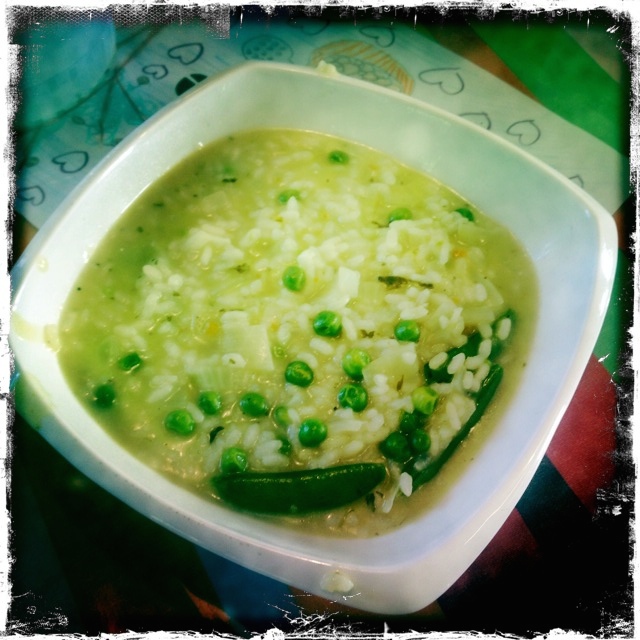
Risi e bisi

This soupy rice and peas dish originating in Venice amounts on the plate to so much more than its simple name suggests. Make sure you retain the pods of your peas as they are incorporated in.

ourkitchengarden.net

Fresh from the garden: shelling peas, sugar snaps, onions
Recipe source: adapted from a recipe  by Stevie Parle on telegraph.co.uk
Serves: 6 or 24 tastes

Equipment:
  • Mixing bowls, 5 mixed size
  • Scales
  • Measures – jug, tablespoon
  • Chopping boards and knife
  • Large stockpot & smaller saucepan
  • Large spoon
  • Stick blender with small blending bowl attachment
  • Spatula
  • Ladle
  • Sieve
  • Wooden spoon
  • Grater
  • Serving bowls

Ingredients:

  • 300g peas (combination of freshly podded, frozen and sugar snaps)
  • 1½ litres water
  • 2 onions
  • 75g butter
  • Olive oil
  • Flaked salt & black pepper
  • 2 tablespoons bouillon
  • 300g Arborio rice
  • 75g parmigiano or grana padano

What to do:

  • Pod the fresh peas, keeping the peas and pods in separate bowls.Wash the sugar snaps, de-string and slice in half or into thirds. Weigh the peas and sugar snaps and then add frozen peas to make up the remainder of the 300g.
  • Measure the water into the smaller of the saucepans and set it to boil. Peel and finely chop the onions.
  • Melt the butter with a splash of oil in a nice big saucepan or stockpot over a low heat. Add the onions and a pinch of salt and gently fry until very soft but not coloured (about 15 minutes).
  • Meanwhile, add the bouillon and the pea pods (not the peas) to the boiling water in the smaller saucepan and boil hard for at least 10 minutes until soft.
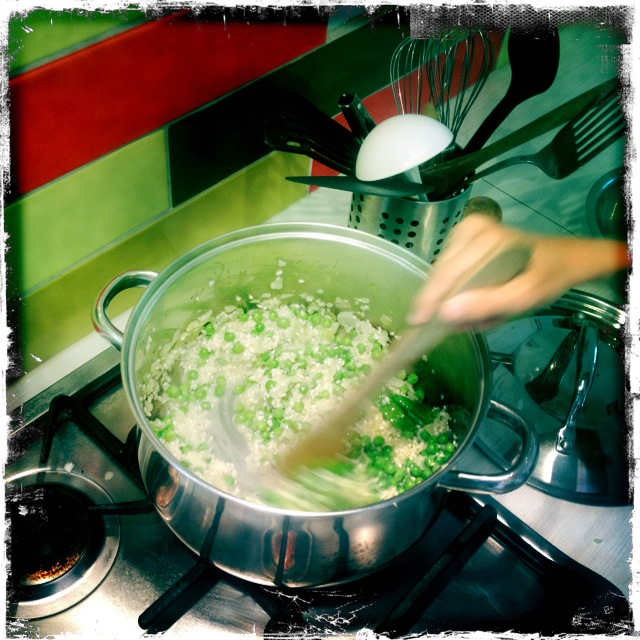
  • Stir all the peas and the rice into the onions and season well. Make sure everything is nicely coated in the butter, then add the reserved stock, gradually bringing it to the boil and stirring gently. Turn the heat down low so that it is gently simmering and leave it to bubble away, stirring occasionally until the rice is just cooked and the peas are soft (about 20 minutes).
  • When the 10 minutes is up for the smaller saucepan, carefully using the large spoon, scoop out the solids to the blending bowl of the stick blender, with a small amount of liquid. Blend them until you have a slightly stringy paste, then pass through the sieve so you have a purée. Add a splash of oil and a little seasoning and put to one side.
  • Grate the parmesan. After the 20 minutes are up for the stockpot, stir in the purée and parmesan, check the seasoning, and add a little more stock or hot water if the consistency is not soupy enough (you should need a spoon to eat it) then spoon into bowls and serve.

Notes: How many peas are in a pod? What does risi e bisi mean?

ourkitchengarden.net

Categories: Kitchen Garden, Recipe | Tags: , , , , , , , , , | Leave a comment

Green tomato chutney

This is the best way to use up the last of the green tomatoes and preserve them for the cooler months. Don’t forget to stir the pot regularly!

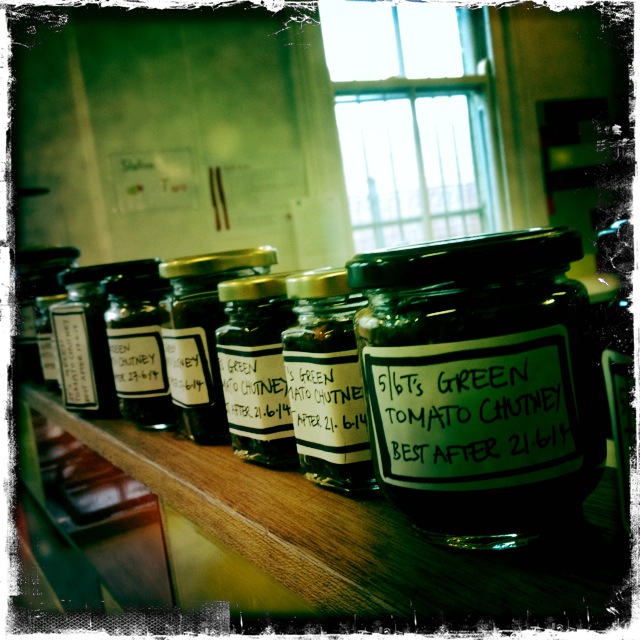
I also water-bath the jars after sealing by placing them in a large pot, not touching, on a clean tea towel in about 15cm of cool water. I set the pot to boil for about 10 minutes, and then carefully remove the jars with tongs. I leave them to cool and then label the jars. This ensures preservation.

ourkitchengarden.net

Fresh from the garden: tomatoes, onions, apples, garlic, bay leaves
Recipe source: adapted from a recipe by Jeremy & Jane Strode
Makes: About 4 large or 6 small jars

Equipment:

  • Colander
  • Mixing bowls – 6 mixed sizes
  • Chopping boards and knives
  • Microplane grater
  • Heavy based stockpot
  • Wooden spoon
  • Scales
  • Measures: jug, tablespoon, teaspoon, ½ teaspoon
  • Jars with metal lids
Ingredients:

  • 1kg green tomatoes
  • 500g brown onions
  • 200g apples
  • 2 cloves garlic
  • 1 knob fresh ginger
  • 1 tablespoon sea salt
  • 1/2 teaspoon coriander seeds
  • 1/2 teaspoon fennel seeds
  • 2 teaspoon yellow mustard seeds
  • 1 teaspoon ground white pepper
  • 3 cloves
  • 2 bay leaves
  • 1 teaspoon chilli flakes
  • ½ cinnamon stick
  • 300ml cider vinegar
  • 225g brown sugar

What to do:

  • Wash the tomatoes, drain into the colander and discard any with holes or are mushy. Chop them into small pieces.
  • Peel and chop the onions, apples (discarding the cores) and garlic.
  • Peel the ginger and carefully microplane into a small bowl.
  • Place tomatoes, onion, apples, garlic, ginger, salt, all the spices and half the vinegar in a heavy-based stockpot. Bring to the boil and simmer, stirring, for one hour.
  • Add remaining vinegar and the sugar and simmer for another 90 minutes or until thick. Stir regularly to prevent catching.
  • Spoon hot chutney into sterilised jars and cover with airtight lids for one month before serving.

Notes: Why are the tomatoes green? What is a microplane grater? Why we do have to cook the chutney for so long? Why do we leave the jars for a month before serving?

ourkitchengarden.net

Categories: Kitchen Garden, Recipe | Tags: , , , , , , , , , | Leave a comment

Penne pesto

For a spicy alternative, rocket leaves can be added to the basil and pounded together or you could try a parsley combination… cooked chickpeas can be used in place of pine nuts in case of nut allergy, and gluten free pasta works fantastically!

ourkitchengarden.net

Fresh from the garden: basil, garlic
Recipe source: pesto adapted from a recipe by Alice Waters in The Art of Simple Food
Serves: 4 or 24 tastes

Equipment:

  • Large saucepan or stockpot
  • Mixing bowls – 4 mixed sizes
  • Scales
  • Salad spinner
  • Cheese grater
  • Medium frying pan
  • Mortar & pestle
  • Tea towel
  • Measuring jug
  • Spatula
  • Tablespoon
  • Serving bowls
Ingredients:

  • 250g dried penne
  • 1 big bunch basil, to yield about 100g
  • 1 large clove garlic
  • Salt
  • 80g pine nuts
  • 50g parmesan cheese – grana padano or parmigiano
  • 200ml extra virgin olive oil


What to do:

  • Fill the large saucepan or stockpot with water and set it to boil.
  • Weigh the pasta and add it to the pot when boiling with a tablespoon of salt – cook for 10 minutes.
  • Meanwhile, pick the basil leaves from the stalks and weigh before you wash them! Then wash in several changes of water and thoroughly spin-dry the basil.
  • Heat the frying pan on a medium heat and lightly dry-toast the pine nuts, shaking regularly so that they don’t stick.
  • Peel the garlic clove and place in the mortar and pestle with a good pinch of salt. Pound these to a paste.
  • Grate the parmesan cheese.
  • Add the pine nuts to the mortar & pestle and continue to pound. Once smooth-ish, transfer to the bowl and stir in the parmesan.
  • Tear the basil leaves and put them into the mortar with a sprinkle of flaked salt. Pound the leaves to a paste. Return the pine nut mixture to the mortar and, pounding it all together, gradually pour in all the olive oil.
  • Taste for seasoning and adjust if necessary, then using the spatula, scrape out the pesto into a clean big mixing bowl.
  • When the pasta is cooked, scoop out into the pesto bowl with a small amount of cooking water to moisten. Divide among bowls and serve!

Notes: With what else can you use pesto? What also goes with well with basil? Why do we toast the pine nuts? Can you name any other pasta sauces?

Categories: Kitchen Garden, Recipe | Tags: , , , , , , , | Leave a comment

Green leaves and potato soup

These sunny-but-cool days & lengthening nights sing to me of soup, soup and more soup – and this is a great way to use up any bolting rocket or snaily kale!

Fresh from the garden: rocket, silverbeet, kale, potatoes, basil
Recipe source: Melissa
Serves: 6 or 24 tastes

ourkitchengarden.net

Equipment:

  • Kettle
  • Scales
  • Chopping boards & knives, scissors
  • Peelers, garlic press
  • Bowls – big
  • Salad spinner
  • Large stockpot
  • Wooden spoon
  • Measures –jug, tablespoon
  • Stick blender/ handheld mixer
  • Ladle
  • Serving bowls
Ingredients:

  • 500g waxy potatoes like Kipflers
  • A small bunch of spring onions
  • A small bunch of rocket
  • A handful silverbeet
  • A handful kale
  • 4 cloves garlic
  • 50g unsalted butter
  • 1 litre water
  • 1 tablespoon bouillon
  • Black pepper
  • A bunch of basil

What to do:

  • Fill the kettle and, making sure you have dry hands, set it to boil.
  • Scrub the potatoes under running cold water (do not peel!) & cut into 2cm cubes.
  • Peel the garlic cloves and squeeze them through the garlic press. Wash & trim the spring onions and slice into finger-width pieces.
  • Melt butter in the large stockpot over medium heat and sauté the spring onion and garlic for a minute, and then add the potato cubes and turn so that the potato cubes sweat in the butter.
  • Meanwhile wash the rocket in several changes of water and spin dry. Roll up and slice into thin ribbons. Wash the silverbeet in several changes of water and shake dry. Slice or cut the leaves up the middle to remove the stems, then chop them into 1cm pieces. Roll up the leaves and finely slice them into ribbons.
  • Wash the kale leaves and shake dry. Cut or tear the leaves from the stalks, chop the stalks into half-finger-width pieces, and slice up the leaves into ribbons.
  • Carefully measure the boiling water and the bouillon into the pot of potatoes and stir. Bring it to a boil, then turn down to a simmer, cover and cook gently over low heat for 10 minutes, then add the silverbeet and kale stalks.
  • Cook for 2 minutes – check that the potato is tender, then stir in rocket, silverbeet and kale leaves. Increase heat to medium and simmer for another 2 minutes. If it’s really thick you may need to add another cup of hot water and pinch of salt.
  • Wash the basil and pick the leaves from the stalks, spin dry.
  • With dry hands, plug in the stick blender and carefully blitz the soup until it is silky smooth. Add the basil leaves and blitz again.
  • Taste for correct seasoning and ladle into bowls to serve.

Notes: How many different procedures are there here? Why do we want the potato to ‘sweat’?

Categories: Kitchen Garden, Recipe | Tags: , , , , , , , , , , | Leave a comment

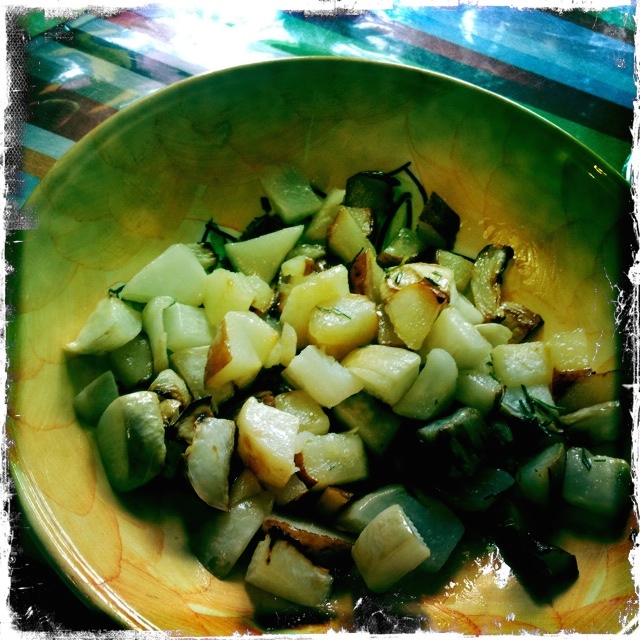
Roasted turnips and pears with rosemary honey drizzle

The colder weather brings us turnips, parsnips and swedes but they’re a tricky bunch to convince kids to eat… Unless they’re swaddled in buttery honeyed goodness! Serve this with roast pork.

Fresh from the garden: turnips, pears, rosemary
Recipe source: adapted from a recipe by Susie Middleton in Fast, Fresh & Green (seen on marthastewart.com)
Serves: 4 as a side dish or 24 tastes

ourkitchengarden.net

Equipment:

  • Large rimmed baking tray
  • Baking paper
  • Paper towel
  • Chopping boards and knives
  • Mixing bowls
  • Spatula
  • Mezzaluna
  • Scales
  • Measures: ¼ cup, tablespoon, teaspoon
  • Small saucepan
  • Serving bowls
Ingredients:

  • 4 medium purple-topped turnips
  • 2 firm ripe Bosc pears
  • 2 tablespoons olive oil
  • 1½ teaspoons coarse salt
  • 25g unsalted butter
  • 1 tablespoon honey
  • 1 sprig fresh rosemary


What to do:

  • Preheat oven to 220C. Line a large rimmed baking sheet with baking paper and set aside.
  • Scrub the turnips under running water and wipe dry. Without peeling, chop them into 2cm cubes by cutting into slices first, then rods, then cubes.
  • Wash and dry the pears and prepare in the same way as the turnips, discarding the cores.
  • In a large bowl, toss together turnips and pears with oil and salt until well combined. Place in an even layer on prepared baking sheet.
  • Transfer to oven and roast, turning with a spatula once or twice during cooking, until browned and turnips are easily pierced with a paring knife, 25 to 30 minutes, rotating baking sheet halfway through baking.
  • Meanwhile, wash the rosemary sprig and wipe dry with paper towel. Strip the needles from the stalk and finely chop using the mezzaluna. We will need about a tablespoon’s worth.
  • Melt the butter in a small saucepan over medium heat. Add honey and rosemary; let simmer for a few seconds and remove from heat.
  • Transfer turnips and pears to serving bowls and drizzle with butter mixture. Toss to combine and serve.

Notes: What other classic fruit and vegetable combinations can you think of? What does a turnip smell like?


Categories: Kitchen Garden, Recipe | Tags: , , , , , , , , | 2 Comments

Poached egg salad with peas and basil mayo

We love making mayonnaise at Bondi and always talk about the difference in flavour from the ready-bought stuff! This salad is wonderful – creamy from the mayo and egg yolk but also tangy from the dressed lettuce – and it’s so worth fetching some fresh peas to pod as they really pop in your mouth!

ourkitchengarden.net

Fresh from the garden: lettuce, eggs, peas, basil, salad burnet, lemon, garlic
Recipe source: Melissa
Serves: 4 at home or 24 tastes

Equipment:

  • Small saucepan
  • Colander
  • Medium high-sided frying pan
  • Bowls – 3 large, at least 4 small
  • Salad spinner
  • Paper towel & tea towel
  • Citrus juicer
  • Chopping boards and knives, scissors
  • Measures: tablespoon, teaspoon, ½ teaspoon
  • Stick blender & its cup
  • Measuring jug, fork
  • Slotted spoon
  • Serving plates


Ingredients:

  • A handful of fresh peas in the shell
  • 4 eggs
  • 2 large handfuls of lettuce
  • A handful salad burnet

For the basil mayonnaise:

  • A small branch of basil leaves
  • 1 egg
  • ½ teaspoon salt
  • 1 small clove garlic
  • 1 level teaspoon mustard powder
  • 120ml rice bran oil
  • 25ml olive oil
  • 1 teaspoon white wine vinegar
  • 1 lemon
  • Freshly milled black pepper

What to do:

For the salad:

  • Fill the small saucepan up with water and set it to boil. Pod the peas and have ready a big bowl of cold water. When the water is boiling, add the podded peas and cook for 3 minutes. Drain and refresh in the bowl of cold water. Drain and reserve.
  • Separate out the lettuce leaves over the sink and rinse under the tap.Fill up a big bowl with cold water & wash the iceberg leaves in several changes of water, looking for any dirt in the bottom of the bowl. Spin dry in small batches.
  • Lay out the tea towel and line it with kitchen paper. Spread the salad leaves over the paper and roll the whole lot up like a log. Keep the rolled parcel of leaves in the fridge until needed.
  • Wash and spin dry the burnet and strip off the leaves, discarding the stalks. Wrap them carefully in paper towel and keep them in the fridge with the lettuce.

For the mayonnaise:

  • Wash, spin dry and separate off the basil leaves and discard the stalks into the compost.
  • Cut the lemon in half and squeeze one half to yield ½ teaspoon lemon juice. Peel the garlic clove and finely slice.
  • Now break the egg into the cup of the stock blender, add the salt, garlic, mustard powder and a few twists of freshly milled black pepper, thenblitz to blend these together.
  • Now measure the oils into the jug, mix well with a fork and ask a helper to pour it in a thin trickle into the cup whilst it’s blending. When all the oil is in, add the vinegar, lemon juice and basil leaves, then blend again until the leaves are quite finely chopped.

To poach the eggs:

  • Fill a medium-sized frying pan with water to a depth of approximately 5cm, heat it up to the boil, then lower the heat it to a bare simmer.
  • Then break the 4 eggs into the four separate small bowls taking care not to break the yolks and removing any shell with your fingertips. Then lower them, one at a time, into the simmering water and let them cook together, uncovered, for 4 minutes. Fill a large bowl with cold water.
  • Then, use the slotted spoon to lift them from the water and transfer them to the bowl of cold water, until you are ready to use them.

To serve:

  • Bring the lettuce out of the fridge, gently slice up the leaves if needed and put into a big mixing bowl. Drizzle a teaspoon each of olive oil and white wine vinegar over the leaves with a pinch of salt and grind of pepper, and turn gently to combine.
  • Arrange the leaves on each serving plate.
  • Holding a clean tea towel in one hand, scoop up an egg with the slotted spoon and carefully drain of water. Arrange a poached egg in the centre of each salad plate, drizzle some of the mayonnaise over the top of each salad, followed by a sprinkle of the peas and then the salad burnet leaves.
  • Serve.

Notes:Why do we add a trickle of oil at first into the egg mixture of the mayonnaise? Why shouldn’t we break the eggs when poaching them? What is salad burnet and what does it smell like?

Categories: Kitchen Garden, Recipe | Tags: , , , , , , , , | Leave a comment

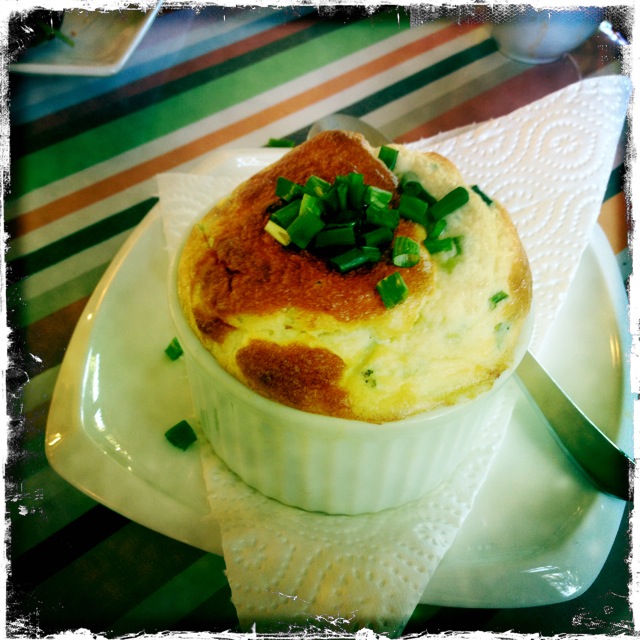
Cheese and spring onion souffles

This classic comfort food recipe has appeared on this blog in a slightly different version of two cheeses souffle – but this version with spring onions has gone down a treat, even if we do say so ourselves…

Fresh from the garden: eggs, spring onion
Recipe source: adapted from a recipe on bbcgoodfood.com
Serves: 5 at home or 25 tastes

ourkitchengarden.net

Equipment:

  • 5 x 250ml ramekins or soufflé dishes
  • Baking paper & string
  • Scissors
  • Baking tray
  • Scales
  • Paper towel, pot holders
  • Bowls – 1 large, 5 small
  • Saucepan
  • Wooden spoon
  • Measuring jug
  • Stand mixer and bowl
  • Metal spoon
  • 4 under-plates to serve
Ingredients:

  • 25g butter plus extra to grease the ramekins
  • 100g feta cheese
  • 100g parmesan
  • 2 or 3 spring onions
  • 5 eggs
  • 25g flour
  • 250ml milk
  • Flaked salt & black pepper

What to do:

  • Heat the oven to 200C. Butter the ramekins.
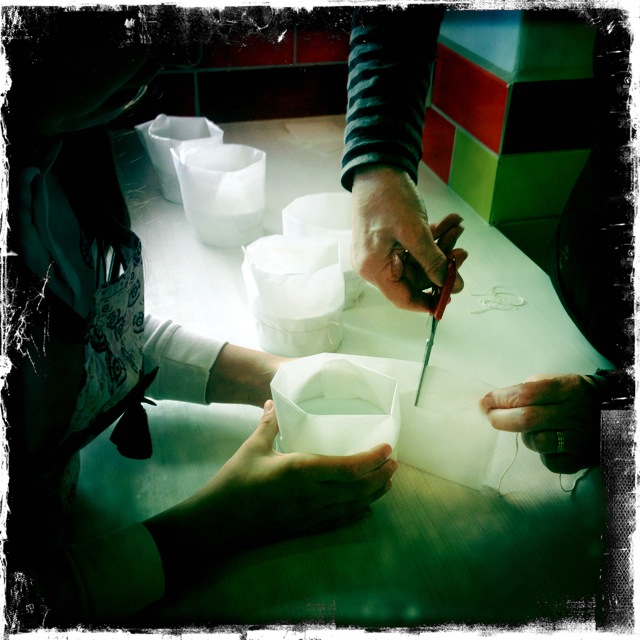
  • Make a collar for each ramekin by tearing a 40cm length of baking paper, folding it into thirds, and buttering one side. Then roll it around the ramekin, buttered side in, and tying with string to secure. Place them on the baking tray when done.
  • Measure the parmesan, then grate it. Crumble the feta cheese.
  • Wash the spring onions and pat dry with paper towel. Strip off the tough outer layer and trim the roots and tops. Finely chop them into thin discs to yield about 2 tablespoons.
  • Carefully separate each of the eggs, putting the whites into the very clean and dry bowl of the stand mixer, and reserving the yolks in a small bowl.
  • Melt 25g butter in the saucepan, stir in the flour and gently cook on a low heat for a minute or so. Slowly add the milk, stirring all the time to make a thick sauce. Cook for a couple of minutes to cook out the flour.
  • Stir in the cheeses and spring onions then add 4 of the egg yolks, season generously and mix well.
  • Whisk the egg whites until they are stiff and form soft peaks.
  • Using a metal spoon, start folding the egg whites into the cheese mixture carefully – begin by using about 1/3 of the whites first and then adding the rest once combined – and pour into the buttered soufflé dishes.
  • Cook for 12–15 minutes until the soufflés are risen and golden.
  • Using pot holders, carefully place a soufflé on to an lined underplate and serve TOUT SUITE!

Notes: What is a ramekin? Why do we separate the egg yolks and whites? Why do we need to cook out the flour? Where does the word soufflé come from?

ourkitchengarden.net

Categories: Kitchen Garden, Recipe | Tags: , , , , , , , , , | Leave a comment

Ava’s orange Anzacs

My daughter Ava has been ‘helping’ me in the kitchen since she was 3, and especially loves rolling biscuits. She tries to hide under the table to eat the raw mixture, but I see through her tricks!

Fresh from the garden: oranges
Recipe source: Melissa. And Ava!
Makes: about 30 biscuits

ourkitchengarden.net

Equipment:

  • Bowls – big, small
  • Measures – cup, tablespoon, ½ teaspoon
  • Sieve
  • Microplane zester
  • Large spoon x 2
  • Small saucepan
  • Scales
  • Eggcup
  • Spatula
  • Teaspoons
  • Kettle
  • 2 baking trays & baking paper
Ingredients:

  • 1 cup plain flour
  • ¾ cup desiccated coconut
  • 1 cup rolled oats
  • 1 cup raw sugar
  • 1 orange
  • 125g butter
  • 2 tablespoons golden syrup
  • ½ teaspoon bicarbonate of soda
  • 1 tablespoon boiling water


What to do:

  • Preheat oven to 150°C. Line the baking trays with the baking paper.
  • Sift the flour into the large bowl. Add the coconut, oats and sugar and stir to combine.
  • Finely zest the orange and add the zest to the mixture. Stir until well combined.
  • In the small saucepan, melt the butter and golden syrup over a gentle heat until liquid.
  • Measure the bicarb soda into the eggcup and mix in the boiling water.Add it to the saucepan of melted butter mixture, stirring and then scrape this into the dry ingredients.
  • Take a teaspoonful of mixture at a time and with your hands, roll into even small balls. Place these in even lines on the baking trays, allowing room to spread.
  • Cook for about 15 minutes, until lovely and golden.
  • Allow to cool on the trays and then eat!

Notes: Why are these called ‘Anzac’ biscuits? What does the bicarb soda do? Why is it important to roll the balls into similar sizes?


Categories: Kitchen Garden, Recipe | Tags: , , , , , , , | Leave a comment

Create a free website or blog at WordPress.com.