Monthly Archives: August 2012

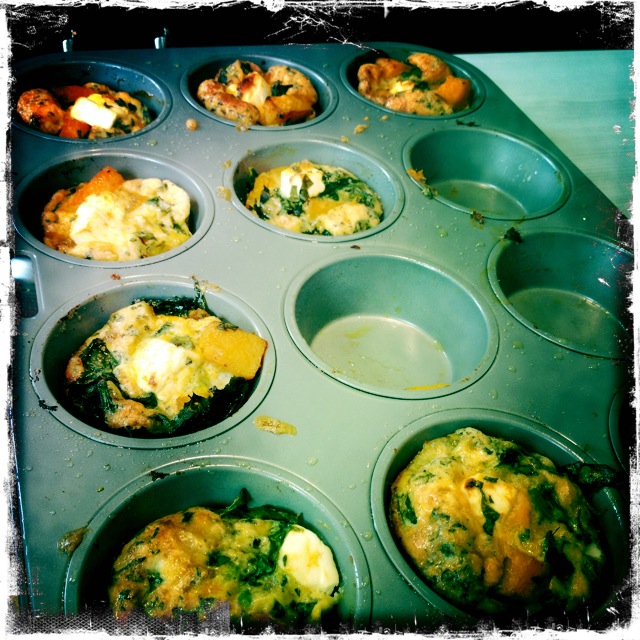
Spinach, feta and pumpkin frittate

Fresh from the garden: eggs, spinach, pumpkin, marjoram, thyme

Recipe source: adapted from a recipe by Gordon Ramsay ………………………………………………………………………………………………………………………………………

The original recipe calls for sweet potato instead of pumpkin: I think either works well. Gordon also suggests cooking in one big pan over heat and then finishing under the grill, but we pour ours into muffin pans to oven-bake… we also add some of our lovely Bondi herbs for an aromatic twist.
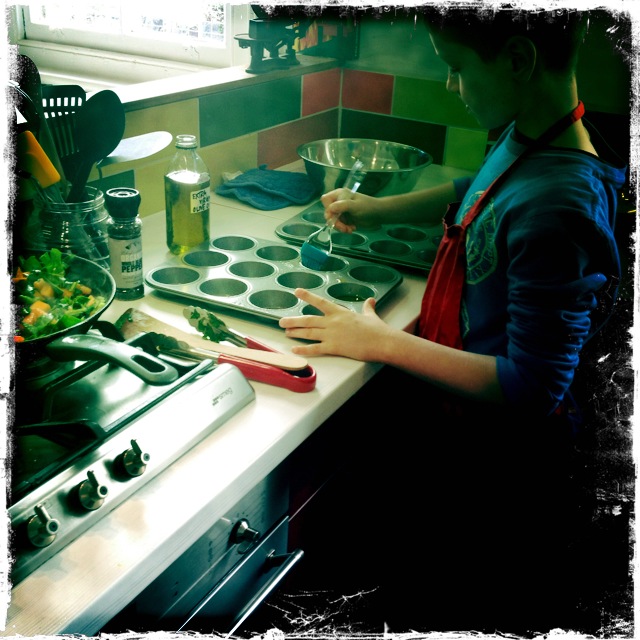
Equipment:

  • Metal spoon
  • Chopping board & knives
  • Paper towel
  • Large frying pan
  • Wooden spoon
  • Large bowl
  • Tongs, whisk
  • Cupcake tins: 1 x 12-hole large or 1 x 24-hole mini
Ingredients:

  • 300g pumpkin
  • A large handful of spinach
  • Small handful marjoram and thyme sprigs
  • 3-4 tablespoons olive oil
  • Flaked salt and freshly ground black pepper
  • 200g sheep’s feta
  • 20g parmesan
  • 10 large eggs

What to do:

  • Preheat the oven to 180C.
  • Wash the pumpkin & scrape out the seeds, reserving for the chooks.
  • Wash the spinach and shake dry. Cut off the stalks and chop the leaves into 1cm strips, to yield about 150g cut strips.
  • Wash the herbs and pat dry with paper towel. Strip the leaves from the stalks & reserve.
  • Carefully cut the peel from the pumpkin if needed, and then chop flesh evenly into 1cm cubes.
  • Heat the frying pan with the oil and toss in the pumpkin. Season well with salt and pepper. Cook, turning occasionally, for about 4 minutes over medium heat until the potatoes are just tender and lightly golden at the sides.
  • Meanwhile, cut the feta into small cubes and grate the parmesan.
  • Stir the spinach into the pumpkin and cook for 2 minutes until wilted.
  • Then add the cubed feta and gently stir to mix in.
  • In the large bowl, lightly beat the eggs with the herbs, parmesan, a pinch of salt and a grind of pepper.
  • Divide the pumpkin mixture evenly into the cupcake holes, spoon the egg mixture over and bake in the oven: 15 minutes for the mini frittate and 20 minutes for the large.

Notes: Why is the name of this recipe frittate, ending in e? What other vegetables could you use in the recipe? What other animal’s milk makes feta?
Categories: Kitchen Garden, Recipe, School Holiday Program | Tags: , , , , , , , , , , | Leave a comment

Rhubarb and mint muffins

Fresh from the garden: eggs, rhubarb, mint

Recipe source: Melissa

………………………………………………………………………………………………………………………………………………

These are super-easy to whip up and delicious warm from the oven! You can substitute any berries and we love the herby addition of English or chocolate mint.

Equipment:

  • 12-hole muffin tin
  • Paper muffin cases
  • Bowls – large, medium
  • Colander
  • Chopping board and small knife
  • Measures – cup, ½ cup, 1/3 cup
  • Stand mixer & bowl
  • Whisk
  • Spatula
  • Skewer
  • Serving plates
Ingredients:

  • 2 eggs
  • 1/3 cup vegetable oil
  • 2 cups self-raising flour
  • ½ cup caster sugar
  • 1 cup yoghurt
  • 1 large or several small stalks of rhubarb
  • A sprig of mint


What to do:

  • Preheat the oven to 180C.
  • Line the muffin tin with the muffin cases.
  • Wash the rhubarb stalk, then drain it into the colander. Chop all the leaves off and discard into the compost. Peel off any stringy fibres and then cut into very thin slices to yield one cup.
  • Wash the mint and strip off the leaves, discarding the stem. Chop the leaves finely.
  • Measure out the flour and sugar into the bowl of the stand mixer and turn on for a minute to mix.
  • Whisk the eggs in the medium bowl and then add with the yoghurt and oil to the mixer and mix again until well combined.
  • Remove the bowl from the stand and using the spatula, gently fold through the sliced rhubarb and chopped mint.
  • Spoon into the muffin cases evenly.
  • Carefully slide into the oven and bake for 20 minutes until a skewer inserted into the middle of the muffin comes out clean.
  • Divide among serving plates and eat!

Notes: Why is it so important to remove all the rhubarb leaves? Why do we strip off the fibres? Why should the skewer come out clean when the muffins are cooked?

Categories: Kitchen Garden, Recipe, School Holiday Program | Tags: , , , , , | Leave a comment

Our winter salad

Fresh from the garden: Salad leaves, rocket, edible flowers, lemon, parsley, marjoram, thyme, coriander, oregano

Recipe source: Melissa ………………………………………………………………………………………………………………………………………

This is a lovely salad to pair with heavily flavoured dishes and is easy and quick to assemble.

Equipment:

  • Bowls – 2 large
  • 2 salad spinners
  • Tea towel
  • Kitchen paper
  • Chopping board & knife
  • Mortar & pestle
  • Measure – 1/3 cup
  • Citrus juicer
  • Mezzaluna, teaspoon
  • Serving bowls, little tongs


Ingredients:

  • A large handful salad leaves
  • A few garnishing flowers

Herby vinaigrette dressing

  • 1 small garlic clove
    • Flaked salt & black pepper
    • 1 lemon
    • 1/3 cup extra virgin olive oil
    • A small handful mixed herbs: parsley, marjoram, thyme, coriander, oregano

What to do:

  • Fill up the 2 big bowls with cold water & wash the salad leaves, gently dunking them a handful at a time into the water, then pulling out to see if any dirt is left behind. Repeat in fresh water until no dirt remains. Spin the leaves dry and then wipe the bowls dry.
  • Wash the flowers separately and drain on a piece of paper towel. Keep the flowers reserved, picking off the petals to use.
  • Wash and spin dry the herbs, and pick off the leaves.
  • Lay out the tea towel and line it with kitchen paper. Spread the salad leaves over the paper and roll the whole lot up like a log. Keep the rolled parcel of leaves in the fridge until needed.

To make the dressing:

  • Peel the garlic clove and put it in the mortar with a large pinch of salt. Pound to a paste.
  • Juice the lemon and add the juice to the mortar (without the pips) then stir the lot with the teaspoon and scrape it into a large bowl.
  • Stir in the olive oil and grind a little pepper, then whisk the dressing lightly. Add the herbs, chopping any large leaves in the mezzaluna if needed. Add to the dressing in the large bowl.

To assemble:

  • Unwrap the parcel of salad leaves & tip them into the bowl with the flower petals, herbs and the dressing. Gently turn the leaves in the dressing using your hands or tongs.
  • Transfer the salad to the serving bowls and serve immediately with little tongs.

Notes: What is the correct way to wash the leaves?Why do we completely dry the leaves before adding the dressing? What else could you add to the salad?

Categories: Kitchen Garden, Recipe, School Holiday Program | Tags: , , , , , , , | Leave a comment

Pizza with rocket, bocconcini and garden herbs

Fresh from the garden: rocket, thyme, oregano, marjoram, sage, parsley

 Recipe source: adapted from a recipe by Stephanie Alexander in ‘Kitchen Garden Cooking With Kids’ ………………………………………………………………………………………………………………………………………

Equipment:

For the pizza dough:

  • Bowls – 1 small, 1 large
  • Fork
  • Scales
  • Measures: teaspoon, tablespoon, cup
  • Stand mixer with dough hook
  • Pastry brush

For the pizza topping:

  • Chopping board
  • A large knife
  • Medium frying pan
  • Wooden spoon
  • Kitchen towel
  • Large bowl
  • Tongs
  • A metal spoon
  • A large oven tray
  • A large board for cutting pizza
  • Pizza cutter
  • Serving plates


Ingredients:

For the pizza dough:

  • 1/2 cup lukewarm water
  • 2 teaspoons instant dry yeast
  • 1/2 teaspoon sugar
  • 2 teaspoons extra virgin olive oil, plus extra for greasing the bowl
  • 200g plain flour, plus extra for flouring
    • 1 teaspoon salt

For the pizza topping:

  • 1 tub bocconcini
  • 1 large red onion
  • 2 tablespoons extra-virgin olive oil
  • 50g parmesan
  • A large handful rocket

Tomato sauce:

  • ¼ cup extra-virgin olive oil
  • 1 brown onion
  • 3 garlic cloves
  • A few sprigs thyme, sage, oregano, marjoram, parsley
  • 1 can chopped tomatoes
  • Flaked salt and black pepper

What to do:

To make the dough:

  • Place the water, yeast and sugar in the small bowl. Mix with the fork and leave for 5–10 minutes until the mixture looks frothy.
  • Add the 2 teaspoons of oil to the yeast mixture and mix well.
  • Place the flour and salt and yeast mixture in the bowl of the stand mixer and beat for at least 8 minutes, until the dough looks smooth.
  • Brush the inside of a large bowl with a little of the extra virgin olive oil, using the pastry brush.
  • Turn the pizza dough into the oiled bowl. Cover with a clean, dry tea towel and put in a draught-free place until the dough has doubled in size. This process, which is called ‘proving’, will take at least 1 hour.

What to do:

  • Tip the risen dough onto the workbench and knead briefly, then shape it into a round ball and return it to the bowl.
  • Cover the bowl with the tea towel and leave again, this time for at least 20 minutes.
  • Preheat the oven to 220°C. You can prepare the topping now while you wait for the oven to heat up.

For the tomato sauce:

  • Wash, dry and pick the leaves from the herbs.
  • Peel and finely chop the onion and garlic.
  • Heat most of the olive oil in the frying pan & gently cook the onion and garlic until translucent but not brown.
  • Open the tin of tomato and add to the frying pan with a pinch of salt, a grind of pepper and the herbs.
  • Simmer gently for 10 minutes, stirring occasionally, until it has reduced with minimal liquid.

For the topping: 

  • Peel the red onion, cut in half and finely slice into rings.
  • Open the tub of bocconcini and cut or tear each ball into 3 or 4 pieces.
  • Grate the parmesan.
  • Wash and spin the rocket dry. Leaving small leaves whole, chop large leaves into ribbons.

Assembling the pizza:

  • Scatter some flour on the workbench and roll to form a thin rectangle to fit the large baking tray.
  • Assemble the pizza directly onto the tray, flouring the tray first.
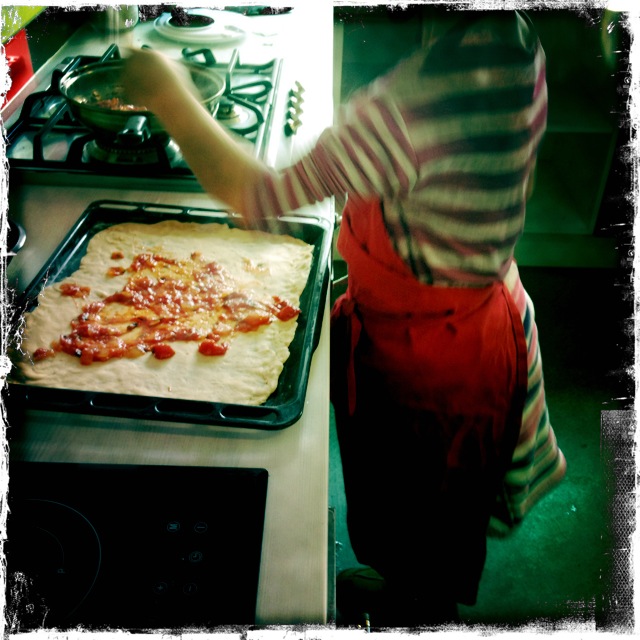
  • Using the metal spoon, swirl a couple of spoonfuls of tomato sauce onto the pizza base, spreading so that it becomes totally covered.
  • Layer on the onion slices and then dab the bocconcini on top. Drizzle a little olive oil on, season well and slide it into the oven.

Baking the pizza:

  • Bake the pizza for 15 minutes or until the edges are very crusty and the cheese is bubbling.
  • Once the pizza is done, transfer it to a clean wooden chopping board using the wide egg lifter.
  • Cut the pizza crossways into small squares, and lift onto serving plates.
  • Sprinkle the grated parmesan onto the pizza and then add the rocket. Serve!

Notes: Where does pizza come from? What other sort of vegetables could you use in a pizza? What sort of other pizza could we make? What is pizza bianca?


Categories: Kitchen Garden, Recipe, School Holiday Program | Tags: , , , , , | Leave a comment

Linguine with cavolo nero and herb sauce

LINGUINE WITH CAVOLO NERO AND HERB SAUCE

Fresh from the garden: cavolo nero, coriander, thyme, marjoram, oregano

Recipe source: Melissa ………………………………………………………………………………………………………………………………………………

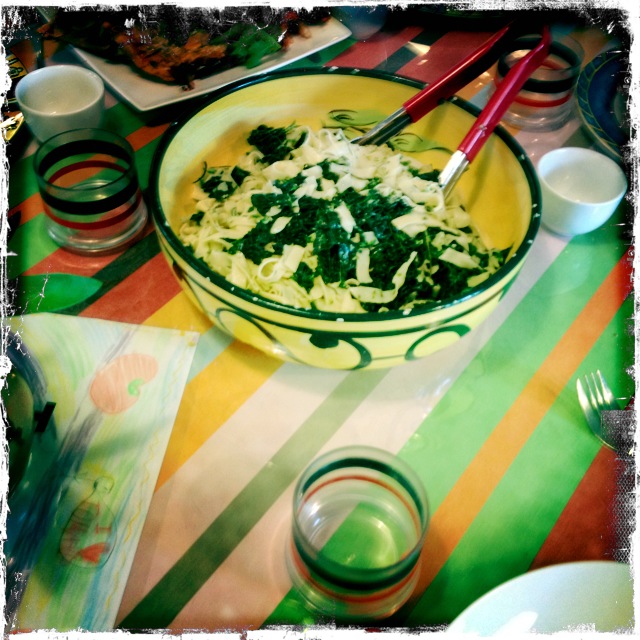
This is a delicious accompaniment to our freshly-rolled pasta! We use the prehistoric-looking cavolo nero (also known as Tuscan kale) but you can also use silverbeet or spinach just as well…

Equipment:

  • Large stockpot with draining insert
  • Chopping board
  • Large & small knife
  • Salad spinner
  • Wooden spoon
  • 2 large bowls
  • Scales
  • Medium saucepan
  • Tongs
  • Serving bowls
Ingredients:

  • 500g linguine
  • 225g unsalted butter
  • 8 garlic cloves
  • A large handful of cavolo nero leaves
  • A small bunch of coriander
  • 4 sprigs of thyme
  • 4 sprigs marjoram
  • 4 sprigs oregano
  • Small bunch parsley
  • Flaked salt & black pepper

What to do:

  • Fill the large stockpot with water and heat on high.
  • Wash the cavolo nero leaves and shake dry. Strip off the leaves, discarding the stems, and cut into ribbons 1cm wide.
  • Wash & spin dry the herbs, then pick the leaves if needed, discarding the woody stems.
  • Finely chop the herbs.
  • Finely chop the garlic.
  • Chop up the butter into cubes and melt the in the saucepan over a medium heat.
  • Stir in the garlic and cook gently for a couple of minutes.
  • Stir in the herbs.
  • When the water in the large stockpot is boiling add the pasta & cooking salt, stir, put the lid back on and when boiling again cook for 2 or 3 minutes until ‘al dente’.
  • Drain the pasta and transfer to back into the stockpot.
  • Add the butter mixture to the stockpot and toss carefully.
  • Season with salt and pepper to taste and serve into bowls.

Notes: What does al dente mean? Why do we pick the leaves from the herbs? What does cavolo nero actually mean?

Categories: Kitchen Garden, Recipe, School Holiday Program | Tags: , , , , , , , , , , , , , , | Leave a comment

Basic linguine recipe

BASIC LINGUINE RECIPE

Fresh from the garden: eggs

Recipe source: adapted from a recipe by Stephanie Alexander in ‘Kitchen Garden Cooking With Kids’

………………………………………………………………………………………………………………………………………………

Our Kitchen Garden students love making pasta! This recipe is just for the dough mixture and you can add whatever sauce you want…

Equipment:

  • Pasta machine
  • Scales
  • Measures – teaspoon, ½ teaspoon
  • Food processor
  • Plastic film
  • Large knife
  • Pastry brush
Ingredients:For the dough:

  • 500g ‘00’ plain flour
  • 5 free-range eggs
  • Cooking salt

What to do:

  • Weigh the flour, then combine it with 1½ teaspoons of salt in the bowl of the food processor. With the motor running, add the eggs. Process for a few minutes until the dough clings together and feels quite springy.
  • Tip the dough onto a clean, dry workbench. Knead the dough for a few minutes, then wrap it in plastic film and let it rest for at least 1 hour at room temperature.

____________________________________________________________________

  • Get an adult to help fix the pasta machine to a suitable bench. Screw the clamp very tightly.
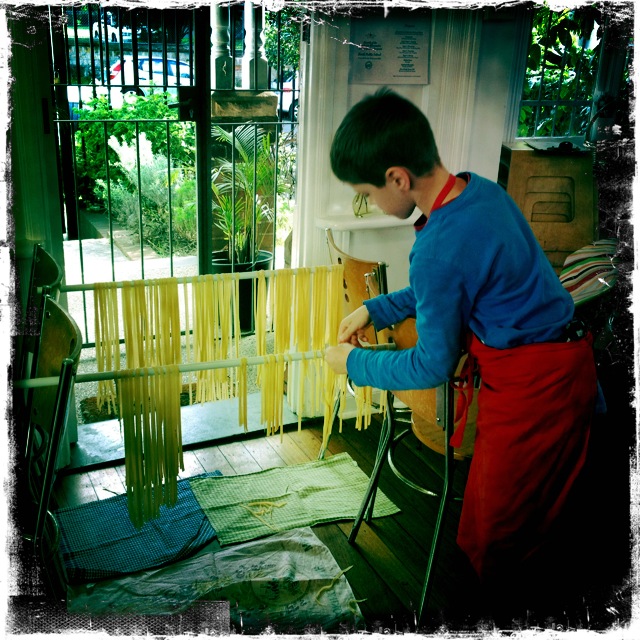
  • Set up your pasta hanging poles, ideally between 2 chairs.
  • Clear a large space on the workbench alongside the pasta machine. All surfaces must be clean and dry. Press the dough into a rectangle about 8 cm wide.
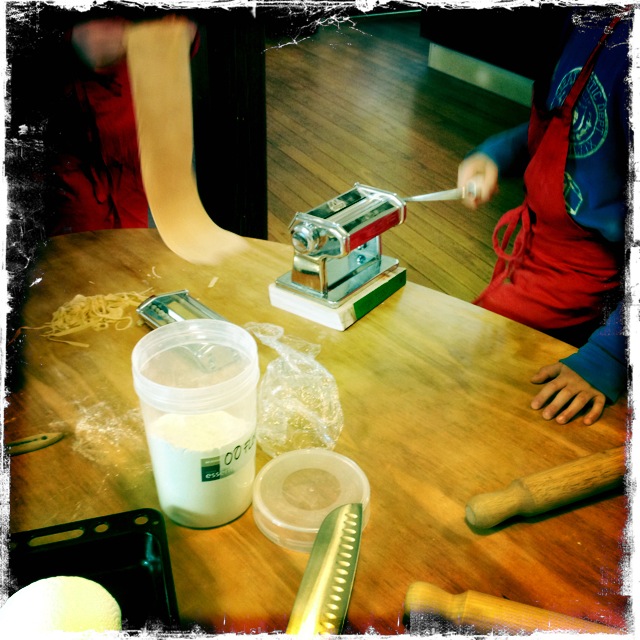
  • Set the rollers on the pasta machine to the widest setting and pass the dough through. The dough will probably look quite ragged at this stage. Fold it in 3, turn it 90 degrees and roll it through again. Go to the next-thickest setting and pass the dough through 3-4 times.
  • Continue in this manner (changing the settings and passing the dough through) until the dough has passed through the second thinnest setting. Don’t use the very thinnest setting, as the dough gets too fine and is hard to manage. If the dough gets too long to handle comfortably, cut it into 2-3 pieces using the large knife, and roll each piece separately.
  • Fix the cutter attachment to the machine and carefully roll the pasta strips into the larger strips for linguine, gently catching them as the come through.
  • Drape the linguine over the hanging poles to dry while you make your sauce.
  • Clean the pasta machine by brushing it down with a dry pastry brush and clear and clean the table.

Notes: Never wash the pasta machine – it will rust! Just brush down with a strong brush to remove the leftover dough.

Categories: Kitchen Garden, Recipe, School Holiday Program | Tags: , , , , , , , | Leave a comment

School holiday program July 2012

We  all had such a fab time in this first kitchen garden school holiday program! The children were so keen, so well-behaved, and SO helpful!

SCHOOL HOLIDAY PROGRAM MENU

Introduction – Knife Licences – Chook care

MORNING TEA

Pumpkin, spinach & feta frittate – Rhubarb & mint muffins – Lemongrass tisane

 Garden walk – Harvesting

 LUNCH

Linguine with cavolo nero and herb sauce – Pizza with rocket, bocconcini and garden herbs – Our winter salad

Seeds – Composting – Sustainability

Watch & Grow Project

And these are some of the things they did during the day-long program:

  • Earned their knife licences by displaying ‘bear paw’ & ‘spider crab’ hand positions and understanding how to behave around knives, and also how to carry, hold and clean them;
  • Followed recipes from beginning to end and understood all the procedures;
  • Made pizza and pasta dough from scratch;
  • Tended to the chooks;
  • Explored their five senses with the garden walk-around and herb identification;
  • Pounded the mortar & pestle, whizzed the stand mixer, sliced the mezzaluna, wheeled the pizza cutter;
  • Sautéed, boiled, fried, baked, stirred, tossed, spooned, grated, melted, brushed, rolled, proved, weighed, measured, chopped, sliced, diced, beat, whisked, juiced, folded, and more;
  • Cleared as they went, washed up, dried up, set the cutlery, the glasses, the water jugs… and ate! And then cleared the tables and swept up;
  • Reinforced the belief to live sustainable lives: that is to try and remember to re-use, recycle or renew when possible;
  • Learnt about compost ‘lasagne’;
  • Understood the importance of seasonal and local produce;
  • And worked fabulously as a team, displaying focus and willingness to help!

We hope to see all the children again,and to welcome heaps more in the next holidays… and look out for all the recipes in the next few posts!

Categories: Kitchen Garden, School Holiday Program | Tags: , , , , , , , , , , , | Leave a comment

Create a free website or blog at WordPress.com.