Author Archives: melhm

Lavender honey cakes

These little cakes are so delicious (and veeeeery buttery…) and a fun way of using the aromatic little flowers! Take a moment to smell the lavender sugar…

ourkitchengarden.net

Fresh from the garden: lavender, eggs
Recipe source: adapted from our book, A Year in the Kitchen Garden
Makes: 12 cupcakes

Equipment:

  • 12 hole cupcake tin
  • Paper cupcake cases
  • Stick blender & cup & bowl
  • Large metal spoon
  • Stand mixer
  • Whisk, sifter, tongs
  • Scales
  • Chopping board & knife
  • Bowls – large, med, small
  • Measuring – cup, ½ cup, ¼ cup
  • Wire rack
  • Skewer
  • Serving plates
Ingredients:

  • 2 fresh stalks of lavender flowers plus extra to garnish
  • ½ cup caster sugar
  • 250g unsalted butter, at room temperature
  • ¼ cup honey
  • 3 eggs
  • 1½ cups self raising flour
  • ¾ cup buttermilk or plain yoghurt

TO FINISH:

  • 1 tablespoon icing sugar
  • Lavender flowers
  • Thick cream if desired

What to do:

  • Preheat the oven to 180°C.
  • Grease the cupcake moulds with a little butter or simply drop a paper case in if you have them.
  • Snip the lavender flowers from the stalks. Wash and carefully dry the flowers. Measure the sugar into the bowl of the stick blender, add 2 of the lavender flowers and blend together. Transfer the mixture to the stand mixer.
  • Beat the lavender sugar, butter and honey in the stand mixer until light and creamy. Add eggs, one at a time, beating well after each addition. (The mixture might look a little curdled at this point but no matter!)
  • Measure the flour and then pour into the sifter. Sift the flour into the mixture. Using a large metal spoon, gently fold the flour and buttermilk or yoghurt into mixture.
  • Spoon into prepared baking pan and smooth top. Bake for 20 minutes until a skewer inserted comes out clean.
  • Stand for 5 minutes before turning cake out onto a wire rack.
  • When cool, divide among serving plates. Measure out the icing sugar into the sifter and dust the cakes, sprinkling on the extra flowers too.
  • Serve each plate of cakes with a little bowl of thick cream if you want.

Notes:What else can you make with lavender? What is buttermilk? Why do we gently fold the flour and buttermilk in to the batter?

Categories: Kitchen Garden, Recipe | Leave a comment

Cornersmith’s winter bouillon

This recipe is a ‘sister recipe’ to the Cornersmith Salad. The aim of this recipe is to use up the excess vegetable parts – carrot tops, fennel tops, spinach stems, parsley stems etc. The recipe can be varied with the seasons by adding what you have on hand.

ourkitchengarden.net

Fresh from the garden: leeks, fennel, carrots, parsley, mint, coriander, onions
Recipe source: Alex and Jamie at Cornersmith Café, Marrickville
Makes: about 20 medium to large jars

Equipment:

  • Jars and lids
  • Large oven tray
  • Paper towel
  • Scales
  • Chopping boards& knives
  • Large bowls
  • Wooden spoons
  • Food processor
  • Funnel
Ingredients:

  • 1kg brown onion
  • 1kg leeks
  • 1kg fennel, including tops
  • 1kg Dutch carrots
  • 1kg celery
  • Carrot tops
  • 4 bunches parsley
  • 2 bunches mint
  • 2 bunches coriander
  • 200 sundried tomatoes
  • 2 heads garlic
  • 1kg fine cooking salt

What to do:

  • Preheat the oven to 140C.
  • Wash the jars and lids in hot soapy water, rinse well and drain upside down.
  • Place all the jars onto an oven tray, right side up, and slide into the oven to sterilize for 15 mins.
  • Dry lids with a clean piece of paper towel.
  • Wash (and scrub if needed) all the vegetables and herbs. Peel the onion & garlic, and carrots if needed.
  • Using the large knife, chop all ingredients into medium sized chunks.
  • In a large bowl, mix the ingredients thoroughly with the salt so it is mixed in evenly.
  • In batches if necessary, add the ingredients to the food processor.
  • Process into a thick paste.
  • Put the funnel into the top of the sterilized jars.
  • Fill the jars and seal tightly.

Notes:This is used as a replacement to stock: one or two teaspoons dissolved in 500ml boiling water. It can be added to stews and soups or any meals that need a boost of flavour.

Bouillon will last for 6 months unopened and stored in a cool dark place. Once opened,it will last for 3 months in the fridge.

Categories: Kitchen Garden, Recipe | Tags: , , , , , , , , , , | Leave a comment

Crispy asparagus with herby lemon aioli

Crunchy? Herby? Garlicky? Yup, ticks all the boxes… yum yum yum! Hooray for spring!

ourkitchengarden.net

Fresh from the garden: asparagus, lemon, eggs, herbs
Recipe source: adapted by Melissa from simplycratch.com
Serves: 6 or 24 tastes

Equipment:

  • Baking sheet, baking paper
  • Chopping board & knife
  • Grater &microplane zester
  • Bowls – large, med, small
  • Whisk, sifter, tongs
  • Measuring – jug, ½ cup, ¼ cup
  • Citrus juicer
  • Scales
  • Salad spinner
  • Stick blender & cup
  • Garlic press
  • Serving plates
Ingredients:

FOR THE ASPARAGUS:

  • 1 large bunch of asparagus
  • 2 eggs
  • 3/4 cup panko breadcrumbs
  • 1/4 cup plain flour
  • 30g parmesan
  • Flaked salt & black pepper

FOR THE AIOLI:

  • A small handful garden herbs
  • 1 whole egg
  • 2 egg yolks (left over from the asparagus)
  • 1 teaspoon Dijon mustard
  • 1 juicy lemon
  • 1 cup rice bran oil
  • 2 garlic cloves
  • Flaked salt & black pepper

What to do:

FOR THE ASPARAGUS:

  • For the asparagus:
  • Preheat oven to 220C. Line a baking sheet with baking paper.
  • Wash the asparagus and trim the woody ends into the compost. Slice the asparagus in half to make short stubs.
  • Finely grate the parmesan to yield about ¼ cup.
  • Separate the egg whites from the yolks into a medium bowl and gently whisk. (Reserve the yolks for the aioli).
  • In alarge bowl add the panko, sift the flour, the grated parmesan, a pinch of salt and pepper and stir.
  • Roll a few of the asparagus in the egg whites, drain off any excess and then roll in the panko mixture to coat. Place on the prepared baking sheet and repeat with all the asparagus.
  • Pop into the preheated oven and bake for 15-20 minutes turning the asparagus half way through, and continue to bake until the outside is lightly golden. Let cool for a few minutes before serving.

FOR THE AIOLI:

  • Zest the lemon and then cut it in half and juice the halves. You will need 50ml lemon juice in total.
  • Smash the garlic cloves, peel them and squeeze them through the garlic press.
  • Wash the herbs, spin them dry, strip them and finely chop.
  • Into the stick blender cup add the whole egg, the egg yolks, the mustard and only 20ml lemon juice. Whizz together until all is combined.
  • Measure the rice bran oil, then get a friend to help super-slowly stream in the oil into the egg mixture while you are whizzing(this takes a few minutes so don’t rush it).
  • To make this mayo into an aioli, slowly add in the remaining 30ml lemon juice, the zest, the pressed garlic, the chopped herbs and a good sprinkle of salt and pepper. Blend until smooth.
  • (For the best tasting mayo at home, store in an air-tight glass jar and refrigerate overnight.)

TO FINISH THE DISH:

  • Divide the asparagus among your serving plates, then drizzle a little pool of aioli onto each.
  • To eat: pick up an asparagus spear with your fingers, scoop up some aioli and eat!
Categories: Kitchen Garden, Recipe | Tags: , , , , , , , | Leave a comment

Cornersmith’s pickled beetroot

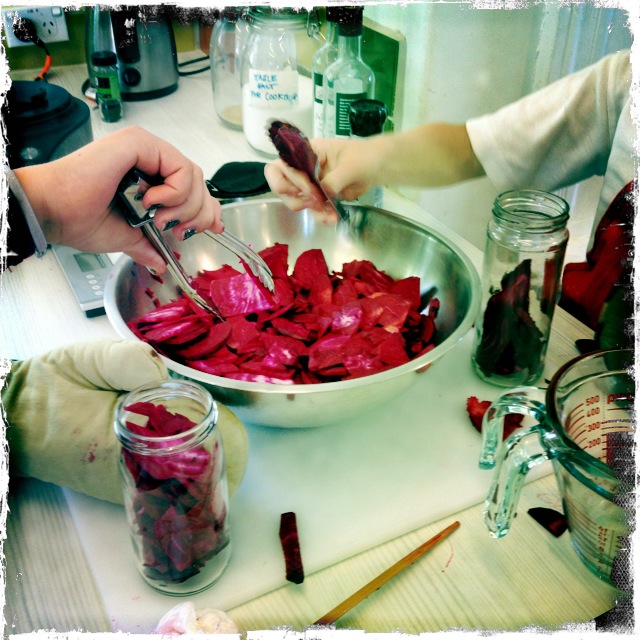
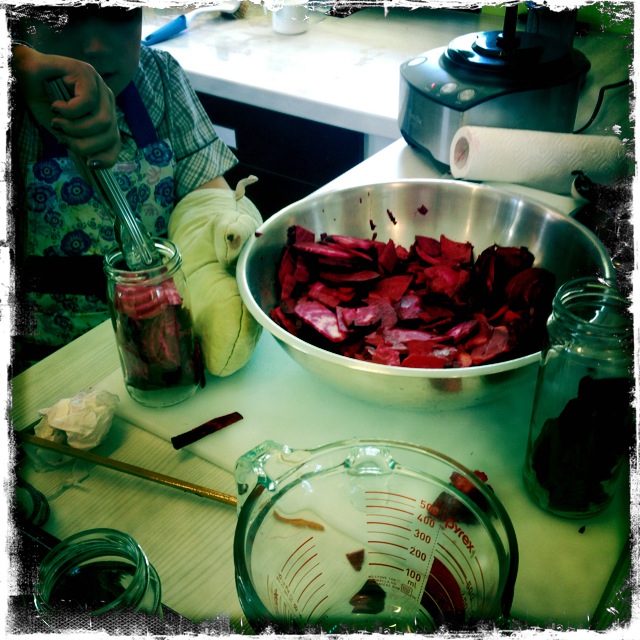
We pickled our own beetroot last week for the HalloweenFete… As long as your jars & lids are scrupulously clean and sterilised, the beautiful jars should last for ages! Not that our fete jars did however…

ourkitchengarden.net

Fresh from the garden: beetroot
Recipe source: Alex and Jamie at Cornersmith Café, Marrickville

Equipment:

  • Chopping boards and knives
  • Potato peelers
  • Food processor with vegetable blade attachment
  • Paper towel
  • Oven mitts
  • Large saucepan & wide pan
  • Tongs
  • Scales
  • Wooden spoon
  • Measures – cup, 1/4 cup, tablespoon
  • Glass jug for pouring
  • Jars and lids
  • Labels
Ingredients:

  • 3kg+ medium size beetroot
  • 1 litre white wine vinegar
  • 1 litre water
  • 1¾ cups raw sugar
  • ¼ cup salt
  • 2 tablespoons peppercorns
  • 2 tablespoons dried dill

 What to do:

  • Preheat the oven to 140C.
  • Wash the beets.  Trim off the leaves for another use.  Weigh the beetroot – you’ll need about 3kg. Peel the beets and add peels to compost.
  • Very thinly slice the beets using the blade attachment on the food processor.  (You could also use a large knife or a mandolin.)
  • Wash the jars and lids in hot soapy water, rinse well and drain upside down.
  • Place all the jars onto an oven tray, right side up, and slide into the oven to sterilize for 15 mins.
  • Dry lids with a clean piece of paper towel.
  • In a saucepan put vinegar, salt, water, sugar, peppercorns and dill. Gently heat until sugar is dissolved and then slowly bring to the boil.
  • Slide the tray of jars out of the oven and then carefully using tongs& an oven mitt, pack the sliced beets in.
  • Ladle the hot syrup into a glass jug and then pour over to cover beetroots. Leave a 5mm space at the top.
  • Seal immediately and leave to cool. Label when cool.
  • Leave to mature for at least a week.  The jars should be kept in a cool, dark place and will last at least 6 months if not a year!
  • Refrigerate after opening and eat within a month.

Notes:What other vegetables could we pickle? What other preserves could we make? Why do we sterilize the jars?

ourkitchengarden.net

Categories: Kitchen Garden, Recipe | Tags: , , , , , , , | 1 Comment

Wild rocket, broad bean, radish & Reggiano salad

This salad is a beautiful celebration of Spring, with lots of lovely contrasting textures and flavours.

ourkitchengarden.net

Fresh from the garden: wild rocket, lettuces, broad beans, radishes, marjoram, edible flowers
Recipe source: Melissa, kitchen specialist Bondi PS

Equipment:

  • Saucepan & lid
  • Bowls – 2 large, 2 med, 1 small
  • Colander
  • 2 salad spinners
  • Paper towel
  • Mandoline
  • Potato peeler
  • Measuring – 1/4 cup, tablespoon, teaspoon
  • A small jar with lid
  • Plates or bowls to serve
Ingredients:

  • 2 large handfuls of wild rocket
  • A handful lettuce leaves
  • 500g broad beans in pod
  • 4 radishes
  • 2 sprigs marjoram
  • 50g parmigiano-reggiano
  • 1 tablespoon red wine vinegar
  • A teaspoon of honey
  • 1/4 cup extra-virgin olive oil
  • Flaked salt & black pepper
  • Wild rocket or nasturtium flowers

What to do:

  • Fill the saucepan with water & set to boil on high heat.
  • Pod the broad beans, discarding the outer shell into the compost and add beans to the boiling water. Fill a large bowl with cold water and have ready.
  • Boil the broad beans for 3 minutes, drain and then immediately refresh in the bowl of cold water. Drain again and double-pod by slipping the outer shell off into the compost. Reserve beans.
  • Wash the rocket & lettuces really well and spin dry in sections, reserving in a large clean, dry bowl. Wash & dry the marjoram sprigs, picking the leaves and leaving whole.
  • Using the potato peeler, shave off thin slices of parmesan into the small bowl.
  • Scrub the radishes clean, wipe dry and using the mandoline or a peeler, carefully slice into thin discs.
  • For the dressing, measure the olive oil, red wine vinegar and honey and pour them into the jar. Add a sprinkle of salt and pepper, and then put the lid on & give the jar a good shake.
  • Drizzle the dressing around the large lettuce and rocket bowl and gently turn the leaves with your fingers.
  • Place the leaves in the serving bowls, scatter the broad beans and radish slices and then sprinkle over the marjoram leaves and parmesan shavings.
  • Finish by carefully placing the wild rocket flowers on top of the bowls of salad. Serve immediately!

Notes: Where does parmigiano-reggiano come from? Why do we use honey vinaigrette here instead of the lemony dressing? What do the wild rocket flowers taste like?

Categories: Kitchen Garden, Recipe | Tags: , , , , , , , | Leave a comment

Bruschetta with broad bean and parmesan mash

Broad beans are our veggie equivalent of blood oranges… Super-seasonal and only available at this time of year, so we just have to jump at the chance! We just love them and eat as many of them, and in as many ways as possible, in springtime!

ourkitchengarden.net

Fresh from the garden:broad beans, rocket, garlic, lemon thyme
Recipe source: Melissa, kitchen specialist at Bondi PS

Equipment:

  • Saucepan& lid
  • Bowls – big, med, small
  • Microplane zester & citrus juicer
  • Chopping board& bread knife
  • Measures – tablespoon
  • Scales
  • Grill trays
  • Colander
  • Mortar & pestle
  • Butter knife
  • Serving plates
Ingredients:

  • 1kg broad beans
  • Great sourdough bread (like Iggy’s)
  • 50g parmesan
  • 3 tablespoons E-V olive oil
  • A lemon
  • Cooking salt
  • Flaked salt & black pepper
  • 2 garlic cloves
  • 5 sprigs thyme

What to do:

  • Fill the saucepan with water & set to boil with the lid on. Heat the grill.
  • Slice the bread thickly and place on grill trays, ready for grilling.
  • Pod the broad beans into the medium bowl and put the outer shells into the compost.
  • Zest the lemon and then cut it in half and juice one half only.
  • Wash and dry the thyme and pick from stems, and finely chop.
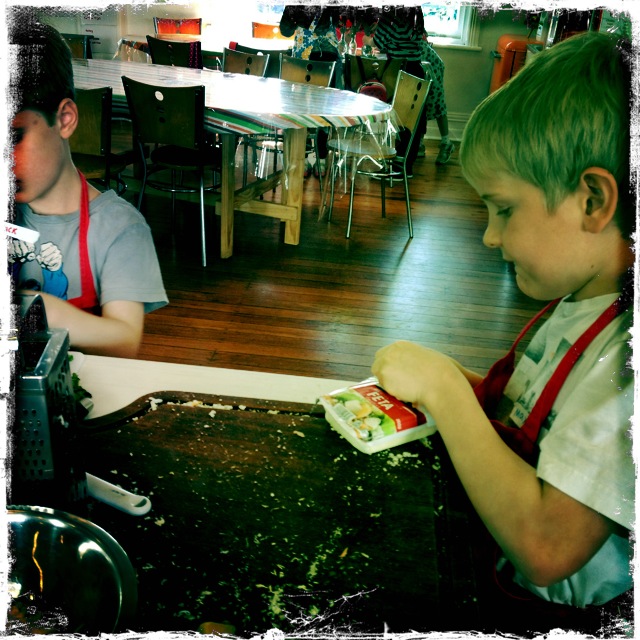
  • Grate the cheese into the small bowl.
  • When the water is boiling, drop all the broad beans in with a teaspoon of cooking salt. Put the lid back on to bring back to the boil quickly, and boil for 2 minutes. Fill the big bowl with cold water.
  • After 2 minutes, drain the broad beans into the colander & then immediately refresh in the bowl of cold water. Drain again & wipe the big bowl dry.
  • Double-pod the broad beans into the big bowl, discarding the outer skin into the compost.
  • Pound the broad beans with the pestle in the mortar with the olive oil & a pinch of salt (you may have to do this in 2 batches) until smooth – a few beanie lumps are fine!
  • Into the broad bean mixture stir the lemon zest and juice bit by bit, tasting as you go – and then the grated pecorino and herbs with a grind of pepper. Taste again for seasoning.
  • Slide the bread into the oven to grill & lightly toast, turning when needed & watching to make sure it doesn’t burn.
  • When ready bring toast out from the grill. Cut the end off the garlic cloves and rub each cut-side down on the toast a few times.
  • Spread a little broad bean paste onto each slice of toast (cut in half if large) & arrange onto serving plates with a good grind of pepper.

Notes: What does ‘double-pod’ mean? Why do we do this to the broad beans? What other name are broad beans known by?

Categories: Kitchen Garden, Recipe | Tags: , , , , , , | Leave a comment

Kitchen News – 25th October 2012

We’re here! Term 4 and there’s much excitement brewing…

First up: the Halloween Fete! We’ve been jamming, pickling, bottling and canning our wares: some of our classes have been marvellously helping to add to our sale bounty for Sunday so come along to our stand for all your preserved needs! We’ll also have some award-winning tomato chilli jam and blood orange marmalade for sale so get in quick!

This Sunday, 28th October 10am to 3pm at Bondi Public School, 5 Wellington St Bondi.

Next: the official book launch – representatives from all classes will be helping prep and cook for our prestigious guests at Wednesday’s lunch – and we’re even cooking a course (or 3) in the pizza oven! Watch this space for news and photos of this auspicious event…

ourkitchengarden.net

And Christmas – well that’s a whole other kettle of fish so we’ll worry about that when the time comes!

Anyway, to business – it’s the Celebration of the Broad bean this week in the cottage, with 20kg+ harvested so far! So we’re going all out with bruschetta with broad bean and parmesan ‘mash’ and a salad of wild rocket, broad bean, radish & parmesan, honey dressing. We’ve been crunching our way too through crispy asparagus with lemon & herb aioli, and bottling Cornersmith’s recipes of pickled beetroot and also their Winter bouillon as mentioned above… and trialling for next week’s launch: Lavender honey cakes, which as you can imagine have been a total disaster popularity-wise…

All recipes will be up here by the weekend! Have a great week and we hope to see you on Sunday!

Categories: Kitchen Garden | Tags: , , , | Leave a comment

Linguine with broad beans, lemon and garden herbs

Our Kitchen Garden students love making pasta – and this recipe sings of spring! It includes the dough mixture as well as instructions on how to use a pasta machine.

ourkitchengarden.net

Fresh from the garden: eggs, rocket, broad beans, lemon, marjoram, parsley, coriander, thyme
Recipe source: Melissa
Serves: 6 at home or 24 tastes

Equipment:

  • Salad spinner
  • Pasta machine
  • Scales, garlic press
  • Measures – teaspoon
  • Food processor
  • Plastic wrap
  • Chopping board & knife
  • Pastry brush, grater
  • Large stock pot & saucepan
  • Tongs, large & small bowls
  • Serving bowls
Ingredients:

  • 500g plain flour
  • 5 free-range eggs
  • Salt
  • 1kg broad beans in pod
  • A large handful of herbs
  • 1/2 cup extra-virgin olive oil
  • A lemon
  • 4 garlic cloves
  • Flaked salt & black pepper
  • 50g parmesan

What to do:

To make the pasta:

  • Weigh the flour, then combine it with a teaspoon of salt in the large bowl.
  • Crack the eggs carefully into the small bowl, discarding any shell, then add them to the flour. Mix thoroughly, then tip the dough onto a clean, dry workbench.
  • Knead the dough for a few minutes, then wrap it in plastic film and let it rest for 1 hour at room temperature.

_________________________________________________________________

  • Fill the large stockpot and the saucepan with water and set to boil on high with the lids on.
  • Fix the pasta machine to a suitable bench or table – if the surface is not thick enough you may need to place a thick book under the machine. Screw the clamp very tightly.
  • Clear a large space on the workbench alongside the pasta machine. All surfaces must be clean and dry. Press or roll the dough into a rectangle about 8 cm wide.
  • Set the rollers on the pasta machine to the widest setting and pass the dough through. The dough will probably look quite ragged at this stage. Fold it in 3, turn it 90 degrees and roll it through again. Go to the next-thickest setting and pass the dough through 3-4 times.
  • Continue in this manner (changing the settings and passing the dough through) until the dough has passed through the second thinnest setting. Don’t use the very thinnest setting, as the dough gets too fine and is hard to manage. If the dough gets too long to handle comfortably, cut it into 2-3 pieces using the large knife, and roll each piece separately.
  • Lay the pasta strips on a lightly floured surface & dust with a little more flour. Attach the pasta cutter to the machine and pass through the largest rollers, draping it in your hands to catch.
  • Carefully separate each strip and hang over a pole to dry.
  • Clean the pasta machine by brushing it with a dry, wide pastry brush & putting back in its box.  

To finish the dish:

  • Check that the stockpot & saucepan have been filled with water and are set on high to boil.
  • Pod the broad beans, discarding the outer shell into the compost and add beans to the boiling water. Fill a large bowl with cold water and have ready.
  • Boil the broad beans for 3 minutes, drain and then immediately refresh in the bowl of cold water. Drain again and double-pod by slipping the outer shell off into the compost. Put the beans into the big bowl.
  • Wash and dry the lemon and zest it. Cut the lemon in half and squeeze its juice into the big bowl too.
  • Peel the garlic cloves and squeeze them through the garlic press into the bowl too.
  • Measure the parmesan and grate what you need. Wash and spin dry the herbs and strip their leaves, chopping with the mezzaluna, then add them into the garlicky broad bean bowl.
  • Measure 1/3 cup of olive oil into the bowl and sprinkle on a few pinches of flaked salt and toss to incorporate.
  • When the stockpot has started a fast boil, gather your drying pasta on a large baking tray. Add  a tablespoon of cooking salt and then the pasta to the pot, stir once and quickly put the lid back on.
  • As soon as the pot begins to boil again, take the lid off. The pasta should only take 1 or 2 minutes to cook from boiling. Taste to check – it’s important that the pasta remains al dente and is not overcooked!
  • Using tongs, carefully pull the pasta (and some of its cooking liquid) out and into the big lemony bowl, sprinkle half the parmesan on and toss thoroughly to incorporate.
  • Divide into serving bowls, sprinkle the remaining parmesan on and eat immediately!

Notes: Never wash the pasta machine – it will rust! Just brush down with a strong brush to remove the leftover dough.


Categories: Kitchen Garden, Recipe | Tags: , , , , , , , , , , | Leave a comment

Orange and cardamom cakes with cream cheese icing

Orange and cardamom is such a fantastic combination and we use it a lot in cakes, but these two flavours can also be found in savoury dishes from places like Morocco and India.

ourkitchengarden.net

Fresh from the garden: oranges, eggs
Recipe source: adapted from Stephanie Alexander Kitchen Garden Cooking for Kids
Makes: 12 large or 24 small cupcakes

Equipment:

  • Cupcake cases
  • Scales
  • Measures:  ½ cup, ¼ cup, teaspoon
  • 12-hole cupcake tin
  • Chopping board & knife
  • Food processor
  • Citrus juicer
  • Bowls –  1 big, 2 medium
  • Grater, whisk, sifter
  • Wooden spoon, zester, spatula
  • 2 dessert spoons
  • Wire rack, skewer
  • Serving plates
Ingredients:

  • 125g butter at room temperature
  • 3/4 cups caster sugar
  • 2 large oranges
  • 2 eggs
  • 125g self-raising flour
  • 2 teaspoons ground cardamom


Cream cheese icing

  • 50g pure icing sugar
  • 50g cream cheese
  • 25g butter

 What to do:

  • Preheat the oven to 190°C.
  • Drop one of the paper cases into each hole of the cupcake tin.
  • Chop the butter into small cubes and drop into the food processor. Add the sugar and mix for 1 minute.
  • While this is being done grate the zest from the oranges and place in a medium bowl.
  • Juice the oranges and add to the zest.
  • Crack eggs into the orange mixture and lightly whisk to combine.
  • In a separate medium bowl sift the flour and ground cardamom together.
  • Add the egg and orange mixture and the sifted flour alternately to the butter mixture. Process until smooth and creamy.
  • Spoon the batter evenly into the cupcake tins until about 2/3 full and bake for about 15 minutes until cooked. Check by piercing one cake with a skewer & if clean, they’re ready! Carefully remove them from the oven and cool on the wire rack.
  • While the cake is cooking make the icing: Wash & dry the bowl & blade of the food processor.
  • Sift the icing sugar into the bowl and then mix all ingredients together until smooth and creamy.
  • Once cakes are cool use the spatula to spread a little icing on each cake, and then arrange on serving plates. Eat! 

Notes: What other spice and fruit combinations can you think of?

Categories: Kitchen Garden, Recipe | Tags: , , , , , , | Leave a comment

Asparagus, feta and sweet potato frittate

You can also use pumpkin in this recipe instead of sweet potato: either works well. You can also cook one big frittata in a frying pan over heat and then finish it under the grill, but we pour ours into muffin pans to oven-bake… and add some of our lovely Bondi herbs for an aromatic twist.

ourkitchengarden.net

Fresh from the garden: eggs, asparagus, sweet potato, marjoram, thyme
Recipe source: Melissa
Makes: 12 large or 24 mini fritatte

Equipment:

  • Pastry brush
  • 12-hole cupcake tin
  • Chopping board & knives
  • Potato peelers, scissors
  • Salad spinner
  • Large frying pan
  • Grater, scales
  • Wooden spoon
  • Bowls – large, med, small
  • Tongs, whisk
  • Serving plates
Ingredients:

  • Half a large sweet potato
  • Half a bunch of asparagus spears
  • Small handful marjoram and thyme sprigs
  • 2 tablespoons olive oil
  • Flaked salt and freshly ground black pepper
  • 100g feta cheese
  • 10g parmesan
  • 6 large eggs

What to do:

  • Preheat the oven to 180C.
  • With the pastry brush, paint a little olive oil into each hole of the cupcake tins to grease.
  • Peel the sweet potato and carefully chop into 1cm cubes.
  • Trim the woody ends from the asparagus and then chop or snip into 1cm pieces.
  • Wash the herbs and spin them dry. Strip the leaves from the stalks & reserve.
  • Heat the frying pan with the oil and toss in the sweet potato. Season well with salt and pepper. Cook, turning occasionally, for about 4 minutes over medium heat until the cubes are just tender and lightly golden at the sides.
  • Meanwhile, cut the feta into small cubes and grate the parmesan.
  • Stir the asparagus into the sweet potato and cook for 2 minutes until just tender.
  • Then add the cubed feta and gently stir to mix in.
  • In the large bowl, lightly beat the eggs with the herbs, parmesan, a pinch of salt and a grind of pepper.
  • Divide the sweet potato mixture evenly into the cupcake holes, spoon the egg mixture over and bake in the oven for about 15 minutes until cooked.

Notes: Why is the name of this recipe frittate, ending in e? What other vegetables could you use in the recipe? What animals’ milk makes feta?

Categories: Kitchen Garden, Recipe | Tags: , , , , , , , , , | Leave a comment

Blog at WordPress.com.