Author Archives: melhm

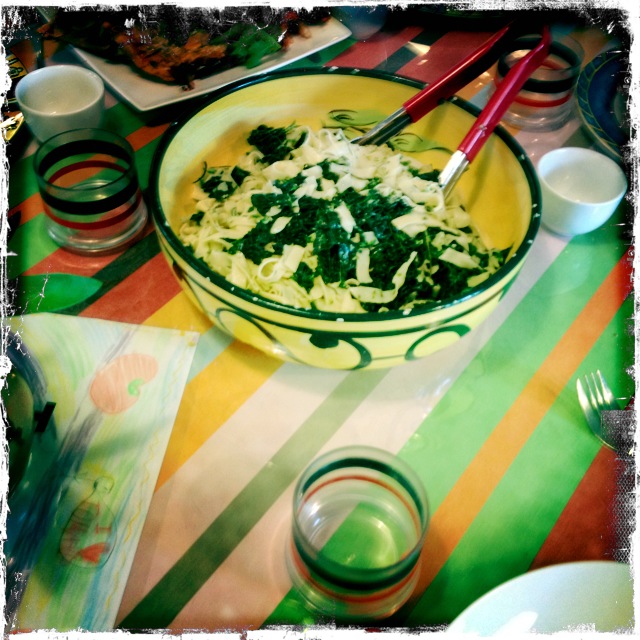
Linguine with cavolo nero and herb sauce

LINGUINE WITH CAVOLO NERO AND HERB SAUCE

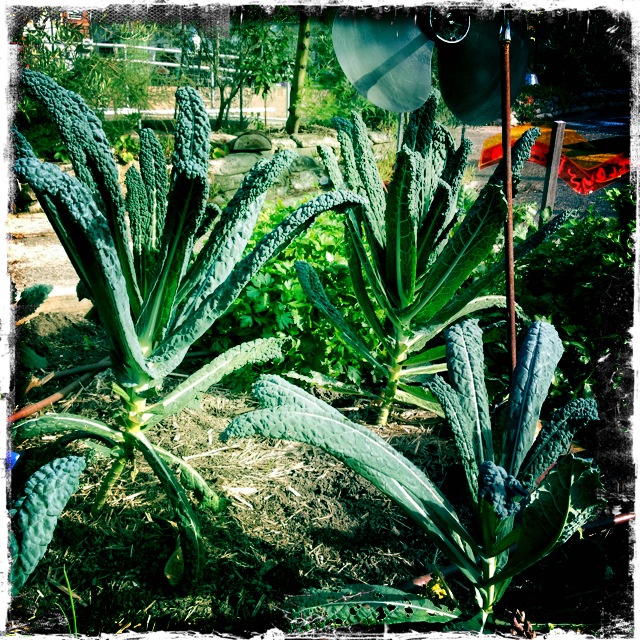
Fresh from the garden: cavolo nero, coriander, thyme, marjoram, oregano

Recipe source: Melissa ………………………………………………………………………………………………………………………………………………

This is a delicious accompaniment to our freshly-rolled pasta! We use the prehistoric-looking cavolo nero (also known as Tuscan kale) but you can also use silverbeet or spinach just as well…

Equipment:

  • Large stockpot with draining insert
  • Chopping board
  • Large & small knife
  • Salad spinner
  • Wooden spoon
  • 2 large bowls
  • Scales
  • Medium saucepan
  • Tongs
  • Serving bowls
Ingredients:

  • 500g linguine
  • 225g unsalted butter
  • 8 garlic cloves
  • A large handful of cavolo nero leaves
  • A small bunch of coriander
  • 4 sprigs of thyme
  • 4 sprigs marjoram
  • 4 sprigs oregano
  • Small bunch parsley
  • Flaked salt & black pepper

What to do:

  • Fill the large stockpot with water and heat on high.
  • Wash the cavolo nero leaves and shake dry. Strip off the leaves, discarding the stems, and cut into ribbons 1cm wide.
  • Wash & spin dry the herbs, then pick the leaves if needed, discarding the woody stems.
  • Finely chop the herbs.
  • Finely chop the garlic.
  • Chop up the butter into cubes and melt the in the saucepan over a medium heat.
  • Stir in the garlic and cook gently for a couple of minutes.
  • Stir in the herbs.
  • When the water in the large stockpot is boiling add the pasta & cooking salt, stir, put the lid back on and when boiling again cook for 2 or 3 minutes until ‘al dente’.
  • Drain the pasta and transfer to back into the stockpot.
  • Add the butter mixture to the stockpot and toss carefully.
  • Season with salt and pepper to taste and serve into bowls.

Notes: What does al dente mean? Why do we pick the leaves from the herbs? What does cavolo nero actually mean?
Categories: Kitchen Garden, Recipe, School Holiday Program | Tags: , , , , , , , , , , , , , , | Leave a comment

Basic linguine recipe

BASIC LINGUINE RECIPE

Fresh from the garden: eggs

Recipe source: adapted from a recipe by Stephanie Alexander in ‘Kitchen Garden Cooking With Kids’

………………………………………………………………………………………………………………………………………………

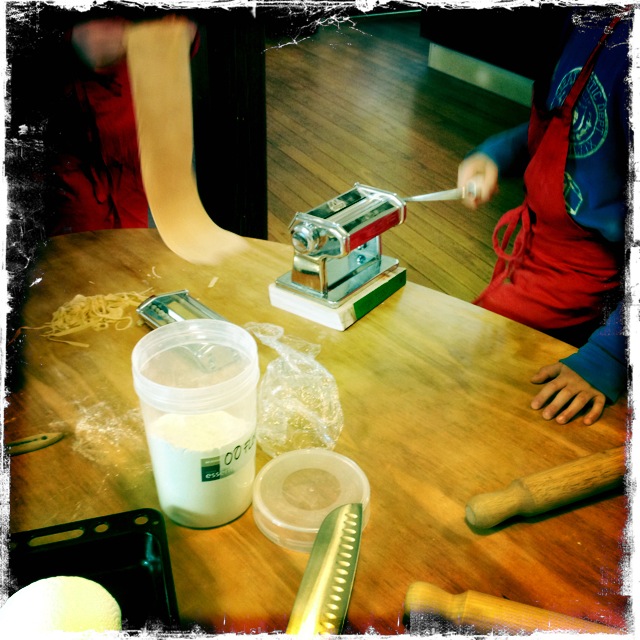
Our Kitchen Garden students love making pasta! This recipe is just for the dough mixture and you can add whatever sauce you want…

Equipment:

  • Pasta machine
  • Scales
  • Measures – teaspoon, ½ teaspoon
  • Food processor
  • Plastic film
  • Large knife
  • Pastry brush
Ingredients:For the dough:

  • 500g ‘00’ plain flour
  • 5 free-range eggs
  • Cooking salt

What to do:

  • Weigh the flour, then combine it with 1½ teaspoons of salt in the bowl of the food processor. With the motor running, add the eggs. Process for a few minutes until the dough clings together and feels quite springy.
  • Tip the dough onto a clean, dry workbench. Knead the dough for a few minutes, then wrap it in plastic film and let it rest for at least 1 hour at room temperature.

____________________________________________________________________

  • Get an adult to help fix the pasta machine to a suitable bench. Screw the clamp very tightly.
  • Set up your pasta hanging poles, ideally between 2 chairs.
  • Clear a large space on the workbench alongside the pasta machine. All surfaces must be clean and dry. Press the dough into a rectangle about 8 cm wide.
  • Set the rollers on the pasta machine to the widest setting and pass the dough through. The dough will probably look quite ragged at this stage. Fold it in 3, turn it 90 degrees and roll it through again. Go to the next-thickest setting and pass the dough through 3-4 times.
  • Continue in this manner (changing the settings and passing the dough through) until the dough has passed through the second thinnest setting. Don’t use the very thinnest setting, as the dough gets too fine and is hard to manage. If the dough gets too long to handle comfortably, cut it into 2-3 pieces using the large knife, and roll each piece separately.
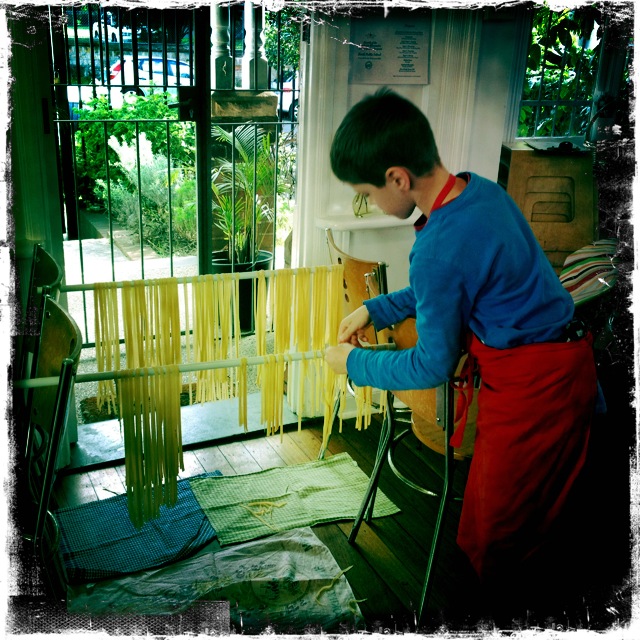
  • Fix the cutter attachment to the machine and carefully roll the pasta strips into the larger strips for linguine, gently catching them as the come through.
  • Drape the linguine over the hanging poles to dry while you make your sauce.
  • Clean the pasta machine by brushing it down with a dry pastry brush and clear and clean the table.

Notes: Never wash the pasta machine – it will rust! Just brush down with a strong brush to remove the leftover dough.

Categories: Kitchen Garden, Recipe, School Holiday Program | Tags: , , , , , , , | Leave a comment

School holiday program July 2012

We  all had such a fab time in this first kitchen garden school holiday program! The children were so keen, so well-behaved, and SO helpful!

SCHOOL HOLIDAY PROGRAM MENU

Introduction – Knife Licences – Chook care

MORNING TEA

Pumpkin, spinach & feta frittate – Rhubarb & mint muffins – Lemongrass tisane

 Garden walk – Harvesting

 LUNCH

Linguine with cavolo nero and herb sauce – Pizza with rocket, bocconcini and garden herbs – Our winter salad

Seeds – Composting – Sustainability

Watch & Grow Project

And these are some of the things they did during the day-long program:

  • Earned their knife licences by displaying ‘bear paw’ & ‘spider crab’ hand positions and understanding how to behave around knives, and also how to carry, hold and clean them;
  • Followed recipes from beginning to end and understood all the procedures;
  • Made pizza and pasta dough from scratch;
  • Tended to the chooks;
  • Explored their five senses with the garden walk-around and herb identification;
  • Pounded the mortar & pestle, whizzed the stand mixer, sliced the mezzaluna, wheeled the pizza cutter;
  • Sautéed, boiled, fried, baked, stirred, tossed, spooned, grated, melted, brushed, rolled, proved, weighed, measured, chopped, sliced, diced, beat, whisked, juiced, folded, and more;
  • Cleared as they went, washed up, dried up, set the cutlery, the glasses, the water jugs… and ate! And then cleared the tables and swept up;
  • Reinforced the belief to live sustainable lives: that is to try and remember to re-use, recycle or renew when possible;
  • Learnt about compost ‘lasagne’;
  • Understood the importance of seasonal and local produce;
  • And worked fabulously as a team, displaying focus and willingness to help!

We hope to see all the children again,and to welcome heaps more in the next holidays… and look out for all the recipes in the next few posts!

Categories: Kitchen Garden, School Holiday Program | Tags: , , , , , , , , , , , | Leave a comment

Ribollita

Our kitchen garden Tuscan kale

From the garden: parsley, celery, carrots, cavolo nero

Recipe source: adapted from a recipe by Ruth Rogers in The River Café Cookbook

…………………………………………………………………………………………………………………………………………………………………………………………………….

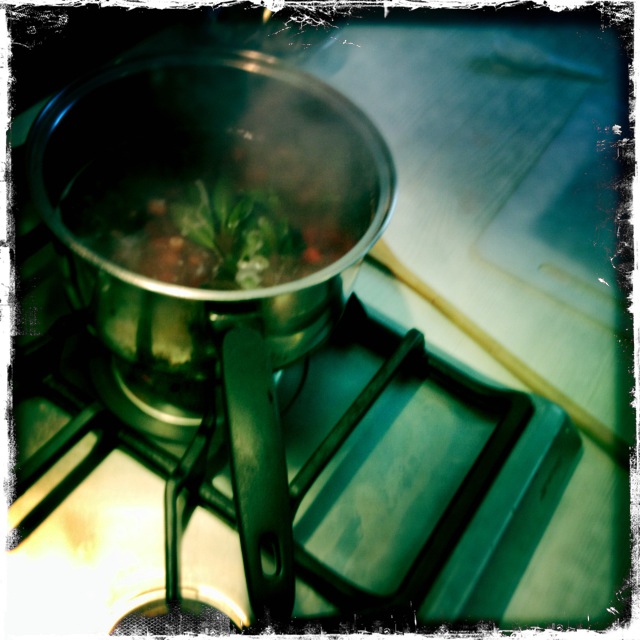
Ribollita is a famous Tuscan soup. Like a lot of European cooking, the soup has peasant origins. It was originally made by reheating (ie. reboiling = ribollita) the leftovers from the previous day. Some sources date it back to the Middle Ages, when the servants gathered up food-soaked bread trenchers from feudal lords’ banquets and boiled them for their own dinners.

Equipment:

  • Colander
  • Medium saucepan
  • Chopping board & small knife
  • Large heavy-based saucepan
  • Salad spinner, colander
  • Potato peeler
  • Garlic press, fork
  • Measures: tablespoon
  • Wooden spoon
  • Serving bowls
  • Ladle
Ingredients:

  • 125g dried cannellini or borlotti beans
  • 1 tablespoon bicarbonate of soda
  • 5 cloves garlic, 2 red onions
  • Small branch sage (about 10 leaves)
  • 4 tablespoon olive oil plus extra for drizzling
  • 1 bunch flat-leaf parsley
  • 1 head celery, 2 carrots
  • 1 tin chopped tomatoes
  • 1kg cavolo nero
  • ½ loaf stale ciabatta bread
  • Flaked salt & black pepper

What to do:

  • The night before, place your dried beans in a large bowl and fill the bowl with cold water and the bicarb.
  • The next day, rinse and drain the beans, then put them into the medium saucepan with about 3cm cold water to cover. Add 3 garlic cloves, a branch of sage, a teaspoon of salt & grind of pepper. Set on a medium heat and simmer until beans are soft – could be anything from 20 minutes to an hour.
  • Meanwhile, wash and spin dry the parsley and chop finely.
  • Wash and shake the celery dry then chop stalks and leaves into thin strips.
  • Wash and peel the carrots, chop into small pieces.
  • Peel and chop the onions into small dice.
  • Peel and squeeze the garlic cloves through the press.
  • Heat the oil in the large saucepan and fry the parsley, garlic, celery, carrot and onion together for about 10 minutes until the flavours combine.
  • Add the tomatoes and continue to cook on a gentle heat for a further 10 minutes.
  • Meanwhile wash the cavolo nero, remove the stalks and coarsely chop the leaves. Add them to the pan. Stir in half of the beans with enough of their liquid to cover. Simmer for 30 minutes.
  • Carefully cut the crusts from the loaf with a breadknife and tear the bread into pieces.
  • Mash the remaining beans with the back of the fork and return to the soup with just enough boiling water to make the soup liquid. Add the bread, a generous amount of olive oil, and season with salt and pepper. As exact amounts are not possible, you must balance the amount of liquid to bread so that soup is very thick. Ladle out into your bowls.

Notes: Why do we soak the beans overnight? What does cavolo nero mean? What are other names for cavolo nero? What other soup names do you know?

Categories: Kitchen Garden, Recipe | Tags: , , , , , , , | Leave a comment

Rosemary & thyme grissini

Fresh from the garden: rosemary, thyme 

Recipe source: adapted from The Cook and the Chef TV program

………………………………………………………………………………………………………………………………………………

A simple & fun breadstick-making exercise – I’ve found that the thinner you make the grissini, the crunchier and more delicious they are. It also pays to knead the dough well too. These are fab with the hummus…

Equipment:

  • Kitchen towel
  • Chopping board
  • Large knife
  • Large bowl
  • Large spoon
  • Measuring jug
  • 2 baking trays
  • Pastry brush


Ingredients:

  • 2 cups plain flour
  • ½ teaspoon cooking salt
  • Large sprig rosemary
  • 4 or 5 sprigs thyme
  • 1 teaspoon yeast
  • ½ teaspoon brown sugar
  • 1 tablespoon extra virgin olive oil
  • 100ml lukewarm water
  • A pinch or two of flaked salt

What to do:

  • Preheat oven to 180°C
  • Wash & dry herbs thoroughly.
  • Strip herbs from stalks and chop up finely to yield 2 tablespoons of herbs.
  • Mix all the dry ingredients (except for the flaked salt) and herbs together in a large bowl.
  • Add the water and olive oil and knead together until a smooth dough is formed – this might take between five and ten minutes. If the dough is too wet just add some more flour, bit by bit.
  • Brush baking trays with a little olive oil.
  • Flatten the dough out and roll into a round pizza shape. Divide into halves, then quarters, and then again and again until you get 16 pieces of ‘pie’.
  • Roll each ball into a thin cigar shape, break into 2 & place evenly onto the baking trays.
  • Sprinkle the whole tray with a large pinch of salt.
  • Carefully slip the trays into the oven & bake for about 15 minutes until golden brown.

Notes: Grissini are thought to have been invented in Italy in the 17th century – what other dishes have originated in Italy?


Categories: Kitchen Garden, Recipe | Tags: , , , , , , , , | Leave a comment

Yotam Ottolenghi’s Hummus

Fresh from the garden: lemon, sage, parsley

Recipe source: adapted from a recipe by Yotam Ottolenghi’s beautiful and inspirational book, Plenty

………………………………………………………………………………………………………………………………………………

This recipe is really worthy setting the reminder app on your phone to soak the beans… it is totally delicious and I defy you not to keep eating the whole lot… and why not? It’s really only chickpeas, tahini and water! Hooray!

Equipment:

  • Scales
  • Glass bowl
  • Colander, sieve
  • Medium saucepan
  • Chopping board & knife
  • Salad spinner
  • Lemon juicer
  • Garlic press
  • Food processor
  • Spatula
  • Measures – tablespoon, teaspoon
  • 4 small serving plates
Ingredients:

  • 250g dried chickpeas
  • 1 tablespoon bicarbonate of soda
  • 1 small branch of sage
  • 125g tahini paste
  • ½ a lemon
  • 6 garlic cloves
  • Extra-virgin olive oil
  • Small handful parsley
  • 1 teaspoon sweet paprika
  • Flaked salt and black pepper

What to do:

  • Before cooking the chickpeas you will need to soak them overnight. Place them in a large non-metallic bowl with double their volume of water and a tablespoon of bicarb.

Start of lesson:

  • Drain the chickpeas into the colander and rinse them well, then put them into the medium saucepan with about 3cm cold water to cover.
  • Rinse the sage, keeping the branch whole, and shake dry. Peel 3 of the garlic cloves and add them, whole, to the saucepan. Also add the branch of sage and a grind of pepper. Bring to the boil, then set on a low heat & simmer for about 30 minutes until totally soft and easy to mush.
  • Juice the lemon half. Crush the remaining 3 cloves of garlic.
  • Wash and spin dry the parsley carefully, pick off the leaves and chop finely.
  • Drain the chickpeas into the sieve over a clean bowl, reserving the cooking liquid. Transfer them & the cooked garlic cloves to the food processor, keeping a few to garnish at the end, and add the tahini, a tablespoon of lemon juice, the crushed garlic, and ½ teaspoon salt. Blitz for a minute or two until totally smooth.
  • Add some of the cooking liquid and blitz again. You want the mixture to be very soft, almost runny, but just holding its shape. Taste and add more salt if you like.
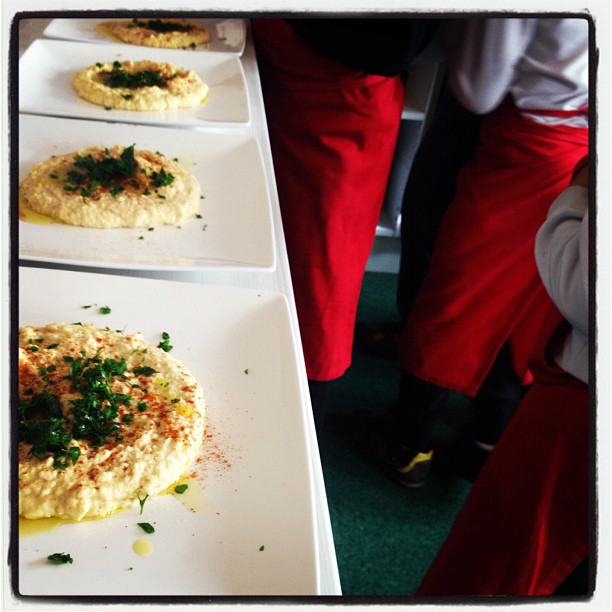
  • To serve, spread the warm hummus onto your serving plates, drizzle with a little stream of olive oil, a sprinkle of paprika, the reserved chickpeas and the chopped parsley.

Notes: What are pulses? Can you name any others? What is tahini? Where does hummus come from? What else you could eat hummus with?

Categories: Kitchen Garden, Recipe | Tags: , , , , , , , | Leave a comment

Kitchen News – June 20th 2012

Today was the most beautiful day and we had the kindie kids playing sports in the grassy playground beside the cottage all afternoon – it was lovely to hear all their voices and to see them hula-hooping away in the sunshine! And good it is too that the grass has hardened up a bit after the deluges we’ve had recently … I picked some beautiful bright yellow wattle for the vases on our stripy tables, and its presence reminds me that we are in the deep midwinter, with solstice – and shortest daylight – upon us… lucky we are indeed to live with such beautiful days!

Getting down to business – this week’s menu theme is tapas/ antipasto/ mezze, with some great class discussion on foods from other countries that we now call our own… we’ve whizzed some delicious hummus from chickpeas we soaked overnight and then simmered (yes, more pulses this week, I just can’t get enough of them!) eaten with our own rosemary and thyme grissini; some fabulous mozzarella and thyme arancini; the most moist and gooey tortilla de patata that my stepmother Carmen would be proud of; and some power-packed and spicy champiñones al ajillo (garlicky mushrooms) served with a simple Spanish-style dressed leaf salad… poor chooks though: nothing left for them! The girls in 4W today ate it ALL UP! Luckily our feathered girls got the mushy veggies left over from making stock or they would be turning against me in hunger & disgust! Next week we’ll also try our hand at pickling some of our wonderful cauliflower, broccoli and carrots for a juicy giardiniera…

To all our readers: please think of volunteering if you have a little time next term! Some of our trusty helpers have had to say goodbye & we will be looking to fill lots of spots… we need you! Thank you!

PS All these recipes are up (or about to be!) – please post a comment here if you want one from the past few months & don’t see it, as I’ll try and get the popular recipes up asap.

And don’t forget our kitchen garden SCHOOL HOLIDAY PROGRAM! Book now, spaces are filling fast!

Cheers! Melissa

Categories: Kitchen Garden | Tags: , , , , , , , , , | Leave a comment

Kitchen Garden program for littlies?

Whilst on the campaign trail for these school holidays, I’ve had more than a few requests for the 5 to 8 years age group… so I’m thinking now that I might start planning a couple of half-day sessions for the holidays after next – so between Terms 3 & 4… what do you think?

We would definitely focus on a more tactile, hands-on affair, with lots of kneading and rolling and tearing and smelling rather than chopping and boiling!

Our Kitchen Garden

I think it would make a lovely little morning! Hunting for chook eggs, looking for slugs, squishing up herbs, doing a bit of craft – focussing on the seasons, hand-rolling bigoli pasta…

Let me know if you’re interested & I’ll pop you on the mailing list!

Categories: Kitchen Garden, School Holiday Program | Tags: , , , , , | 2 Comments

Burnt cream tart with raspberries


So here you have it, in all its glory – not strictly a Kitchen Garden recipe, but definitely one for the folder… Lisa asked on Sunday night if I fancied taking home a baggie of the cassia-infused mascarpone she uses at Sean’s for the persimmon & quince trifle… My first reaction was huh? What could I possibly do that would do it justice? Anyway she gave me a few hints – and this recipe was my humble answer:


Burnt cream tart with raspberries

Ingredients:

Italian shortcrust pastry

1 lemon

200g plain flour plus extra for rolling

100g cold unsalted butter

2 tablespoons caster sugar

1 egg

1 tablespoon iced water

Filling

200g caster sugar

2 eggs

1kg mascarpone (we use Paesanella)

1 cassia stick (or cinnamon if you can’t get it)

1 vanilla bean

To finish

1 cup caster sugar

A punnet raspberries or other yummy berries

What to do:

STAGE ONE

Carefully zest the lemon using a microplane grater.

For the pastry sift the flour and add to salt in a food processor. Chop the butter and add to flour mixture – whiz until mixture resembles fine breadcrumbs.

Sprinkle in the zest and caster sugar and pulse to incorporate.

Using 2 small bowls separate the egg and add yolk to processor with the cold water and motor running. Reserve egg white.

As soon as the pastry resembles a ball, take out of processor. Flatten dough to form a disc and wrap in cling film. Refrigerate for at least an hour.

STAGE TWO

Roll out pastry onto floured surface to approximately 4mm thick. Rolling the pastry onto a rolling pin, lift it gently into a 26cm pie tin, and prick all over with a fork, cover again with cling film and place back in the fridge for 30 minutes.

Preheat oven to 180C.

Place foil in the pastry then baking beans and blind bake in the oven for 20 minutes.

STAGE THREE

Using the oven mitts, remove the pastry shell from the oven, remove the beans & foil and let the shell cool for 2 or 3 hours.

STAGE FOUR

Grind the cassia bark then sieve it into a bowl.

Split the vanilla bean in half, scrape out the seeds and reserve.

Whip the caster sugar and eggs together and then fold in the mascarpone with the cassia and vanilla seeds. Chill for 1 hour.

TO FINISH

Using a spatula, scrape the mascarpone out into the tart shell and even out. Then evenly sieve the cup of caster sugar over the mascarpone and either heat the sugar into a brittle layer with a handheld blowtorch or heat a non-flammable spoon or egg slice over a flame and caramelise the sugar that way. (NB. Your implement may not survive this intact!)

Garnish with some lovely fresh raspberries and try not to eat the whole thing yourself..! So good.


Categories: Kitchen Garden, Recipe | Tags: , , , , , , , | Leave a comment

Hearty cabbage & chickpea soup

Winter = soup! This is lovely hearty way to get stuck into some cold weather… I used some Nolans Road organic kabuli chickpeas (from Wholefoods House, Woollahra) that were fantastic & only needed about 20 minutes cooking after soaking all night… and also ate it with some toasted day old Iggy’s country round sourdough (just seen) of course!

Our Kitchen Garden soup

Equipment:

  • Bowls – glass, large, med
  • Garlic press
  • Chopping board
  • Stockpot
  • Medium saucepan
  • Colander, sieve
  • Measures – tablespoon, jug
  • Wooden spoon, ladle
  • Serving bowls


Ingredients:

  • 150g dried chickpeas
  • 1 tablespoon bicarbonate of soda
  • A small branch of sage
  • 6 cloves garlic
  • 2 leeks
  • 1 onion
  • 1 head cabbage
  • A small handful parsley
  • 2 tablespoons olive oil
  • Flaked salt & black pepper
  • 2 litres vegetable stock
  • 1 tin chopped tomatoes

What to do:

  • The night before, place your dried chickpeas in the glass bowl and fill the bowl with cold water to double the height of the chickpeas, add the bicarb and stir. They will need to soak for at least 12 hours.
  • At the start of the lesson:
  • Drain the chickpeas into the colander and rinse them well, then put them into the medium saucepan with about 3cm cold water to cover.
  • Rinse the sage, keeping the branch whole, and shake dry. Peel 3 of the garlic cloves and add them, whole, to the saucepan. Also add the branch of sage, a teaspoon of salt & grind of pepper. Set on a medium heat and simmer for 2o minutes.
  • Meanwhile wash the leeks, scoring and peeling the outer layers off to look for hidden dirt, and then finely chop the leeks into thin slices.
  • Chop the cabbage in half and wash, checking for slugs or dirt to clean! Chop finely, cutting the core into small slivers.
  • Peel and chop the onion into small dice. Squeeze the remaining 3 cloves of garlic through the press. Wash the parsley and spin dry. Finely chop.
  • In the large stockpot, heat the olive oil over medium heat. Stir in the onion, leeks and garlic and cook GENTLY until onion is transparent, about 5 minutes.
  • Stir in stock or water, with a teaspoon of salt and grind of pepper. Bring to the boil, then stir in bouillon powder if using, and the cabbage. Simmer until cabbage wilts, about 10 minutes.
  • Chickpeas: After 20 minutes set the sieve over a heatproof bowl and carefully pour the chickpeas and their liquid in to drain, then scoop the chickpeas out into the cabbage soup with a cup of the cooking liquid.
  • Stir in the tomatoes and return to the boil, then simmer for about 20 minutes stirring often.
  • Check for seasoning and add in the chopped parsley. Ladle into serving bowls.
Categories: Kitchen Garden, Recipe | Tags: , , , , , , , , | Leave a comment

Create a free website or blog at WordPress.com.