Posts Tagged With: eggs

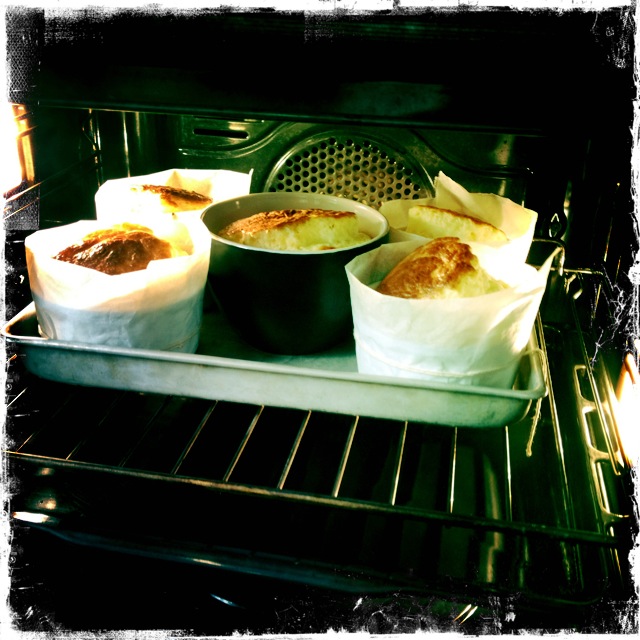
Two cheeses souffle

Cheesy, eggy – comfort food in its most simple form… and deceptively simple to do!

ourkitchengarden.net

Fresh from the garden: eggs, chives
Recipe source: adapted from a recipe on bbcgoodfood.com
Serves: 4 or 24 tastes

ourkitchengarden.net

Equipment:

  • 4 x 250ml ramekins or soufflé dishes
  • Baking paper
  • String & scissors
  • Baking tray
  • Scales
  • Paper towel
  • Bowls – 1 large, 5 small
  • Saucepan
  • Wooden spoon
  • Measuring jug
  • Stick blender
  • Metal spoon
  • 4 under-plates to serve
Ingredients:

  • 25g butter plus extra to grease the ramekins
  • 150g soft goats’ cheese
  • 100g parmesan
  • A small handful chives
  • 5 eggs
  • 25g flour
  • 250ml milk
  • Flaked salt & black pepper

 What to do:

  • Heat the oven to 200C. Butter the ramekins.
  • Make a collar for each ramekin by tearing a 40cm length of baking paper, folding it into thirds, and buttering one side. Then roll it around the ramekin, buttered side in, and tying with string to secure. Place them on the baking tray when done.
  • Measure the parmesan, then grate it. Crumble the goats’ cheese.
  • Wash the chives and pat dry with paper towel. Using the scissors, finely snip them to yield about 2 tablespoons.
  • Carefully separate each of the eggs.
  • Melt 25g butter in the saucepan, stir in the flour and gently cook on a low heat for a minute or so. Slowly add the milk, stirring all the time to make a thick sauce. Cook for a couple of minutes to cook out the flour.
  • Stir in the cheeses and chives then add 4 of the egg yolks, season generously and mix well.
  • In a clean and dry bowl, use the stick blender to whisk all the egg whites until they are stiff and form soft peaks.
  • Using a metal spoon, start folding the egg whites into the cheese mixture carefully – begin by using about 1/3 of the whites first and then adding the rest once combined – and pour into the buttered soufflé dishes.
  • Cook for 12–15 minutes until the soufflés are risen and golden.
  • Using pot holders, carefully place a soufflé on to an underplate and serve TOUT SUITE!

 Notes: What is a ramekin? Why do we separate the egg yolks and whites? Why do we need to cook out the flour? Where does the word soufflé come from?
ourkitchengarden.net

Categories: Kitchen Garden, Recipe | Tags: , , , , , , | 2 Comments

Veggie patch fritatta

This is such a lovely fresh recipe. Add a beautifully tossed salad & some great bread and you have all the makings of a wonderful and simple lunch or supper. We’ve used what we had in the garden: radishes and snowpeas – so use what YOU have!

ourkitchengarden.net

Fresh from the garden: eggs, onion, radishes, snowpeas, parsley, rocket
Recipe source: Melissa
Serves: 4 at home or 24 tastes 

Equipment:

  • Chopping board & knife
  • Salad spinner
  • Tea towel
  • Measures: tablespoon
  • Medium ovenproof frying pan
  • Large bowl
  • Whisk
  • Oven mitts
  • 4 serving plates
Ingredients:

  • An onion
  • A small handful radishes
  • A small handful snowpeas
  • A small handful parsley
  • A tablespoon of butter
  • 2 tablespoons extra-virgin olive oil
  • 12 large eggs
  • Flaked salt and pepper
  • A small handful rocket for garnish

What to do:

  • Preheat the oven with grill element on to 180C.
  • Peel and finely chop the onion. Trim the radishes, wash well and then carefully slice into thin discs.
  • Top, tail and de-string the snowpeas and chop into 4 or 5 pieces. Wash and spin-dry parsley and chop finely.
  • Wash and spin-dry the rocket and roll up in a clean tea towel, reserving in the fridge until needed.
  • Heat the butter and olive oil in the frying pan, and when melted, add the onion and cook on a medium heat until translucent. Then add the radish slices and cook for about 5 minutes until golden. Sprinkle with a pinch of flaked salt and add the snowpeas, tossing to combine.
  • Meanwhile, crack the eggs into the large bowl – making sure there is no shell – and beat them together with a pinch of salt and grind of pepper. Stir in the parsley.
  • When the butter has melted, carefully pour the eggs into the frying pan and turn the heat to medium-low. Cook, undisturbed, for about 5 minutes or until the bottom of the frittata is firm, checking by gently lifting up the frittata up at the side of the pan.
  • Transfer the frying pan to the oven. Bake, checking every couple of minutes or so, just until the top of the frittata is no longer runny. This should take about 5 to 7 minutes more.
  • Carefully remove from the oven with oven mitts – remembering that the handle will be HOT! – and let rest for a few minutes.
  • Then, still holding the handle with the oven mitt place a clean medium chopping board over the frying pan and turn the whole lot upside down so that the frittata falls gently onto the board.
  • Divide the rocket onto the serving plates with a little drizzle of olive oil, cut the frittata into wedges or cubes, and transfer onto the rocket. Serve and eat!
Categories: Kitchen Garden, Recipe | Tags: , , , , , , | Leave a comment

Creamy polenta with poached eggs and sage

This is such a vibrant and comforting dish, with the frizzled sage leaves giving everything a crispy, colourful lift. Just be sure the eggs are very fresh – and then there’s no need to add vinegar or do any of that silly swirling stuff!

ourkitchengarden.net

From the garden: eggs, sage, garlic
Recipe source: Melissa
Serves: 4 or 24 tastes

Equipment:

  • Chopping board &small knife
  • 1 heavy-based saucepan & lid
  • Scales
  • Measuring jug
  • Grater
  • 1 small saucepan
  • Salad spinner
  • Paper towel
  • Wooden spoons
  • Bowls – 4 small
  • Deep-sided frying pan
  • Serving bowls
Ingredients:

  • 250ml milk plus extra 100ml on standby
  • 250ml water
  • 1 bay leaf
  • 1/2 cup fine polenta
  • 1/3 cup mascarpone
  • 50g pecorino
  • 25g butter
  • 4 very fresh large eggs
  • A branch of sage leaves
  • Flaked salt and black pepper

ourkitchengarden.net What to do:

  • Bring the milk, water and bay leaf to the boil in the larger saucepan then remove from heat and allow to infuse for 20 minutes. Strain and discard the bay leaf, bring to the boil again, pour in the polenta and stir continuously until it thickens, about 10-20 minutes, depending on the variety of polenta.
  • Meanwhile grate the pecorino and measure out the mascarpone.
  • When the polenta is cooked, add the mascarpone and grated pecorino and mix until well combined. Taste for seasoning and adjust if necessary. The polenta should be soft and creamy and only just hold its shape. You may need to add a little extra of the standby milk to loosen up the polenta if it becomes too stiff – this will also depend on what brand of polenta you use. You want a sloppy, porridge type consistency.
  • About 5 mins before the polenta is ready, poach the eggs. Fill the deep-sided frying pan 5cm deep with water and bring to a simmer. Carefully crack each egg separately into a small bowl without breaking it and then carefully slide into the water until they’re all in. Let the pan sit on a simmer for 4 minutes.
  • Pick the sage leaves, then wash and spin them dry. Heat the butter in the small saucepan over medium heat. Add the sage leaves and cook, stirring, until they are dark green, crispy and fragrant.
  • To serve, divide polenta among serving bowls. Lift the eggs out of the water, drain, and then place one on top of each bowl. Season generously and scatter with the frizzled sage leaves & browned butter.

Notes: What is polenta? What is cooking by ‘absorption’ method? Why shouldn’t we break the eggs when poaching them? What is to simmer?

ourkitchengarden.net

Categories: Kitchen Garden, Recipe | Tags: , , , , , , , , , , , , | Leave a comment

Basil aioli

Herby? Garlicky? Yup, ticks all the boxes… yum yum yum! Hooray for mayonnaise!

ourkitchengarden.net

Fresh from the garden: lemon, eggs, basil, garlic
Recipe source: Melissa
Makes: about 300ml

Equipment:

  • Salad spinner
  • Bowls – large, small
  • Chopping board & knife
  • Citrus juicer
  • Garlic press
  • Stick blender & cup
  • Measuring – jug, cup, teaspoon
  • Serving bowls

Ingredients:

  • A small handful basil
  • 1 juicy lemon
  • 2 garlic cloves
  • 3 eggs
  • 1 teaspoon Dijon mustard
  • 1 cup rice bran oil
  • Flaked salt & black pepper

What to do:

  • Pick the basil leaves, wash them well, spin them dry and finely chop.
  • Cut the lemon in half and juice the halves. You will need 50ml lemon juice in total.
  • Smash the garlic cloves, peel them and squeeze them through the garlic press.
  • Separate two of the eggs and reserve the 2 yolks in a small bowl.
  • Into the stick blender cup add the whole egg, the egg yolks, the mustard and only 20ml lemon juice. Whizz together until all is combined.
  • Measure the rice bran oil, then get a friend to help super-slowly stream in the oil into the egg mixture while you are whizzing (this takes a few minutes so don’t rush it).
  • To make this mayo into an aioli, slowly add in the remaining 30ml lemon juice, the pressed garlic, the chopped basil and a good sprinkle of salt and pepper. Blend until smooth.

Notes: What is aioli? Why is it different to mayonnaise? What else could you serve it with? What could you make with the leftover egg whites?

Categories: Kitchen Garden, Recipe | Tags: , , , , , , , , , , | Leave a comment

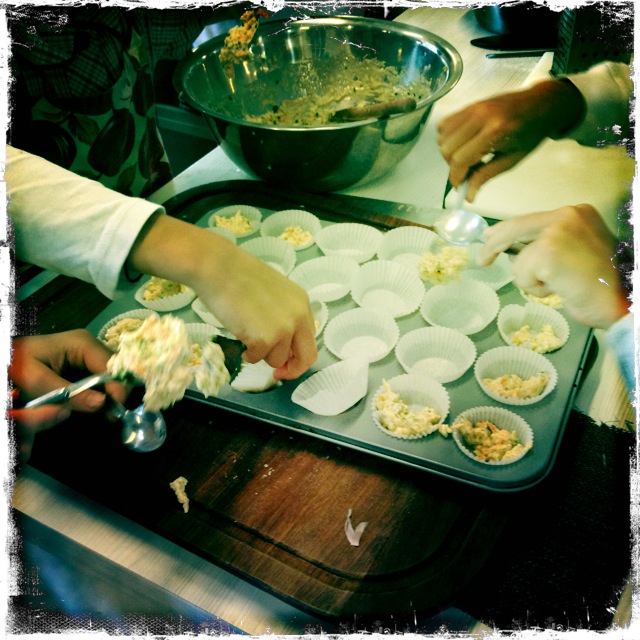
Mini chive, gruyere and rocket frittate

Tasty little morsels – these are lovely just warm out of the oven with a dollop of basil aioli or even cold to pop in a lunch box!

ourkitchengarden.net

Fresh from the garden: chives, eggs, rocket, parsley
Recipe source: adapted from recipe by Cynthia Black Australian Good Taste
Makes: 48 mini frittate

Equipment

  • Pastry brush
  • 2 mini muffin pans
  • Paper towel
  • Scissors
  • Graters
  • Bowls – big, small
  • Chopping board & knife
  • Whisk
  • Salad spinner
  • Measures –  jug, cup, tablespoon, teaspoon
  • Serving plates
Ingredients:

  • 2 tablespoons olive oil
  • A small bunch of chives
  • 9 eggs
  • 200ml thickened cream
  • 50g gruyere
  • 30g parmesan
  • A small handful rocket plus extra to garnish
  • 2 or 3 sprigs of parsley
  • Basil aioli

What to do:

  • Preheat oven to 180°C. Brush the holes of the non-stick mini muffin pans with a little of the oil.
  • Wash the chives and pat dry with paper towel. Using the scissors, thinly snip. Divide the chives between the mini-muffin holes.
  • Measure and coarsely grate the gruyere. Finely grate the parmesan. Sprinkle the cheeses into each of the chive holes.
  • Wash, spin-dry and shred most of the rocket to yield about a cup, reserving a few leaves for the garnish. Wash and spin-dry the parsley, discard the stalks and chop the leaves to yield about a tablespoon. Add these too to the pans.
  • Crack the eggs into a large bowl and lightly whisk. Measure the cream & add into the same bowl, whisk again and then carefully pour into the prepared pans.
  • Bake for 20 minutes or until just set.
  • Meanwhile clean up your station & then make the aioli (see separate recipe).
  • When the frittate are ready, set aside in pans for 5 minutes to cool slightly before dividing onto your serving plates. Soak the pans in water straight away…!
  • Garnish your serving plates with the rocket, add the frittate, serve with a dollop of aioli & eat!

Notes: Why do we need to preheat the oven? What is gruyere? What does to shred mean?

Categories: Kitchen Garden, Recipe | Tags: , , , , , , , , , | Leave a comment

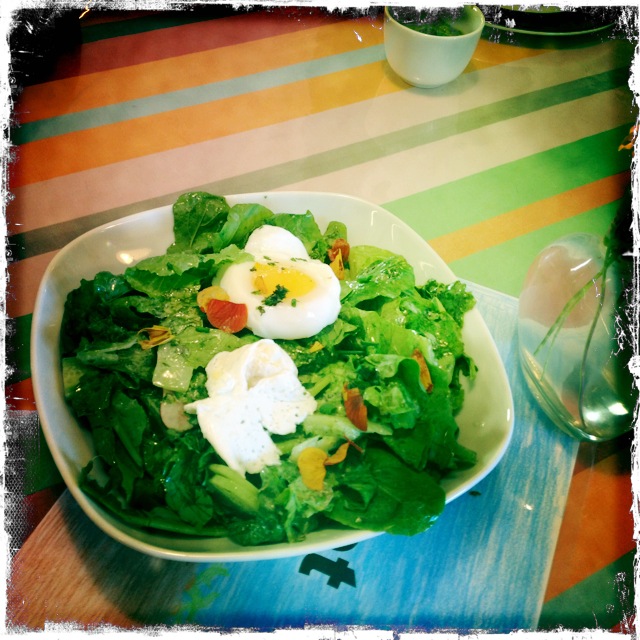
Lettuces, rocket and radish salad with poached eggs and tarragon mayo

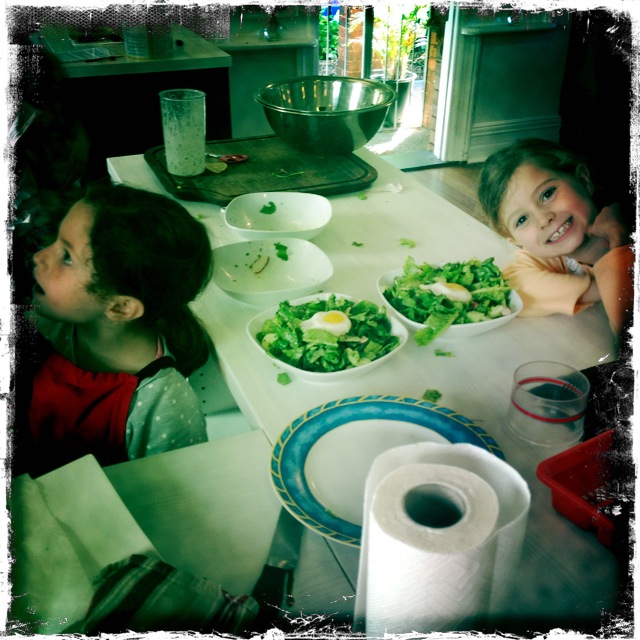
The list of ingredients we can add to a salad is endless… here we base our salads on salad leaves, fresh herbs and then seasonal additions. This one is a favourite with just-poached eggs and a wonderfully creamy dressing. We always try to have a salad on the table for every meal – I find at the beginning of new year the children are reluctant to eat lettuce leaves or radishes, but that changes as they become used to seeing the bowls on the table, and the difference of ingredients according to the seasons…

ourkitchengarden.net

Perfect yolky salad!

Fresh from the garden: Lettuces leaves, rocket, eggs, cucumber, radishes, tarragon, chives, oregano, thyme, marjoram, parsley
Recipe source: Melissa
Serves: 6 or 24 tastes

Equipment:
  • Bowls – 2 large, 1 medium, 2 small
  • A salad spinner
  • Tea towel, kitchen paper
  • Chopping boards & knives
  • Peelers
  • Mandoline
  • Non-stick frying pan
  • Slotted spoon
  • Stick blender & cup
  • Measuring: jug, teaspoon, ½ teaspoon
  • Scales
  • Mezzaluna
  • Citrus juicer
  • Serving bowls

Ingredients:

  • 4 freshest free-range eggs
  • A bunch of salad & rocket leaves
  • A handful of herbs
  • A few garnishing flowers
  • A cucumber
  • Some radishes

For the tarragon mayonnaise:

  • 50g landcress
  • 1 large sprig tarragon
  • 1 extra egg
  • ½ teaspoon flaked salt
  • 1 small clove garlic
  • 1 level teaspoon mustard powder
  • 120ml rice bran or veg oil
  • 25ml olive oil
  • 1 teaspoon white wine vinegar
  • ½ a lemon
  • Freshly milled black pepper

What to do:

For the salad:

  • Fill up the 2 big bowls with cold water & wash the salad leaves in several changes of water. Spin dry and wipe the bowls dry.
  • Lay out the tea towel and line it with kitchen paper. Spread the salad leaves over the paper and roll the whole lot up like a log. Keep the rolled parcel of leaves in the fridge until needed.
  • Fill up another bowl with water and wash the herbs and small garnishing leaves. Spin dry and  pick leaves, discarding stalks into compost.
  • Pick the petals from the flowers and reserve in a small bowl with the garnishing leaves.
  • Chop the herbs and keep separate in their own small bowl.
  • Wash the cucumber and peel if spiky. Slice into mouth-sized pieces.
  • Wash the radishes and trim any roots and stalk. Slice into smaller pieces or chunks – or even better, use the mandoline to carefully slice super-thin discs.

To poach the eggs:

  • Fill a medium-sized frying pan with water to a depth of approximately 4cm, then heat it to a temperature just sufficient to keep the water at a bare simmer.
  • Then break the eggs into the simmering water, one at a time until they’re all in, and let them cook, uncovered, for 2 or 3 minutes. Fill a large bowl with cold water.
  • The eggs are done when the white is no longer wobbly, then use a draining spoon to lift them from the water and transfer them to the bowl of cold water until you are ready to use them.

For the sauce:

  • Wash, spin dry and separate off the landcress leaves and discard any tough stalks into the compost.  Wash & spin dry the tarragon. Pick the tarragon to yield about 1 tablespoon leaves.
  • Squeeze the lemon half to yield ½ teaspoon lemon juice. Peel the garlic clove & finely chop. Wash & dry the chives and snip finely.
  • Now break the extra egg into the cup of the stock blender, add the salt, garlic, mustard powder and a few twists of freshly milled black pepper, then blitz to blend these together.
  • Now mix the oils in the jug and ask a helper to pour it in a thin trickle into the cup whilst it’s blending. When all the oil is in, add the vinegar, lemon juice, watercress and tarragon leaves, then blend again until the leaves are quite finely chopped.

 To serve:

  • Take the lettuce from the fridge and chop or tear into mouth-sized strips. Pop them into a big bowl, then add the spring onions and herbs & drizzle about a teaspoon of olive oil, a teaspoon of white wine vinegar  & a sprinkle of flaked salt over the whole lot.
  • Using your hands, turn the leaves to coat in the dressing and then divide the lot among your serving bowls.
  • Spoon an egg at a time out of the water and dry off with some paper towel or a tea towel, and then carefully arrange one egg on each salad.
  • Drizzle the mayo over the top of each salad, followed by a sprinkle of a few of the snipped chives and the flowers and serve immediately with tongs or service cutlery.

Notes: What is mayo short for? What other salad dressings could you use? Why do we need to wash the leaves so well? Why do we roll the leaves up to put them in the fridge? When would you need to use vinegar to poach the eggs? Why do we reserve the cooked eggs in cold water?

ourkitchengarden.net

Eggcellent salads!

Categories: Kitchen Garden, Recipe | Tags: , , , , , , , , , , , , | Leave a comment

Spelt pasta

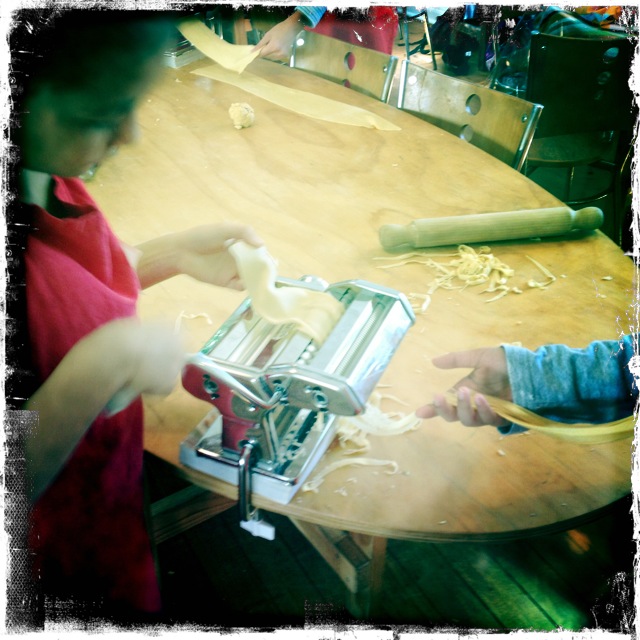
Our Kitchen Garden students love making pasta! This recipe uses spelt flour, an ancient grain that is slightly nutty. Spelt has a lower gluten content than wheat flour, and whilst not suitable for a coeliac diet, can be eaten by those with a low threshold gluten intolerance.

ourkitchengarden.net

Spelt linguine with quick pesto

Fresh from the garden: eggs
Recipe source: adapted from a recipe by Sean Moran at Sean’s Panaroma
Makes: about 600g pasta, enough for 6, or 24 tastes

Equipment:

  • Scales
  • Stand mixer, bowl & paddle
  • Pasta machines
  • Measures – tablespoon
  • Plastic film
  • Large knife
  • Pastry brush
Ingredients:

  • 570g spelt flour plus extra
  • 4 free-range eggs
  • 15ml water

 What to do:

  • Weigh the flour into the bowl of the mixer, then with the motor running, add the eggs one at a time. Process for a few minutes until the dough clings together and feels quite springy.
  • Tip the dough onto a clean, dry workbench. Knead the dough for a few minutes, then wrap it in plastic film and let it rest for about an hour at room temperature.

_______________________________________________________________

  • Get an adult to help fix the pasta machine to a suitable bench. Screw the clamp very tightly.
  • Set up your pasta hanging poles, ideally between 2 chairs.
  • Clear a large space on the workbench alongside the pasta machine. All surfaces must be clean and dry. Press the dough into a rectangle about 8 cm wide.
  • Set the rollers on the pasta machine to the widest setting and pass the dough through. The dough will probably look quite ragged at this stage. Fold it in 3, turn it 90 degrees and roll it through again. Go to the next-thickest setting and pass the dough through 3-4 times.
  • Continue in this manner (changing the settings and passing the dough through) until the dough has passed through the second thinnest setting. Don’t use the very thinnest setting, as the dough gets too fine and is hard to manage. If the dough gets too long to handle comfortably, cut it into 2-3 pieces using the large knife, and roll each piece separately.
  • Depending on which type of pasta you want, you can either lay the strips out on a lightly-floured table and cut them by hand, or you can fix the cutter attachment to the machine and carefully roll the pasta strips into strips for linguine or the thinner cutters for angel hair, gently catching them as they come through.
  • Drape the pasta over the hanging poles to dry while you make your sauce.
  • Clean the pasta machine parts by brushing them down with a dry pastry brush, pop the collected parts back into their boxes, and then clear and clean the table.

Notes: Never wash the pasta machine – it will rust! Just brush down with a strong pastry brush to remove the leftover dough.

ourkitchengarden.net

Busy hands!

Categories: Kitchen Garden, Recipe, School Holiday Program | Tags: , , , , , , , , , , | Leave a comment

Carrot muffins with garlic butter

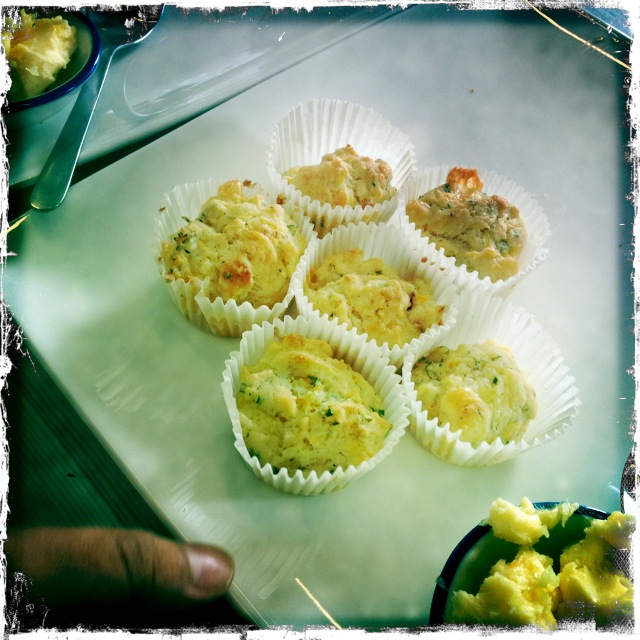
These are wonderful straight out of the oven, with the garlicky butter melting away in a hole in the middle…It’s a great recipe to make with the kids as there’s lots of grating, mashing and snipping, measuring and weighing… If you have no cupcake cases, just melt a tablespoon of butter in a small saucepan and, using a pastry brush cover each hole with a thin film of butter. This will stop the muffins sticking to the pan. We also used chives instead of parsley – snipping them with kids’ scissors – & made them even better!

ourkitchengarden.net

Carrot muffins with garlic butter

From the garden: carrots, parsley, eggs, garlic
Recipe source: adapted from Stephanie Alexander’s Kitchen Garden Cooking with Kids
Makes: 12 large or about 30 mini muffins

Equipment:

  • 12 or 24 hole muffin tin
  • 12 large or 24 small cupcake cases
  • Peeler, grater
  • Chopping board & knives
  • Bowls – 2 medium, 1 small
  • Measures: ½ cup, ¼ cup, teaspoon
  • Scales
  • Garlic press, whisk
  • Baking paper
  • Wire rack
  • Serving plates
Ingredients:

  • 2 large or 4 medium carrots
  • 15 stalks parsley
  • 60g cheddar or gruyere
  • 220g self-raising flour
  • 1 teaspoon table salt
  • 1 egg
  • 3/4 cup buttermilk
  • 1/2 cup vegetable oil
  • 2 cloves garlic
  • 100g unsalted butter at room temperature
  • Flaked salt

ourkitchengarden.net What to do:

  • Preheat oven to 180C. Drop the cupcake cases into the tin.
  • Wash, peel and grate the carrot to yield about ½ a cup. Wash, dry and chop the parsley. Weigh the cheese & then grate it.
  • Weigh the flour then mix it with the cheese, carrot, parsley and table salt together in a medium bowl.
  • In the other medium bowl whisk the egg, buttermilk and oil together.
  • Make a well in the dry ingredients and add the liquid mixture. Mix lightly and then spoon into muffin cases to about 2/3 full. Bake for 25 minutes for the large & about 15-20 for the small muffins.
  • While the muffins are cooking, make the garlic butter: Squeeze the garlic through the garlic press into the small bowl and add the butter and a pinch of salt. Mix until smooth. Place in a log shape on a piece of baking paper, roll up lightly, sealing the edges and put in freezer until firm.
  • Remove muffins from the oven. Allow to sit for a minute before turning out onto the wire rack to cool. Remove the butter from the freezer and slice into thin discs.
  • When the muffins are cool, make a slit in the top of each insert a slice of garlic butter and place on serving plates.

 Notes: What is buttermilk? What is a well in the centre of the dry ingredients?

ourkitchengarden.net

Buttery garlic goodness…

Categories: Kitchen Garden, Recipe | Tags: , , , , , , , , , , , | 1 Comment

Kitchen Garden news – 1st April 2013

Well goodness me, I was so busy with class preparations, the school Easter Hat Parade, travelling to the south coast to visit Granny for her birthday and my lovely aunt Rose & Uncle Paul, and planning Olly’s birthday extravaganza (!) that I completely forgot to write my news for the newsletter last week…!

I also forgot the wine, cheese & dips at home in the fridge and the kids’ back-bubbles for swimming (as well as clean underwear, but that’s another story) so I’m going with the flow now and purposefully trying not to stress about it all… and hoping that it’s not just old age (or young riesling) kicking in…

ourkitchengarden.net

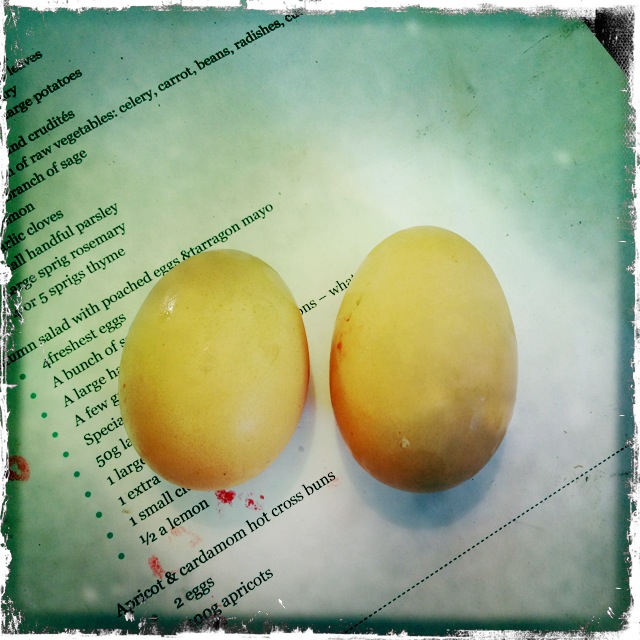
Spot the double-yolker!

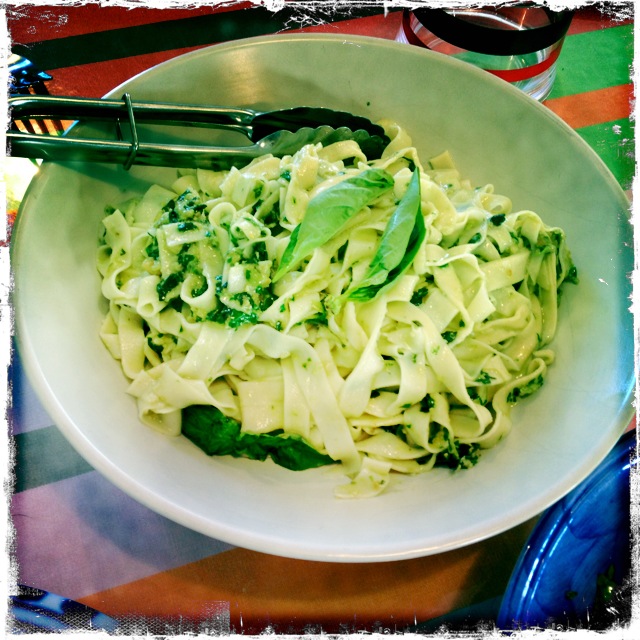
So anyway – on to what’s been happening! We thought we might have had a quieter fortnight this menu than the last Chinese Banquet one… but no! We pushed the boundaries yet again and had everyone cooking up a feast every lesson… on Wednesday morning’s class we found a double-yolker too! What better miracle of food life is there than an egg with too yolks? So we poached it and plopped it into an Autumn salad with poached eggs & creamy tarragon and landcress mayo… We kneaded dough & sliced spuds for Potato and rosemary pizza, and whizzed up one of our favourites: Ottolenghi’s hummus with our Rosemary and thyme grissini and Crudités, and rolled out superfine Handmade linguine with Rocket and basil pesto. And then to finish – of course we had to squeeze in some freshly baked Apricot, cranberry and cardamom hot cross buns just in time for Easter!

ourkitchengarden.net

Ottolenghi’s hummus

ourkitchengarden.net

Rosemary & thyme grissini, crudites

And the result? Clean plates – poor chooks – and happy kids! We had some very wonderful comments – and also some beautiful manners and sharing from, in particular, my lunch compadres in Year 3 one Wednesday arvo. Delicious, delicious!

ourkitchengarden.net

Handmade linguine, rocket & basil pesto

All the other recipes will be up here in the next few days – and even perhaps the one for Banoffee Pie that Olly requested for his 4th party! Mmmmmmmm… Watch this space!

Categories: Kitchen Garden | Tags: , , , , , , , , , | Leave a comment

Stir-fried eggs with tomato and chilli soy

Jill says, ‘This is a simple dish of Chinese ‘scrambled’ eggs that tastes fresh, clean and light. Serve with rice and Asian greens to max it up into a bigger meal.’

ourkitchengarden.net

Fresh from the garden: tomatoes, coriander, eggs, chilli, spring onions
Recipe source: adapted from a recipe by Jill Dupleix
Serves: 6 as a snack or 24 tastes

Equipment:

  • Chopping boards and knives
  • Salad spinner
  • Measures – 1/3 cup, tablespoons, teaspoons
  • Bowls – 2 large, small
  • Fork or whisk
  • 2 woks
  • Serving plates & small sauce bowls
Ingredients:

  • 2 large vine-ripened tomatoes
  • A small bunch of coriander
  • 1 long red chilli (or green if you don’t want too much heat!)
  • 2/3 cup light soy sauce
  • 2 x 6 eggs
  • 2 teaspoons sesame oil
  • 4 spring onions
  • Flaked salt & black pepper
  • 2 tablespoons peanut oil (we use vegetable or Rice Bran oil)

What to do:

  • Cut the tomatoes in half, scoop out and discard the seeds and juice, then finely chop the flesh. Set aside.
  • Wash and spin dry the coriander and pick out some juicy sprigs.
  • Slice the chilli in half lengthways and remove the seeds out by scraping each half. Slice the flesh really thinly and then mix the sliced chilli and soy sauce into 4 small sauce bowls. Set aside.
  • Wash and strip the first layer of skin from the spring onions and then thinly slice them. Crack 6 eggs each into both bowls, and then lightly beat each bowl. Add a teaspoon of sesame oil into each bowl, most of the spring onion, and some salt and pepper and combine.
  • Heat the 2 woks over high heat until hot, then add the vegetable oil. Once the oil is hot, add each bowl of egg mixture into the woks and leave for 10 seconds, then use a wooden paddle or spatula to slowly draw the outside of the egg mixture into the centre, allowing the uncooked egg to cook. Cook for 2-3 minutes until the egg is almost set, then scatter with the tomato. Lightly toss once or twice to warm through. (It’s important not to allow the tomato to cook for too long, or it will make the eggs too watery.)
  • Separate each wok mixture into 2 and then divide out between 4 serving plates. Scatter with the remaining spring onion and the coriander sprigs, then spoon over some chilli soy sauce and serve immediately.

Caution:

  • Wash your hands thoroughly after coming in contact with chilli, as the capsaicin (the oil within the chilli) burns when it comes in contact with your eyes or sensitive skin.

Notes: Why do we discard the tomato seeds & juice in this recipe? Why do we scrape the seeds out of the chilli?

Categories: Kitchen Garden, Recipe | Tags: , , , , , , , , , | Leave a comment

Blog at WordPress.com.